Many people have a difficult time getting their heads around the fact that a million streams or views just isn't that much in our new Music 4.0 age. A minor hit starts at around 50 million and a major hit is in the hundreds of millions.
1 million isn't that much when it comes to radio either, so take at traditional terrestrial radio for a second and see how it stacks up to streaming.
There are 15,730,000 people in New York City, and Artibitron estimates that a station like Z100 (currently the #1 station in the market) reaches at least 0.01% at any given moment (it's probably 5 times that actually). That's 157,000.
If the station plays a song 5 times a day (not uncommon for a song in rotation), that's 157,000 x 5 = 785,000 listens a day.
If the station plays the song for 2 weeks, that's 785,000 x 14 days = 10.99 million listens from just this one station.
There's probably at least one other station in the market playing the song, so that's 10.99 million x 2 = 21.98 million listens.
If the song is playing in New York, it's probably playing in the top 25 markets as well, which means 21.98 million x 25 = 549.5 million listens.
That's the equivalent of almost 550 million streams, but unlike streams, the artist didn't get paid for a single one of the radio listens (the songwriters got paid though).
Keep in mind that the number of plays above aren't even for a big hit (double the number of plays per day at least) and don't include the ratings for the number 1 station (at least by a factor of 5 in New York City).
You can see why our perceptions of a million are a bit skewed. When it comes to sales, yes, a million is a big deal, but it's not the same scale when judging plays, streams or views.
Help Support This Blog
Showing posts with label streaming royalties. Show all posts
Tuesday, November 3, 2015
How Radio Airplay Compares To Streaming
Labels:
Arbitron,
Music 4.0,
radio airplay,
streaming royalties
Tuesday, October 27, 2015
YouTube Will Cut Labels Off If They Don't Sign Up For Red
If you're a record label or an artist with a large YouTube following, you may find your videos are no longer available to view if you didn't sign up to be part of the network's new Red subscription service that will launch this week.
YouTube sent a letter to content creators a few weeks ago telling them if they didn't sign on by the October 22nd, their videos would be hidden from non-paying viewers as well as well as Red subscribers. Even if they're not hidden, they won't be available for monetization.
According to YouTube, 98% of content creators have signed on so far, but there are many holdouts, among them Disney and many indie labels.
These holdouts, like many of the creators who have signed on, claim that the 55% payout from YouTube is insufficient compared to virtually every other service (who pay at least 70%).
In fact, it's been estimated that the total monthly royalty payout from Spotify is 3 times as much as YouTube, despite having a tenth of the user base.
YouTube Red launches tomorrow, and it will be interesting to see what the reaction will be. Regardless of how the public feels, you can be that content creators will continue to be unhappy.
YouTube sent a letter to content creators a few weeks ago telling them if they didn't sign on by the October 22nd, their videos would be hidden from non-paying viewers as well as well as Red subscribers. Even if they're not hidden, they won't be available for monetization.
According to YouTube, 98% of content creators have signed on so far, but there are many holdouts, among them Disney and many indie labels.
These holdouts, like many of the creators who have signed on, claim that the 55% payout from YouTube is insufficient compared to virtually every other service (who pay at least 70%).
In fact, it's been estimated that the total monthly royalty payout from Spotify is 3 times as much as YouTube, despite having a tenth of the user base.
YouTube Red launches tomorrow, and it will be interesting to see what the reaction will be. Regardless of how the public feels, you can be that content creators will continue to be unhappy.
Labels:
music subscription,
streaming royalties,
YouTube Red
Wednesday, October 14, 2015
Ed Sheeran Generated $20 Million From Spotify So Far
For those of you who think there's no money in streaming music comes this - Ed Sheeran generated more than $20 million from Spotify so far.
Spotify just announced that Sheeran's global hit "Thinking Out Loud" was the first track over the 500 million mark on the service. Using the $0.007 average per stream figure that Spotify says it pays out to rights holders means that the song generated about $3.5 million by itself.
There's more though. Spotify says that all of Sheeran's tracks have been listened to about 2.9 billion times (yes, that's with a "b"). Again, using the $0.007 figure, that gives us a total of $20.3 million!
Keep in mind, this is from one service only, and doesn't include YouTube, Deezer, Pandora, etc.
Now the reality is that most of the $20 million goes to Sheeran's record label, who then pays him a rate of between 15 and 20%, depending upon his deal. That still means he made around $4 million from his streams so far.
Once again, the thing to remember is that it takes hundreds of millions (and billions) of streams or views to add up to something, but these numbers are the norm for a major artist these days.
Spotify just announced that Sheeran's global hit "Thinking Out Loud" was the first track over the 500 million mark on the service. Using the $0.007 average per stream figure that Spotify says it pays out to rights holders means that the song generated about $3.5 million by itself.
There's more though. Spotify says that all of Sheeran's tracks have been listened to about 2.9 billion times (yes, that's with a "b"). Again, using the $0.007 figure, that gives us a total of $20.3 million!
Keep in mind, this is from one service only, and doesn't include YouTube, Deezer, Pandora, etc.
Now the reality is that most of the $20 million goes to Sheeran's record label, who then pays him a rate of between 15 and 20%, depending upon his deal. That still means he made around $4 million from his streams so far.
Once again, the thing to remember is that it takes hundreds of millions (and billions) of streams or views to add up to something, but these numbers are the norm for a major artist these days.
Labels:
Ed Sheeran,
Spotify,
streaming music,
streaming royalties
Wednesday, August 19, 2015
Can 1 Trillion Streams Save The Music Business?
It’s funny how all the players in the music business are faced with the same questions when it comes to streaming distribution. Are all streams being counted? How many actually generate revenue and how much is it? Is the revenue actually making it to the right places?
Artists, bands, musicians, songwriters, managers, labels and publishers ask these questions every day and the answers they receive are often vague, or worse, contradictory.
Take for instance the latest data from a survey conducted by Next Big Sound that counts the number of streams for the first 6 months of 2015. The company found that there were 1,032,225,905,640 (or 1.03 trillion) song plays on Pandora, Rdio, Spotify, SoundCloud, Vevo, Vimeo and YouTube during that period.
Now what’s interesting is that this is only a partial list of streaming services with significant subscriber bases. iTunes Radio, Deezer, Slacker, Rhapsody and Google Play, among others, weren’t included, so this total could actually be low.
Now here’s where the confusion comes in. Nielsen Music’s mid-year report states that there were only 135 billion on-demand streams during the first half of the year. This was based on data from AOL, Beats, Cricket, Google Play, Medianet, Rdio, Rhapsody, Slacker, Spotify, Xbox Music and YouTube/Vevo.
As you can see, only Rdio, Spotify and YouTube/Vevo were included in both surveys, but doesn’t that 135 billion figure still feel a little low? Some discrepancy is understandable due to the fact that Nielsen only included interactive services and not radio-like services like Pandora, but a difference of a factor of almost 10 screams out that something’s not quite right here.
Then there’s the question about getting paid, because after all, 1 trillion is a lot of streams.
It would be nice if there was a single rate that each and every stream was worth regardless of the streaming service that it came from, but unfortunately it’s not that simple.
For instance, interactive streams where the user can actively choose which song is streamed (like Spotify) pay a higher rate than non-interactive streams that are more radio-like (like Pandora). Plus the free tier of both pays less than the premium subscription tier. To make it a little crazier still, different countries may pay different rates, Spotify pays what amounts to a bonus for greater market share, YouTube pays less than them all, and some views might not pay anything. Read more on Forbes.
Labels:
Forbes,
music streams,
Pandora,
Spotify,
streaming music,
streaming royalties
Thursday, June 25, 2015
Artist Payments For Apple Music's Trial Period
The world has been in an uproar over Apple Music's free trial period over the last week or so, and now that the company has agreed to pay artists and songwriters, the only question that remained was how much it would pay to artists and composers.
That question has finally been answered. Apple will pay around 0.2 cents for every play during the free trial period, an amount equivalent to what Spotify pays on its free tier as well.
Apple had originally proposed paying out 71.5% of its income instead of 70% after the trial period to make up for the shortfall, but the straight payment per play felt fairer to everyone involved.
This amount will cost Apple some money, but with $178 Billion (yes, with a B) of cash on hand, it can afford it.
The fact of the matter is that Apple doesn't have to make money with Music since its business thrives on hardware. This puts it at a distinct advantage over other services like Pandora and Spotify that rely on the income to keep the lights on.
The royalty dustup was actually a good thing for Apple Music in that it kept the service in the public spotlight for another week after the announcement, proving that there's no such thing as bad publicity.
That question has finally been answered. Apple will pay around 0.2 cents for every play during the free trial period, an amount equivalent to what Spotify pays on its free tier as well.
Apple had originally proposed paying out 71.5% of its income instead of 70% after the trial period to make up for the shortfall, but the straight payment per play felt fairer to everyone involved.
This amount will cost Apple some money, but with $178 Billion (yes, with a B) of cash on hand, it can afford it.
The fact of the matter is that Apple doesn't have to make money with Music since its business thrives on hardware. This puts it at a distinct advantage over other services like Pandora and Spotify that rely on the income to keep the lights on.
The royalty dustup was actually a good thing for Apple Music in that it kept the service in the public spotlight for another week after the announcement, proving that there's no such thing as bad publicity.
Labels:
Apple Music,
Spotify,
streaming music,
streaming royalties,
trial period
Friday, June 19, 2015
What Apple Music Means To Artists
Here's a nice infographic from TakeLessons.com shows the potential of Apple Music. It's just a little outdated in that Spotify's numbers are now much larger (75 million subscribers of which 20 million are paid).
Also keep in mind that the royalty rates at the bottom of the page can be a bit deceiving in that they're only averages. It's difficult to determine the exactly rate per stream because it's different in each country, is different for different tiers, and in some cases, even based upon the marketshare that the artist has.

Also keep in mind that the royalty rates at the bottom of the page can be a bit deceiving in that they're only averages. It's difficult to determine the exactly rate per stream because it's different in each country, is different for different tiers, and in some cases, even based upon the marketshare that the artist has.
Labels:
Apple Music,
Spotify,
streaming royalties,
TakeLessons.com
Thursday, May 21, 2015
BMI Wins A Royalty Fight With Pandora
As you probably know, BMI and ASCAP have been fighting with Pandora for quite a while over the performance royalty rate that Pandora pays.
The streaming service was paying 1.75% of it's total revenue to the performance rights organizations (PROs), which all of the organizations deemed an unacceptably low rate.
ASCAP managed to renegotiate that rate up to 1.85% in December, but now BMI has won an improvement on that up to 2.5% in the latest court ruling. BMI actually asked for 3.825% initially, but was only granted the lower number.
This was an interesting development for a couple of reasons. Songwriters and publishers will get paid more, which is always a good thing. But the fact was that BMI was forced into this since many large publishers like Sony/ATV, Universal Music Publishing, and BMG Publishing pulled out of BMI and renegotiated their own deals with Pandora. They also settled at the 2.5% mark.
The 2.5% rate is about a 33% increase, so songwriters and publishers can rejoice in that fact, but it's only for non-interactive part of the streaming business. Unfortunately more money is being collected on the interactive part of the business from services like Spotify, but that money flows through the record labels first instead of a PRO or publisher before it gets to the songwriter. Until that changes, songwriters will continue to get the short end of the royalty stick.
The streaming service was paying 1.75% of it's total revenue to the performance rights organizations (PROs), which all of the organizations deemed an unacceptably low rate.
ASCAP managed to renegotiate that rate up to 1.85% in December, but now BMI has won an improvement on that up to 2.5% in the latest court ruling. BMI actually asked for 3.825% initially, but was only granted the lower number.
This was an interesting development for a couple of reasons. Songwriters and publishers will get paid more, which is always a good thing. But the fact was that BMI was forced into this since many large publishers like Sony/ATV, Universal Music Publishing, and BMG Publishing pulled out of BMI and renegotiated their own deals with Pandora. They also settled at the 2.5% mark.
The 2.5% rate is about a 33% increase, so songwriters and publishers can rejoice in that fact, but it's only for non-interactive part of the streaming business. Unfortunately more money is being collected on the interactive part of the business from services like Spotify, but that money flows through the record labels first instead of a PRO or publisher before it gets to the songwriter. Until that changes, songwriters will continue to get the short end of the royalty stick.
Tuesday, May 19, 2015
How Much Money Does A Hit Generate From Spotfy?
If you listen to many artists complain about Spotify, you'd think that they're making almost no money at all from the service. That's probably true for artists that don't get many plays per month (and when it comes to streaming, a million is not that many), but for others with a real hit on their hands it can be substantial.
Spotify has a nice page that explains how it pays royalties, and on it there's a chart that shows the payout of 5 different "hits." Of course, the definition of a hit is different for different types of acts. For instance, a hit for an indie band is gauged far differently than a hit a mainstream artist.

Spotify has a nice page that explains how it pays royalties, and on it there's a chart that shows the payout of 5 different "hits." Of course, the definition of a hit is different for different types of acts. For instance, a hit for an indie band is gauged far differently than a hit a mainstream artist.
As you can see, a global hit album actually returns quite a bit in monthly income at $425,000. In fact, even a huge single can pay out at least as much or more, with a good example being the Marc Ronson/Bruno Mars hit "Uptown Funk" doing twice that amount.
One of the good points of streaming is that unlike a sale where the customer buys the album or song just once, in this case the customer may stream it month after month, thereby generating continued income.
But the problem for the artist isn't how much is generated in royalties - it's how much actually trickles down after the record label takes their cut, and this has been the problem all along.
If a hit has generated $400,000, the typical artist would probably only see $80,000 (on a 20% deal). Of course, if the artist still owes the label money from recording or advances, that figure could be considerably less than that.
As you can see, there's a lot of money being generated in music streaming, it's just not actually making it to the artist. In other words, same as it ever was.
Tuesday, November 11, 2014
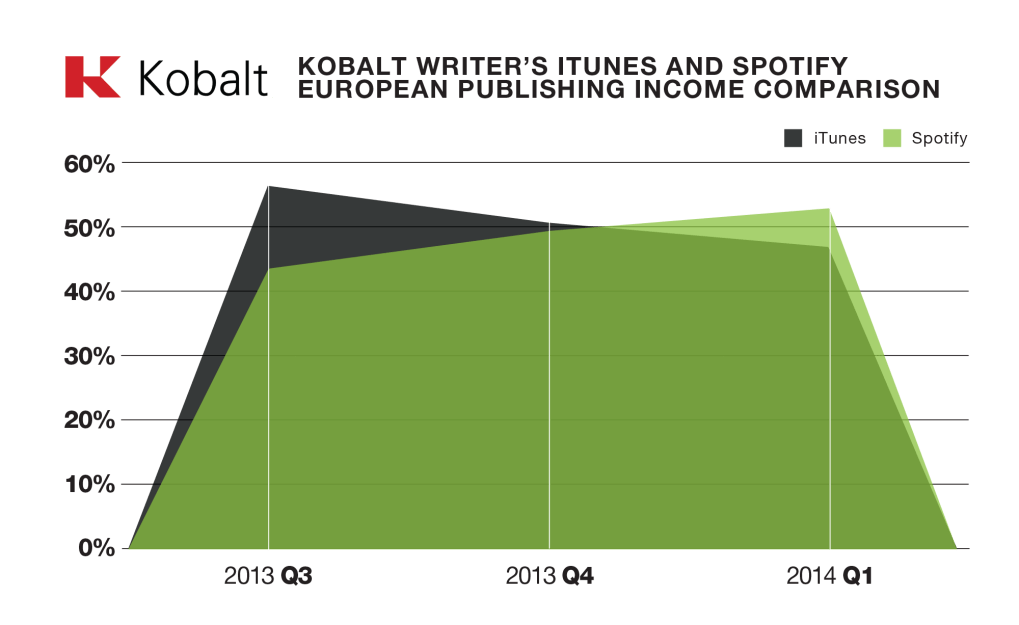
Spotify Royalties Overtake iTunes In Europe
Many high profile artists are railing against the royalty payments provided by Spotify, but it's paying out more and more money every day. In fact, the streaming service has now overtaken iTunes as far as royalty revenue in Europe, according to Kobalt, a company that helps collect music royalties on behalf of artists.
Kobalt has a number of big artists in its stable, including Maroon 5, Lenny Kravit, Dave Grohl, Max Martin, Bob Dylan and many more. The company reports that revenue from Spotify streams were 13% higher than from iTunes last quarter, but it only collects for its artist in Europe.
What's interesting is how fast this has flipped. It was only a year ago that Kobalt found iTunes earnings were 32% higher than Spotify.
People can deny that streaming isn't gaining traction or isn't paying, but the facts say that's definitely not true.
The problem is that many artists aren't seeing these new revenues mostly because of the deals they've struck with their record labels. Labels have always been good at siphoning off money from artist royalties, and even though we're now in the digital age, it seems just as difficult as ever to track.
That said, streaming is coming on strong, and soon it will mean more money for all involved. How much more remains to be seen.

Kobalt has a number of big artists in its stable, including Maroon 5, Lenny Kravit, Dave Grohl, Max Martin, Bob Dylan and many more. The company reports that revenue from Spotify streams were 13% higher than from iTunes last quarter, but it only collects for its artist in Europe.
What's interesting is how fast this has flipped. It was only a year ago that Kobalt found iTunes earnings were 32% higher than Spotify.
People can deny that streaming isn't gaining traction or isn't paying, but the facts say that's definitely not true.
The problem is that many artists aren't seeing these new revenues mostly because of the deals they've struck with their record labels. Labels have always been good at siphoning off money from artist royalties, and even though we're now in the digital age, it seems just as difficult as ever to track.
That said, streaming is coming on strong, and soon it will mean more money for all involved. How much more remains to be seen.

----------------------------------
Sunday, August 10, 2014
Owners Of More Than 25% of US Digital Masters Don't Get Paid
According to the digital rights administration service Audiam, anywhere from 25 to 45% of all master recordings streamed are not properly documented and therefore not associated with the composition. As a result, the royalties from these streams are not paid out.
Audiam estimates this amount to be as much as $5 million a day and includes everything from download stores, streaming services, scan and match locker services, digitally delivered background music, ringtones, ringback tones, text message music clips, YouTube and other digital uses.
And it gets worse - 25% of all compositions on US digital services aren't licensed at all, so that money doesn't make it back to the composer or artist either. Then you have the situations where there's lots of unpaid or unallocated money just sitting in escrow, or even worse, paid to the wrong entities.
What's the one simple thing that you can do to alleviate this situation? Make sure that you always completely fill out any documentation (including metadata) on your song when uploading to a publisher, music distribution service or performance rights organization. Sloppy paperwork leads to more problems in getting paid than anything else in this digital age, although we'll cover a number of other reasons in some upcoming posts.
Audiam estimates this amount to be as much as $5 million a day and includes everything from download stores, streaming services, scan and match locker services, digitally delivered background music, ringtones, ringback tones, text message music clips, YouTube and other digital uses.
And it gets worse - 25% of all compositions on US digital services aren't licensed at all, so that money doesn't make it back to the composer or artist either. Then you have the situations where there's lots of unpaid or unallocated money just sitting in escrow, or even worse, paid to the wrong entities.
What's the one simple thing that you can do to alleviate this situation? Make sure that you always completely fill out any documentation (including metadata) on your song when uploading to a publisher, music distribution service or performance rights organization. Sloppy paperwork leads to more problems in getting paid than anything else in this digital age, although we'll cover a number of other reasons in some upcoming posts.
----------------------------------
Sunday, July 13, 2014
Sony Threatens To Pull Out Of ASCAP And BMI
In what may be a glance at the music publishing world to come, Sony/ATV Music Publishing has threatened to end its relationship with music licensing agencies ASCAP and BMI if the changes it wants aren't implemented. And it looks like Universal Music Publishing could be lining up to do the same thing.
The issue primarily stems from the payments received from streaming royalties, which most publishers think is too little, especially when compared to downloads. Then there's the fact that the performing rights organizations (PROs) have always been nebulous how their payouts are determined. Writers and publishers alike have been frustrated for years over the disparity between royalties payments between ASCAP and BMI on the same song, where one will be higher than the other on one statement, than switch on the next.
Given the fact that we live in an age where song use tracking and royalty accounting is so much easier than in the past, it would seem that the PROs usefulness might now be diminished. Where for most of the 20th Century they were a total necessity for the publishing business, today that's becoming less true, since every play can be digitally tracked.
Sony/ATV has a catalog of over 2 million songs, including huge earners from The Beatles, Taylor Swift and Lady Gaga. Pulling out of ASCAP and BMI would be a significant blow to those organizations, and probably just the beginning of the snowball rolling downhill. It wouldn't be long before the other large music publishers followed suit.
It's probably inevitable that this will happen eventually. What's for sure is that we're about to witness both big changes in the industry and some history in the making right before our eyes.
The issue primarily stems from the payments received from streaming royalties, which most publishers think is too little, especially when compared to downloads. Then there's the fact that the performing rights organizations (PROs) have always been nebulous how their payouts are determined. Writers and publishers alike have been frustrated for years over the disparity between royalties payments between ASCAP and BMI on the same song, where one will be higher than the other on one statement, than switch on the next.
Given the fact that we live in an age where song use tracking and royalty accounting is so much easier than in the past, it would seem that the PROs usefulness might now be diminished. Where for most of the 20th Century they were a total necessity for the publishing business, today that's becoming less true, since every play can be digitally tracked.
Sony/ATV has a catalog of over 2 million songs, including huge earners from The Beatles, Taylor Swift and Lady Gaga. Pulling out of ASCAP and BMI would be a significant blow to those organizations, and probably just the beginning of the snowball rolling downhill. It wouldn't be long before the other large music publishers followed suit.
It's probably inevitable that this will happen eventually. What's for sure is that we're about to witness both big changes in the industry and some history in the making right before our eyes.
----------------------------------
Labels:
ASCAP,
BMI,
Music publishing,
PROs,
Sony/ATV Music,
streaming royalties
Wednesday, October 16, 2013
Spotify And Pandora Pros And Cons
Streaming music is taking off and predictions are that its 29 million worldwide paying subscribers will grow to at least 191 million in 5 years (I think it will be more). In the meantime, Spotify and Pandora are the big dogs on the block for the moment (expect iTunes Radio to take that mantle soon). Here's a pretty good set of pros and cons between them, courtesy of The Music Bed.
Keep in mind that the above is from the consumer's point of view. There's a whole different set of pros and cons when it comes to the artist and songwriter, but it mostly stems around the fact that the royalty rate is so low. Keep in mind that if the number of paying subscribers raises by the factor of 6 as predicted, so will the revenue streams to artists.
It's probably not possible to get a higher royalty rate from streaming services in that few of them make money as is due to the already high cost of the content. That said, the tiny royalties won't be so small with a lot more subscribers on board.
Keep in mind that the above is from the consumer's point of view. There's a whole different set of pros and cons when it comes to the artist and songwriter, but it mostly stems around the fact that the royalty rate is so low. Keep in mind that if the number of paying subscribers raises by the factor of 6 as predicted, so will the revenue streams to artists.
It's probably not possible to get a higher royalty rate from streaming services in that few of them make money as is due to the already high cost of the content. That said, the tiny royalties won't be so small with a lot more subscribers on board.
----------------------------------
Help support this blog. Any purchases made through our Amazon links help support this website with no cost to you.
Follow me on Forbes for some insights on the new music business.
You should follow me on Twitter and Facebook for daily news and updates on production and the music business.
Check out my Big Picture blog for discussion on common music, engineering and production tips and tricks.
Labels:
Pandora,
Spotify,
streaming music,
streaming royalties
Tuesday, August 13, 2013
Aimee Mann Sues An Invisible Distributor
While a variety of high profile artists like Thom Yorke, Nigel Godrich and Pink Floyd are all railing against the perceived royalty injustice at the hands of streaming music services like Spotify, singer-songwriter Aimee Mann has taken a different tact in her new lawsuit against a low profile company called MediaNet. Mann claims that the company has been using more than a hundred of her songs while not paying her any royalties in a suit which could add up to as much $18 million in statutory damages.
Everyone is by now very familiar with Spotify, Pandora, Rdio, Slacker and all the other streaming services that seem to be constantly in the news, but not many can say they know anything about MediaNet. (Check out the rest of the article on Forbes).
----------------------------------
Help support this blog. Any purchases made through our Amazon links help support this website with no cost to you.
You should follow me on Twitter for daily news and updates on production and the music business.
Check out my Big Picture blog for discussion on common music, engineering and production tips and tricks.
Monday, March 11, 2013
The Reasoning Behind Apple's Low Streaming Rate
News seeped out last week about Apple pushing for a low-ball royalty deal with the record labels for their upcoming iRadio (or whatever they're going to call it) streaming service, probably from the labels themselves. The leak was made to make Apple look like the bad guy in the negotiations, and maybe it is, but you won't see the whole story in any of the news reports.
To recap, Apple is looking to pay half of what Pandora now pays, which is 12 cents per 100 songs streamed. That's still lower than what a typical radio station pays for their online service, which is 22 cents per 100. And then you have Spotify, paying what seems to be a whopping 35 cents per 100.
So why should Apple get away with paying so little in comparison to the potential competition?
The fact of the matter is that streaming experts all agree that Pandora's and Spotify's business models are broken, and neither company will survive if they have to continue paying the current rates. In fact, Pandora itself has said as much as it pushes hard for a better royalty deal than it has now. Apple does not only want to stay away from that trap, but it also wants to set a precedent for payment. It's pretty difficult to push for a lower rate once a higher one is agreed on, as Pandora and Spotify are now seeing.
Of course, none of this helps the artist and songwriter, who are not making much even with the current rates. They'd make more if they had better streaming deals with the labels and could participate in more of the upfront fees that the services pay, but that's not going to happen any time soon.
While I can see the labels point in keeping the rate as high as possible, the fact of the matter is that a strong Apple entry is good for the entire business, even at a lower rate. While free streaming with ads doesn't help the artist much, widespread subscription would. Any push in that direction only gets the industry to a better place faster.
To recap, Apple is looking to pay half of what Pandora now pays, which is 12 cents per 100 songs streamed. That's still lower than what a typical radio station pays for their online service, which is 22 cents per 100. And then you have Spotify, paying what seems to be a whopping 35 cents per 100.
So why should Apple get away with paying so little in comparison to the potential competition?
The fact of the matter is that streaming experts all agree that Pandora's and Spotify's business models are broken, and neither company will survive if they have to continue paying the current rates. In fact, Pandora itself has said as much as it pushes hard for a better royalty deal than it has now. Apple does not only want to stay away from that trap, but it also wants to set a precedent for payment. It's pretty difficult to push for a lower rate once a higher one is agreed on, as Pandora and Spotify are now seeing.
Of course, none of this helps the artist and songwriter, who are not making much even with the current rates. They'd make more if they had better streaming deals with the labels and could participate in more of the upfront fees that the services pay, but that's not going to happen any time soon.
While I can see the labels point in keeping the rate as high as possible, the fact of the matter is that a strong Apple entry is good for the entire business, even at a lower rate. While free streaming with ads doesn't help the artist much, widespread subscription would. Any push in that direction only gets the industry to a better place faster.
----------------------------------
Help support this blog. Any purchases made through our Amazon links help support this website with no cost to you.
Interested in the Music 3.0 archives? Buy The Music 3.0 Guide To Social Media. The best of over 800 posts.
You should follow me on Twitter for daily news and updates on production and the music business.
Check out my Big Picture blog for discussion on common music, engineering and production tips and tricks.
Labels:
Apple,
iRadio,
Pandora,
Spotify,
streaming music,
streaming royalties
Wednesday, November 28, 2012
3 Million Plays = A $39 Royalty Check
"My Song Was Played 3.1 Million Times on Pandora. My Check Was $39...
Tuesday, November 20, 2012
by paul
The following comment, posted on our site [Digital Music News] Tuesday, comes from Grammy-nominated, hit songwriter Ellen Shipley. One of her top tracks, "Heaven Is a Place On Earth," [the 1987 hit by Belinda Carlisle] got played more than 3.1 million times on Pandora, in the last three months alone. Here's the rest...
It is interesting and very disturbing that no one is addressing the SONGWRITER's situation in this Pandora debacle.
Pandora wishes to REDUCE the amount of royalties that songwriters have already seen CUT in 2005. Let me give you an example of what Pandora is paying in royalties to SONGWRITERS--not the performers, but the people who write the songs--the foundation of the music world---
PANDORA ----"Heaven Is A Place On Earth" (co-written)
accounting period for 3 months-----3,112,300 streams
My Pandora royalty .................$39.61
AND they want us to take an EIGHTY FIVE PERCENT CUT!!!
Does that give you an understanding of the meager, insulting, outrageous amount of money songwriters are being paid from PANDORA and SPOTIFY and YOUTUBE and GOOGLE (I received 15 cents from GOOGLE the other day)?
PANDORA talks a great deal about their need to make a profit and to survive.... but they could care less about the fate of those creators who already are hurting so badly, they are dropping out of music.
FACT:
According to the FEDERAL CENSUS, we have lost 45% of our professional songwriters in the last ten years or even less (since the advent of streaming and piracy on the Internet depriving us of earning our LEGAL royalties)
So--here is the question:
WHY is it alright for PANDORA to want to exist and grow and earn profits while it is NOT alright for the SONGWRITERS to SURVIVE, be respected, earn a fair royalty?
PANDORA's model is failing-- because as Steve Jobs recognized much earlier on when he rejected the idea of Streaming Digital radio--they don't have a business plan that gives them a way (such as ad revenue) to earn a profit OTHER THAN NOT PAYING FOR MUSIC!
Listen Up Everyone Please:
Without the Songwriters who create music for artists who do NOT write their own songs, there will be little if any music when you go to PANDORA OR SPOTIFY OR YOUTUBE....
I am grateful for my success as a Grammy-nominated, hit songwriter....I am grateful that my songs have reached millions of people and meant something to them in their lives....
But I will NOT perpetrate the myth that somehow Songwriters should give their music away for free or let it be stolen by Corporations interested in their own profits by any means possible.
THis is a human rights issue---We are discriminated against and unprotected by the US governments obligation to make sure our FIFTH AMENDMENT RIGHTS in the BILL OF RIGHTS (the "right to the pursuit of happiness" which includes the right to work at the JOB OF OUR CHOICE and earn an income from that job without--my words- interference from any person, place, corporation, streaming sites that are robbing us of our Constitutional rights.
Let the voice of the Songwriters Be Heard! Send a petition tous--allow us to be represented at all these meetings between the music world and those who would seek to destroy what we have worked so long and hard to achieve in our lives.
Ellen Shipley"
OK, that still doesn't negate the fact that 39 bucks isn't that much for 3 million streams. And of course, the fact that Pandora wants to reduce that amount even further to stay in business just inflames the situation. But the fact is that songwriters have been used to making more money from terrestrial radio play for a long time, but the pool of money for online radio just isn't that large right now, at least for Pandora.
That said, Pandora says that it can't stay in business without a license rate reduction, but maybe it's better for normal market evolution to take its course and let it die, just like any other business that has the same income to expense problem. If there's a real need in the market for such a service (and Spotify can't fill it all), then you'll see someone rush in to fill the gap in no time, perhaps with a business plan to make it work better for all involved.
----------------------------------
You should follow me on Twitter for daily news and updates on production and the music business.
Check out my Big Picture blog for discussion on common music, engineering and production tips and tricks.
Wednesday, April 4, 2012
What It Takes To Earn Minimun Wage
Here are some depressing stats if you're an artist. In order for a solo artist to earn the US monthly minimum wage of $1,160, this is the quantity of music you must sell:
In actuality, if you think you're going to make a career in music as an artist, it's best to get it out of your mind right now that the bulk of your income will be from music sales of any type. It's never been that way before in the business, and it certainly isn't that way now. In fact, 95% of the money that most major artists make come from sources other than music sales, like publishing, touring, merch and sponsorship.
Remember, as stated over and over in Music 3.0, your music is your marketing. It enhances your ability to make money in other ways.
- Spotify streams - 4, 053,110
- Last.FM streams - 1,546,667
- Rhapsody streams - 849,817
- iTunes Tracks - ($0.99) - 12,399
- iTunes Albums ($9.99) - 1,229
- Retail Album CDs ($9.99) - 1,161
In actuality, if you think you're going to make a career in music as an artist, it's best to get it out of your mind right now that the bulk of your income will be from music sales of any type. It's never been that way before in the business, and it certainly isn't that way now. In fact, 95% of the money that most major artists make come from sources other than music sales, like publishing, touring, merch and sponsorship.
Remember, as stated over and over in Music 3.0, your music is your marketing. It enhances your ability to make money in other ways.
-----------------------------------
Help support this blog. Any purchases made through our Amazon links help support this website with no cost to you.
You should follow me on Twitter for daily news and updates on production and the music business.
Check out my Big Picture blog for discussion on common music, engineering and production tips and tricks.
Wednesday, December 28, 2011
Spotify's Royalties Actually Greater Than Radio
OK, here's a surprise. An article by Billboard magazine cited some interesting research by David Touve, an Assistant Professor of
Business at Washington & Lee University who has long studied the
music industry. The study found that Internet streaming, specifically Spotify, actually pays a higher royalty rate than radio airplay.
Touve found that a spin on terrestrial radio results in royalties that range from $0.000186 to $0.000372 in the U.S. and from $0.0004 to $0.0007 in the UK (at current currency rates). That's not much, is it?
Now consider that Spotify pays about 0.3 cents per stream (an estimate based on Billboard sources and media reports), which is 16.1 times greater than $0.000186 and 8.1 times greater than $0.000372.
There are a couple of differences though. Radio royalties feel bigger because so many people listen to radio. On-demand royalties feel small because relatively few people use services like Spotify. Also, the way radio royalties are shared makes a big difference in how much you earn.
The way that works is that ASCAP or BMI is paid a huge lump sum by the broadcaster for the right to use that organization's member's music, and it's then divided up between writers by taking a survey of national airplay. The more plays you get during the survey, the more money you get....maybe. The trick is that it all depends on the time of day, the market, and how many plays you get during the survey period that determines how much is in your royalty check. If you happen to get a big amount of plays either before or after the survey period, you probably won't get credited for them. And to make it even worse, ASCAP and BMI have different ways of weighting the different types of plays, so you make more from radio airplay from one, or television broadcast from the other. One of the benefits of streaming is that you know the exact number of plays and where they come from (or at least you should).
That said, with restricted playlists and decreasing airplay due to stations converting to news or talk, it's harder and harder to make any dough from radio airplay, even if the royalty rates were even.
Okay, so the cash cow of the music business is turning out to be thin and sickly, so what else is new? If you were in music to make a ton of money, you're in it for the wrong reason anyway. To real musicians, producers, execs, and all manor of other people working in the biz, it's all about the music; any money that comes in is a bonus. If you don't have the passion for it, go be a banker and make some real money.
You should follow me on Twitter for daily news and updates on production and the music business.
Touve found that a spin on terrestrial radio results in royalties that range from $0.000186 to $0.000372 in the U.S. and from $0.0004 to $0.0007 in the UK (at current currency rates). That's not much, is it?
Now consider that Spotify pays about 0.3 cents per stream (an estimate based on Billboard sources and media reports), which is 16.1 times greater than $0.000186 and 8.1 times greater than $0.000372.
There are a couple of differences though. Radio royalties feel bigger because so many people listen to radio. On-demand royalties feel small because relatively few people use services like Spotify. Also, the way radio royalties are shared makes a big difference in how much you earn.
The way that works is that ASCAP or BMI is paid a huge lump sum by the broadcaster for the right to use that organization's member's music, and it's then divided up between writers by taking a survey of national airplay. The more plays you get during the survey, the more money you get....maybe. The trick is that it all depends on the time of day, the market, and how many plays you get during the survey period that determines how much is in your royalty check. If you happen to get a big amount of plays either before or after the survey period, you probably won't get credited for them. And to make it even worse, ASCAP and BMI have different ways of weighting the different types of plays, so you make more from radio airplay from one, or television broadcast from the other. One of the benefits of streaming is that you know the exact number of plays and where they come from (or at least you should).
That said, with restricted playlists and decreasing airplay due to stations converting to news or talk, it's harder and harder to make any dough from radio airplay, even if the royalty rates were even.
Okay, so the cash cow of the music business is turning out to be thin and sickly, so what else is new? If you were in music to make a ton of money, you're in it for the wrong reason anyway. To real musicians, producers, execs, and all manor of other people working in the biz, it's all about the music; any money that comes in is a bonus. If you don't have the passion for it, go be a banker and make some real money.
-----------------------------------
Help support this blog. Any purchases made through our Amazon links help support this website with no cost to you.
You should follow me on Twitter for daily news and updates on production and the music business.
Check out my Big Picture blog for discussion on common music, engineering and production tips and tricks.
Labels:
Billboard,
David Touve,
radio royalties,
Spotify,
streaming royalties
Subscribe to:
Posts (Atom)