Monday, January 9, 2012

CDs Still Dominate Album Sales

2011 Album Sales Breakdown image from Bobby Owsinski's Music 3.0 blogHere's something that might take you by surprise. According to Nielsen Soundscan, more than two-thirds of all albums purchased in the US in 2011 were physical CDs.  That means that out of a total of 330.6 million albums sold during the year, 223.5 million of them were discs, or 67.6 percent.  
That said, a few days ago the UK's BPI stated that 76.1 percent of all albums purchased last year were CDs, so they're still somewhat behind on the digital transition.

Want some good news about music sales? In the US, album unit sales were actually up by 1.3 percent last year, while the sales of CDs slumped 5.7 percent. Digital albums also gained a healthy 19.5 percent to reach a record 103.1 million units.  But the big winner was vinyl, which was up by 36.3 percent to nearly 4 million units. Will 2012 show the same results?

-----------------------------------
You should follow me on Twitter for daily news and updates on production and the music business.

Check out my Big Picture blog for discussion on common music, engineering and production tips and tricks.

Sunday, January 8, 2012

The State Of Music In Gaming

Video Game Music image from Bobby Owsinski's Music 3.0 blog
Gaming was a huge new source of income for the music business a few years ago, but it seems like the Rock Band and Guitar Hero fads are now long past. That said, a number of new opportunities will soon be available in gaming, as you'll see in this interview excerpt with Thom Kozik. The interview comes from the 2nd edition of Music 3.0: A Survival Guide For Making Music In The Internet Age.

"A seasoned tech-industry executive of more than 25 years, Thom Kozik has spent most of that time on the gaming side of the tech industry, having served as president of gaming search engines Wazap and All-Seeing Eye (which he sold to Yahoo in 2004), before he became director of business development for Yahoo’s Media group, then Executive Vice President of Online Gaming at Atari. He is now president of Nüko Games.

What’s changed in gaming in the last couple of years?
There are two big things that have changed; the explosion of online gaming in the Western markets (predominantly driven through Facebook), and the music games that we were talking about two years ago have sunsetted with the change in appetite among gamers.

As far as console games like Rock Band and Guitar Hero, there’s a feeling by video game publishers that they’ve milked that cow as far as they could and can no longer sell tracks endlessly into those franchises. They haven’t turned them off completely and there’s still an effort to continue to sell into their installed base, but we’re not going to see another Beatle’s Rock Band on the horizon. The economics just aren’t there.

For an artist who wants to produce for this space, I think there’s actually more opportunity than there was a couple of years ago. Back then the focus was on the music games, but the publishers really didn’t worry about new music at all. They just wanted old back catalog to throw into the channel.

Now browser-based and mobile gaming (which I still consider to be online gaming) is where the action is. The truth is that the biggest growth area is based around games that depend upon and live via an online connection. In mobile games in particular, most of the early games in this area were self-contained experiences where titles like Angry Birds and Doodle Jump had the audio assets for the entire experience, along with all other elements, in the download package that the consumer purchased from an App Store. That’s shifting quickly to games like Infinity Blade, which uses a traditional console gaming engine and has taken the iPhone and iPad markets by storm. No one expected to see a game of this breadth and quality on a mobile device. It wasn’t because of the limitation of the device, but more about the nature of the product being released by the game developers. What’s most important about a game like Infinity Blade and those that are going to follow is that they’re structurally more like console games in that different levels load dynamically as the player progresses. What’s important for musicians is that there’s a need for more soundtracks and audio assets as the publishers continue to sell and ship those new levels to players. This trend in mobile gaming is much bigger than the equivalent of “map packs” that publishers put out for console and PC games in years past.

From a creative standpoint, now you have a few leading indicators of what can really be done on these mobile platforms. We’re opening up a really cool opportunity for the composer, artist or publisher to do the same kind of grand scoring and creative expression of music on a mobile device that they would have done on a console as recently as a couple of years ago. That’s a big opportunity.

On the browser game side, one of the things that we’re going to see is that the game developers and studios have had their eyes opened to what can be done in a web browser, so the games are getting much bigger in scope. What’s important is that in the Angry Birds or Doodle Jump world, the ability to create a score or the amount of music available in the game is fairly limited. Contrast that to the kind of games we’re used to seeing on consoles or PCs or massive multiplayer games like World Of Warcraft. The music is epic -- it’s a lot more than some catchy loops.

It’s soon going to be easier to have great epic scores on mobile games than on the browser because of the nature of the way that a browser talks to the Internet. There is technology out there that can make it easier on a browser, but it will be a question of how smart the game developers are with this."

You can read more from this and my other books at bobbyowsinski.com.
-----------------------------------
You should follow me on Twitter for daily news and updates on production and the music business.

Check out my Big Picture blog for discussion on common music, engineering and production tips and tricks.

Thursday, January 5, 2012

Website Performance Metrics

Performance image from Bobby Owsinski's Music 3.0 blog
One of the things about Music 3.0 is that we can finally measure exactly what the buzz is. Here's a way to interpret your Google Analytics data to see just how successful you website really is. Thanks to Hubspot for the definitions.


1. Unique Visitors - That's the total number of individual visitors to your site during a specific period of time, not counting repeat visits by the same individual. Obviously, if this number continues to increase, you're doing well.


2. New versus Repeat Visitors - This is a comparison of your unique visitors vs. the number of visitors who came back more than once. Although it's great to have repeat visitors (and you really need them), a rate higher than 30% means that you're probably not growing your audience quickly enough.

3. Traffic Sources - This is a breakdown of the specific sources of traffic to your website. There are two - Organic traffic comes from a link found on a search engine results page. Referral traffic comes from a link on another website. This tells you how well your search engine optimization is doing. A referral level of about 30% is what you're looking for.

4. Referring URLs - This is the specific, non-search engine URLs that send traffic directly to your site. They represent the inbound links that are crucial for boosting your site’s search engine rankings and tells you which  sites or bloggers are linking to your site and what type of content they tend to like.

5. Most/Least Popular Pages - This is a comparison of the pages on your site that receive the most and least traffic that tells you which kind of content your visitors prefers.

6. Conversion Rate - This is the percentage of visitors to your site who take a desired action, such as purchasing a product or filling out a lead generation form. This tells you how well you're converting leads into fans or customers.

7. Bounce Rate - This is the percentage of new visitors who leave your site almost immediately after arriving, with no other interactions. A high bounce rate means that your visitors don't find your pages particularly compelling.

Interpreting the above metrics should give you some idea of just how well your site is performing. Hubspot has a bit more on all of these points, plus a few more, if you're interested.
-----------------------------------
You should follow me on Twitter for daily news and updates on production and the music business.

Check out my Big Picture blog for discussion on common music, engineering and production tips and tricks.

Wednesday, January 4, 2012

Optimizing Video For Mobile

Mobile Video image from Bobby Owsinski's Music 3.0 blog
ReelSEO recently posted a video called "5 Tips For Optimizing Video For Mobile Users" that had a number of good points. I'm going to save you the 6 minutes it takes to watch it by giving you the tips below.

As my recent post about mobile video engagement indicated, viewers watch videos a lot longer than they do on their desktops. In order to maintain their attention, take note of the following:

1. Avoid using tiny text. Make sure any text you use is readable on any screen that the video might be viewed on.

2. Make sure the audio is clear. Great audio is always a plus, but even more so when viewing on a phone. Remember that the speakers are small, so you're not going to hear a lot of bass, but that's okay as long as everything is intelligible. Also remember that there's lots of ambient noise so make sure the audio is able to cut through it.

3. Make sure to include links in the video description. A video without links to your site is an opportunity wasted. You want them to continue as a fan, so be sure it's easy for them by including a link.


4. Use lots of close-ups. Close-up shots work great on small screens - wide shots don't.

5. Test the video on your own phone before you upload it. What good is it if it doesn't get the point across? The only way that you'll know for sure is if you test it.

Good tips to keep in mind the next time you make a video. Remember that it's more than likely that a great number of your viewers will be watching on their phone. You can watch the entire clip on ReelSEO.
-----------------------------------
You should follow me on Twitter for daily news and updates on production and the music business.

Check out my Big Picture blog for discussion on common music, engineering and production tips and tricks.

Tuesday, January 3, 2012

3 Features Of Google+ Especially For Artists

Many Facebook users are still doubters about Google+, but the network is growing like a weed so if you're an artist or a band, you just can't ignore it any more. While Facebook still dwarfs it by a factor of 10, remember that it was only introduced 6 months ago, and at the rate Plus is growing, it won't take long for it to catch up. As a matter of fact, estimates that just came out today that expect it to grow to 400 million users by the end of 2012, which is about half of that of Facebook in only 18 months (it took Facebook 4 years to get to Plus's current numbers).

That said, Cyber PR maven Ariel Hyatt of Ariel Publicity wrote an excellent article on Music Think Tank about why Google+ is now a must for any band or artist. Here's an excerpt.

"The Band Page
This is the quintessential feature that you all must be familiar with. A Google + Band Page is a page that you can make, just like a Facebook Fan Page, that caters directly to musicians.

It is crucial that you sign up for a band page as soon as possible so that you can solidify the URL and Band Page name to remain consistent with the rest of your social presence. This process is very simple:
Google+ Screen Shot image from Bobby Owsinski's Music 3.0 blogOnce you sign up for a Google + account, you will see a link to ‘create a page ’ on the right side bar towards the bottom of your profile.
From here, all you need to do is select the ‘Arts, Entertainment and Sports’ option and create the page!

It is truly that easy and will make a HUGE difference in your overall online visibility. Of course, you want to make sure you complete your Google + Band Page with a Bio, Hi-Res pictures of yourself or your band. Unfortunately at this point in time, Google+ Band Pages still don’t have a way for you to upload music directly to the page, so you’ll want to use this page primarily to engage your fans.


Circles

Google +’s Circles are THE core function of the website and is how Google + positioned itself as a unique competitor in the social networking market.

As far as you need to be concerned, Circles are really just lists. See, Google + functions similarly to Twitter in that you can simply follow anyone you’d like without needing their approval by adding them to a Circle. The Benefit of this is that you can create separate Circles for all of the different people and resources that you need to stay on top of. Here are a few types of Circles that I suggest you create:
  • Venues

  • Similar Bands

  • Fans (create a new circle for each major market or region where your fans exist. Great for upcoming show!)

  • Blogs that you follow

  • Music Industry Resources 
So what is Google Hangout? Simply put, Google +’s hangouts is a free and easy to use video conferencing service similar to Skype (actually, Facebook’s introduction of Skype video chatting was a response to Google +’s introduction of Hangouts). The reason this service is so important for emerging musicians is because it allows you expand the face-to-face time with fans to beyond just live events.

+1
Before Google+ was in the running for the social media contender, Google introduced it’s own form of a Facebook Like button called the ‘+1 button’. Then, when Google+ was launched, the +1 button became a fully integrated engagement marketing tool, allowing anyone to ‘+1” any page with the button, which not only acts to help the page rank higher in Google searches, but it now also appears on that person’s Google + profile.

So what does this mean? Well, it doesn’t mean much in terms of how you use Google +. But it does mean that the +1 Button is now an absolute must, along with the Facebook Like button, on your website and blog! Including this will turn your website into an easily sharable, highly visible site on Google +."

You can read the entire article here. Ariel has also posted a number of helpful videos from Google as well.
-----------------------------------
You should follow me on Twitter for daily news and updates on production and the music business.

Check out my Big Picture blog for discussion on common music, engineering and production tips and tricks.

Monday, January 2, 2012

People Watch Longer On Tablets

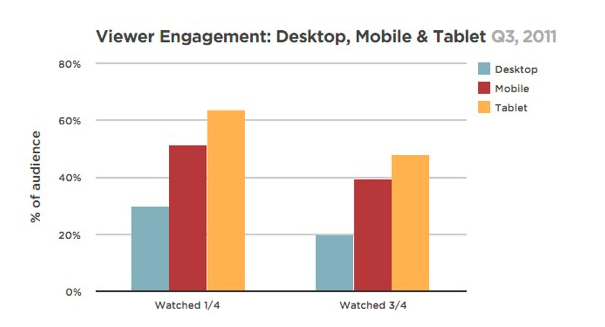
Viewer Engagement Graph 2011 image from Bobby Owsinski's Music 3.0 blogHere's a number that shouldn't come as a shock - tablet users have a longer video engagement than desktop or phone users. A company named Ooyala recently completed a study that determined that tablet users watched 28 percent longer than the desktop average.

They also found that tablet viewers are more than twice as likely to finish a video than on a desktop, which was about 30 percent higher than that of mobile devices.

The study also found that desktops and laptops are more likely to be used for short video clips, whereas videos that are 10 minutes or longer make up 30 percent of the hours watched on mobile devices, 42 percent on tablets, and nearly 75 percent on connected TV devices and game consoles.

It also determined that Android and iOS devices make up 90 percent of the video hours for tablets and mobile devices, where the iPad is king, at least for now. iPads were responsible for 99.4 percent of displays, 97.7 percent of total plays, and 95.7 percent of total hours streamed.

In a bit of a surprise, Facebook has jumped into third place among the biggest video platforms, with an estimated 51.6 million people watching videos on Facebook in July when the study was done. Ooyala also found that Facebook is across the board a more popular means of sharing video than its social media rival, Twitter. In the U.S., for every one video shared on Twitter, over eight are shared on Facebook, but that varies widely depending on the region. In Japan, there’s a 1:1 ratio, whereas in Italy Facebook is 17 times more popular.

To read the full Ooyala’s study, download it out here.
-----------------------------------
You should follow me on Twitter for daily news and updates on production and the music business.

Check out my Big Picture blog for discussion on common music, engineering and production tips and tricks.

Sunday, January 1, 2012

Pixie's Manager Richard Jones Interview

We're going to start the new year off with a clip from Topspin CEO Ian Rogers' excellent web show This Week In Music. This is with Richard Jones, the manager of The Pixies, who discusses DIY even for a band with international visibility.


-----------------------------------

You should follow me on Twitter for daily news and updates on production and the music business.

Check out my Big Picture blog for discussion on common music, engineering and production tips and tricks.

Thursday, December 29, 2011

12 Music Business Predictions For 2012

Behold The Future image from Bobby Owsinski's Music 3.0 blog
It's that time of year again when it's time to speculate on what's in store for us in the new year. Here are 12 educated guesses that I have about 2012.

1. Google+ continues to grow. Depending upon who's research you read, Google+ is already at either 150 million users or 65 million users. Regardless of the number, it's huge considering that it only launched 6 months ago. How many of those users are actually active is debatable, although Google doesn't care much as long as you're signed up and it has your info (that's the underlying truth of the matter). Regardless, Google will continue to add features to Plus next year and continue to gain users at a record number.

2. Vinyl continues to grow as well. You can say that vinyl is a fad except for the fact that every music store owner who sells it says their sales are way up over last year. Add to that the fact that they can't keep record players and turntables in stock tells you that although the vinyl business may never be huge, sales will continue to increase in 2012.

3. Facebook feels Plus's heat. There's no way that Google+ can have so many new users without Facebook feeling it somehow. Even with a number of new features, there were already signs of attrition even before Plus took off. Look for Facebook to do everything they can to keep their user numbers looking good until their IPO, then watch things flatten out after that.

4. Twitter grows up. While dismissed by many, Twitter is still a force to be reckoned with and will be more so in 2012 as the next versions of Twitter and Tweetdeck come online and provide new features such as brand pages and embedding. Look for user numbers and social influence to increase in 2012.


5. The major labels wind down. It took a while but it seems like artists everywhere have finally gotten the message - in this Music 3.0 world you don't need a record label, at least not in the beginning. The Big 3 have less and less to offer while taking more and more of a revenue pie that isn't that big to begin with. The majors will always be there, but will only be useful in some capacity to the "1%."

6. Indie labels make some headway. As I mentioned in the 2nd edition of Music 3.0, the business won't take the next step in its evolution until a new crop of entrepreneurs takes root. There's evidence that's happening, as new more efficient and plugged-in indie labels take hold with their heart in the right place - music, not money.

7. Concert attendance takes a leap. It's true that The Stones are doing their 50th anniversary tour, and Van Halen will be trying to regain their glory days this year, but that's not what will make 2012 a banner year for concert attendance. In 2011, for the first time at least 50% of the biggest earners on the road were not legacy artists. Finally a new crop of current artists are beginning to pull their weight in venues all over the world. Add to this some pricing sensibility that seems to be coming back to the concert marketplace, and a stronger economy, and you have a record year.

8. Music publishers feel the pain. Publishing has always been the secret cash cow of the music industry, not well understood and somewhat hidden from prying eyes. That's no longer the case as artists and writers are more knowledgeable than ever and push for better deals. That said, the music economy has finally caught up with publishing, as mechanical royalties are way down due to low sales and an increase in streaming, and broadcast revenue continues to dwindle. Look for that trend to continue in 2012.


9. Artist royalties take a beating. Even though the industry can be joyful for a slight increase over 2010, that's due to superstars like Adele, Lady Gaga and Taylor Swift, et al. For the average successful artist, the only thing to look forward to is the ability to make a living, as CD sales aren't what they used to be, and downloads give way to streaming, which doesn't pay nearly as much. Time to hit the road to make some dough.

10. Subscription is the new download. Another prediction that I made in Music 3.0 2nd edition is that we'll soon see a major shift from downloads to subscription as a way of consuming music. That's already happening, thanks to Spotify's launch in the US, but we'll see it snow ball in 2012 to the point where many consumers will never purchase another download again.

11.  The cloud is in the air. In 2011 we saw the introduction of cloud services from Amazon, Google and Apple, and while they haven't been in the forefront of our daily news cycle, they are making an enormous impact upon our daily lives as people see how useful storing their data in the cloud can be. Expect to see a gradual increase in cloud computing use in 2012 until we all use it so seamlessly and often that it becomes a huge part of our lives.

12. Micropayments hit their stride. In 2012 micropayments will finally come to pass in the way that all the previous predictions hoped it would. Micropayments are small 1$ or less transactions that up until now have been impossible to make because of transaction costs imposed by banks. The floodgates are now open and numerous services have found ways to work around the bloodsuckers, as artists and indie labels soon find new ways to take full advantage of marketing to their fan base.

That's it. It'll be fun to have a look at the list at this time next year and see exactly which ones came to pass. Have a happy, artistic, and prosperous New Year.

Read my 2012 predictions for music production on my Big Picture production blog.
-----------------------------------

You should follow me on Twitter for daily news and updates on production and the music business.

Check out my Big Picture blog for discussion on common music, engineering and production tips and tricks.


Wednesday, December 28, 2011

Spotify's Royalties Actually Greater Than Radio

Spotify logo image from Bobby Owsinski's Music 3.0 blog
OK, here's a surprise. An article by Billboard magazine cited some interesting research by David Touve, an Assistant Professor of Business at Washington & Lee University who has long studied the music industry. The study found that Internet streaming, specifically Spotify, actually pays a higher royalty rate than radio airplay.

Touve found that a spin on terrestrial radio results in royalties that range  from $0.000186 to $0.000372 in the U.S. and from $0.0004 to $0.0007 in the UK (at current currency rates). That's not much, is it?

Now consider that Spotify pays about 0.3 cents per stream (an estimate based on Billboard sources and media reports), which is 16.1 times greater than $0.000186 and 8.1 times greater than $0.000372.

There are a couple of differences though. Radio royalties feel bigger because so many people listen to radio. On-demand royalties feel small because relatively few people use services like Spotify. Also, the way radio royalties are shared makes a big difference in how much you earn.

The way that works is that ASCAP or BMI is paid a huge lump sum by the broadcaster for the right to use that organization's member's music, and it's then divided up between writers by taking a survey of national airplay. The more plays you get during the survey, the more money you get....maybe. The trick is that it all depends on the time of day, the market, and how many plays you get during the survey period that determines how much is in your royalty check. If you happen to get a big amount of plays either before or after the survey period, you probably won't get credited for them. And to make it even worse, ASCAP and BMI have different ways of weighting the different types of plays, so you make more from radio airplay from one, or television broadcast from the other. One of the benefits of streaming is that you know the exact number of plays and where they come from (or at least you should).

That said, with restricted playlists and decreasing airplay due to stations converting to news or talk, it's harder and harder to make any dough from radio airplay, even if the royalty rates were even.

Okay, so the cash cow of the music business is turning out to be thin and sickly, so what else is new? If you were in music to make a ton of money, you're in it for the wrong reason anyway. To real musicians, producers, execs, and all manor of other people working in the biz, it's all about the music; any money that comes in is a bonus. If you don't have the passion for it, go be a banker and make some real money.
-----------------------------------

You should follow me on Twitter for daily news and updates on production and the music business.

Check out my Big Picture blog for discussion on common music, engineering and production tips and tricks.

Tuesday, December 27, 2011

Music Sales Up 1% In 2011

Digital Music image from Bobby Owsinski's Music 3.0 blog
It's hard to believe but as of December 15th, music sales were actually up 1% over last year, which represents the first time in about 10 years that has happened. That's more impressive when you consider that sales for 2010 were down about 13% from 2009, and prior to that they were down an average of about 8% in the 2000's.

Why the turnaround, you may be asking? For one thing, there were some actual blockbusters this year. First of all, Adele's 21 had sold 5,281,000 with two weeks of sales yet to be recorded. That means that her sales will be a lot closer to 6 million by the end of the year, considering the holiday buying season. million. But hold on; that doesn't include an additional 750,000 copies she sold this year of her last album, 19. Then consider that her single "Rolling in the Deep” has sold 5,665,000 downloads, followed by “Someone Like You” with 3,352,000, “Set Fire to the Rain” with 963,000, and “Rumour Has It” with 551,000. All in all, a banner year for any artist at any time.

There were other big sellers as well, but keep in mind that these numbers are a few weeks old.
  1. Adele, 21 - 4,817,000 copies sold
  2. Lady Gaga, Born This Way - 1,973,000
  3. Michale Buble, Christmas -  1,964,000
  4. Lil Wayne, Tha Carter IV - 1,776,000
  5. Jason Aldean, My Kinda Party - 1,389,000
  6. Mumford & Sons, Sigh No More - 1,328,000
  7. Jay-Z/Kanye West, Watch The Throne - 1,124,000
  8. Beyonce, 4 - 956,000
  9. Lady Antebellum, Own The Night - 908,000
  10. Katy Perry - Teenage Dream - 907,000
What does this mean? Music is still alive and well and people will gladly pay for it in one form or another if they love it (not just like it). Sales like this prove that there's a lot of great music being made today, and fans will buy it when they find it.
-----------------------------------

You should follow me on Twitter for daily news and updates on production and the music business.

Check out my Big Picture blog for discussion on common music, engineering and production tips and tricks.

Monday, December 26, 2011

An Interview With Topspin's Ian Rogers

Ian Rogers image from Bobby Owsinski's Music 3.0 blog
Formerly the General Manager of Yahoo Music, Ian Rogers is currently the CEO of Topspin Media, one of the premier direct-to-fan services currently available. A frequent panelist at industry conferences world-wide, he is one of the most respected and widely quoted voices in the music business today.  I was lucky to  have him agree to an interview for the 2nd edition of my Music 3.0 Internet Music guidebook. Here's a brief excerpt from that interview.
----------------------
"Where do you see things heading a couple of years down the line?
I really see things crystalizing. The industry has been in the way of what consumers wanted for the last fifteen years, but it’s finally getting pushed out of the way. The way fans are consuming music will change again in the next five years time, which should really scare the industry. They just got used to the idea of digital downloads and now they’re going to see their distribution format change yet again.

Five years from now you won’t connect your computer by a wire and transfer tunes to it. CD sales will continue to decline, but they won’t decline to zero because some people will still want collectables. Things like box sets or 12 inch vinyl will still exist.

Then you’re going to have two types of services. One is the subscription services, which are the Spotifys of the world, like Spotify, Rdio, MOG, and Rhapsody. I don’t think you’ll see many new entrants there, and in fact, the weak ones will probably get bought by a company with an existing subscriber base, such as a cable or wireless company.
 And then you’re going to have Apple, Google and Amazon with these more sovereignty-based [cloud] services. You buy the track in some form so you own it, and then it’s lockered and you can access that track from any device. That’s what it’s going to look like.

Companies like Topspin are going to be dealing with the direct-to-consumer channel which will be for the higher end goods. Digital is 50% of our volume and 25% of our revenue right now, but it’s possible that ratio will decrease over time.

What’s the best way to break an act these days?
I’m not sure that it’s changed all that much. More than ever you have to have something that people are passionate about, and you have to build awareness through great recordings and touring. Step two is different in that you now have to build real fan connections and a real relationship with those fans. If you’re lucky enough to do both of those things, then you can talk about selling something.

I think another difference between the proverbial yesterday and today is that we’re moving from a mass market to mass niches, so you have to know what the first niche is that you’re targeting and then go after it. You don’t put the music out there and see who adopts you, you have to know when and how and where you fit. Square peg, square hole, you just go straight into it.

If you look at the way that Yeasayer did it, it wasn’t about an all-out blitzkrieg. Their manager said, “I know exactly the audience that is going to like this. I’m going to tailor our approach to fit that.” It wasn’t that he changed the way they looked or anything, but he didn’t let any photos of the band get out for the first twelve months. He had a specific way that he wanted people to experience the music and the art that went with it. He knew it would resonate with a certain audience, and that’s the way he let it unfold, naturally but still really deliberate. Once he saturated that niche, then he moved on to another audience that would likely dig it, and treated it like it was a brand new band and pulled all those levers again.

The typical scenario is more of a shotgun approach, that “If only I can get it out there, someone is going to find it” kind of thing. That may have worked in the past, but not now.
Yeah, you’re right, but if you look at Odd Future as an example, those guys didn’t really do anything. They literally did just put it out there and the right people did find it and then some magic happened, but that’s the exception because it’s proven that the way your awareness unfolds really matters.

There’s a great study that someone sent to me that found that the influence of people on other people matters a great deal. Having someone say, “You’re going to like this,” is really important. That speaks to the fact that trusted filters really mean something when it comes to marketing music. I think we’ll have more of that happening in the future, and getting music to those new trusted filters in the right way will become increasingly important.

What’s the best way to do that?
I’m not sure but I think this is where the relationship game goes in the future. Having a relationship with the right bloggers and things like that is really going to matter. I think that there will be a “relationship with trusted taste-makers” business somewhere down the road, which is something different. Getting introduced to those sites in the right way will soon be an important part of marketing."

You can read additional excerpts from Music 3.0 and my other books at bobbyowsinski.com.
-----------------------------------

You should follow me on Twitter for daily news and updates on production and the music business.

Check out my Big Picture blog for discussion on common music, engineering and production tips and tricks.

Sunday, December 25, 2011

Top 10 Google Searches In 2011

Google Music image from Bobby Owsinski's Music 3.0 blog
Here we go on a number of end-of-the-year posts. This time it's the Top 10 Google searches in 2011 according to Experian Hitwise:. Take a look at the list first, then I'll explain why it's so interesting.
1. Facebook
2. YouTube
3. Facebook Login
4. Craigslist
5. Facebook.com
6. Yahoo
7. eBay
8. www.facebook.com
9. Mapquest
10. Yahoo.com
The first thing that jumps out is that Facebook is on here 4 times. Why would anyone google "facebook.com" or "www.facebook.com" when they can just type it in? Make you wonder.

Then take notice that Yahoo is on there twice (once more with a ".com"). What's ironic here is that people are searching for a search engine! Makes you wonder, take 2.

I'm pretty baffled at the fact that people don't know enough to just try to type in "youtube.com" directly into their browser instead of doing a search for it. Makes you wonder, take 3.

This helps prove my point that most of the people using the online world are not as sophisticated as we're led to believe by the media. I guess this list is a lot better than if it included Justin Beiber and Britney Spears though.
-----------------------------------

You should follow me on Twitter for daily news and updates on production and the music business.

Check out my Big Picture blog for discussion on common music, engineering and production tips and tricks.

LinkWithin

Related Posts Plugin for WordPress, Blogger...