Monday, November 17, 2014

Artists Get Record Payout From Soundexchange

SoundExchange logo image
If ever there was evidence that streaming is becoming the new music consumption paradigm, this is it. SoundExchange, the not-for-profit performing rights organization that collects non-interactive distribution royalties for copyright holders, distributed a record $267 million in the third quarter. This is up 74% over the prior year period, and almost 40% more than the previous quarter.

The good news is that at the current rate, SoundExchange distributions could reach about $800 million this year, which is what the value of digital downloads for the year is predicted to be as well. In other words, there's as nycg money being collected from just this portion of the streaming business than from all digital downloads.

SoundExchange collects for both artists and record labels (whomever owns the copyright) from non-interactive radio-like services like Pandora and iHeartRadio, satellite radio and cable music channels. Interactive streaming services like Spotify and Rdio pay the royalties directly to the copyright holder or an aggregator like CD Baby or Tunecore.

It's interesting that download sales are falling a lot more rapidly than physical product sales at this time, but the good news is that decrease is being more than offset by streaming royalties. Considering that there's only about 28 million full-price subscribers world-wide at the moment, there's plenty of room for growth, which is great news for artists and songwriters.

If you're not yet signed up with SoundExchange, you're most likely leaving money on the table if your songs are getting played on non-interactive services, so register now!
----------------------------------

Sunday, November 16, 2014

How Long Do We Listen To A Song?

Out of skips image
We now live in a world where it's really easy to skip a song that we're listening to if we're not satisfied. This is a revelation of sorts because it wasn't always that way on a personal level in the days of vinyl and even CDs, and of course it's still like that when it comes to radio. But in today's streaming world a new choice is only a click away to switch to something that's more to our liking.

MusicMachinery.com had a recent piece called "The Skip" that looked in depth at the current listening habits of Spotify users. Why Spotify? It has some of the best user data available, making it easy to extract some conclusions from billions of music plays. Here's what the post found:
  • We're almost as likely to skip to another song as we are to listen to it. 
24.14% skip within the first 5 seconds
28.97% skip within the first 10 seconds
35.05% skip within the first 30 seconds
48.6% skip before the song finishes!
  • The average listener skipped 14.65 times per hour.
  • Mobile users skip more - 51.1% versus 40.1% for desktop users.
  • People skip more in the morning before they start work. The less they concentrate on the music, the less they skip.
  • The skipping rate is higher on the weekends, when people have more spare time.
The takeaway is that a true listen to your music may be very elusive. What may be counted as a stream may only be someone passing through until they find something that they really like!
----------------------------------

Thursday, November 13, 2014

YouTube's Music Key Ups The Ante For Other Streaming Services

YouTube Music Key image
Today YouTube finally unveiled its long awaited Music Key subscription service and at least at first glance, other streaming music services should take notice. It offers a number of features that other services might not be able to easily offer, making it more difficult for a company to be able to differentiate itself in an increasingly crowded space.

While it was common information that for a $10 per month fee, Music Key would allow the user ad-free and offline playback as well as the ability to listen in the background, what we didn’t know was that you’d also get access to the entire Google Play catalog too. This includes a large selection of not only audio, but video as well. Plus there’s also an abundance of playlists and the ability to listen and watch over compatible services like Sonos and Chromecast.

So why should the other services take more than a casual notice to the launch? First of all, its about video as much as audio. If there’s an enticement to get a heavy YouTube user to pay 10 bucks its getting rid of the pre-roll or popup banner ads when they watch a video. YouTube is already the most widely used service for consuming music online, and yes, you can still do that for free, but everyone hates the ads. I bet a lot of people will buy in for this reason alone.

On the other hand, many music lovers access YouTube to find primarily their favorite song. They don’t necessarily care about the video attached, and many times the video only shows a static picture anyway. While the main attraction for users may be the ad-free environment at first, that can quickly change once they’re exposed to the other features. You can keep a customer with one killer feature, but for every additional feature that he comes to rely on, it becomes increasingly more difficult to pry that user away to another service. Read more on Forbes.
----------------------------------

Wednesday, November 12, 2014

An Artist's Look At Music Delivery Format Pros And Cons

In the recent past, there have always been multiple containers (a container is the way the music is packaged for distribution) of music that an artist had available for sale. First there were vinyl singles and vinyl albums, then vinyl albums and cassettes, then CDs and cassettes, then digital downloads and CDs, and now we can add streaming digital music to the list. With the recent resurgence of vinyl, an artist has four container options for distribution of his or her work. Here's an excerpt from my Music 4.0: A Survival Guide For Making Music In The Internet Age that takes a look at the pros and cons of each.


As you can see from the chart above, each of the current delivery methods has an assortment of pros and cons. This is not to say that one container is better than another in our current music world, but it helps to be aware of the benefits and disadvantages of each.

You can read additional excerpt from Music 4.0 and my other books on the excerpts section of bobbyowsinski.com.
----------------------------------
Tuesday, November 11, 2014

Spotify Royalties Overtake iTunes In Europe

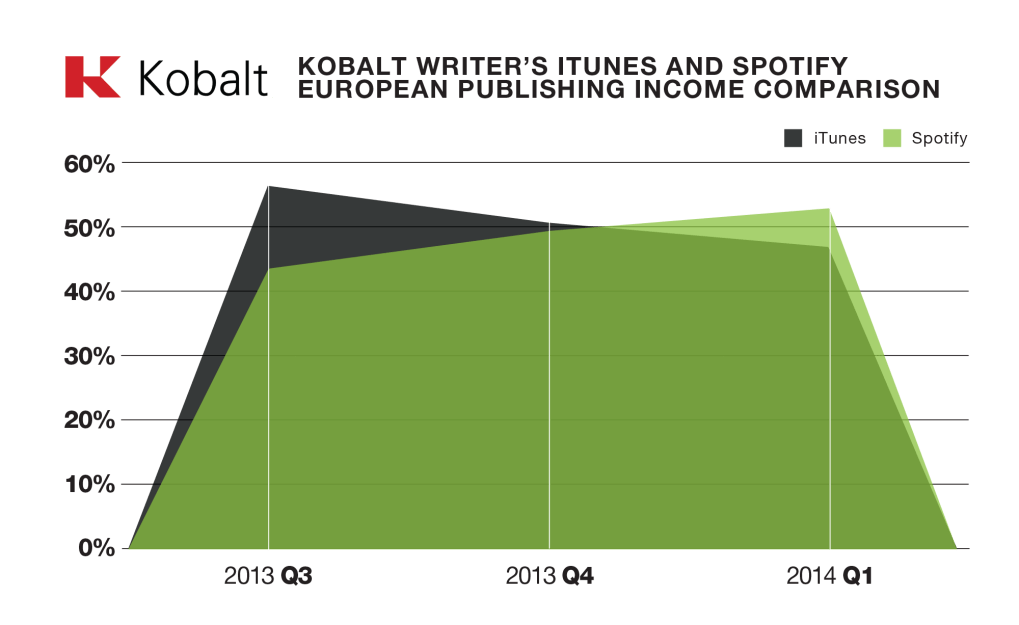
Many high profile artists are railing against the royalty payments provided by Spotify, but it's paying out more and more money every day. In fact, the streaming service has now overtaken iTunes as far as royalty revenue in Europe, according to Kobalt, a company that helps collect music royalties on behalf of artists.

Kobalt has a number of big artists in its stable, including Maroon 5, Lenny Kravit, Dave Grohl, Max Martin, Bob Dylan and many more. The company reports that revenue from Spotify streams were 13% higher than from iTunes last quarter, but it only collects for its artist in Europe.

What's interesting is how fast this has flipped. It was only a year ago that Kobalt found iTunes earnings were 32% higher than Spotify.

People can deny that streaming isn't gaining traction or isn't paying, but the facts say that's definitely not true.

The problem is that many artists aren't seeing these new revenues mostly because of the deals they've struck with their record labels. Labels have always been good at siphoning off money from artist royalties, and even though we're now in the digital age, it seems just as difficult as ever to track.

That said, streaming is coming on strong, and soon it will mean more money for all involved. How much more remains to be seen.

Kobalt iTunes and Spotify income

----------------------------------

Monday, November 10, 2014

Streaming Service Grooveshark Gets Into Events

Grooveshark logo image
Grooveshark has always been one of the more interesting music streaming services in that it's always been a tiny outsider trying to stay competitive with the deep pockets of the industry. Starting as an alternative download service to iTunes in 2007, the company couldn't get much traction from the major record labels as far as licensing agreements. This lead to the service morphing into a more radio-like model that quickly ran afoul of a number of record labels, since licensing agreements were still not in place.

The company has since lost lawsuits filed by the major labels and even had its Facebook compatibility features pulled from its website and its Android app removed by Google.

None of this has stopped Grooveshark from trying new things though, and the latest is getting into events with Grooveshark Presents, a crowdsourced concert initiative that attempts to use the company's streaming data to help artists and promoters to better plan events.

The first concert occured on November 10th in Gainesville, Florida (where Grooveshark's corporate offices reside) with artists Autograf, Happy Accidents, and Bells & Robes.

Grooveshark.com currently calls itself a "Virtual DJ" allowing the user to broadcast a playlist, which is a great idea, except for the fact that artists and labels claim they're not being paid.

While Grooveshark is appealing its loses in court, it continues to try to stay relevant. The fact that it has 30 million monthly users is pretty impressive, but it still remains to be seen whether this new niche will ultimately be enough to keep the company alive over the long term in the face of continuing industry pressure.
----------------------------------

Sunday, November 9, 2014

The New Bandcamp Subscription Feature And Why It Won't Work

Bandcamp logo image
Indie music aggregator Bandcamp recently launched a new feature that enables fans to subscribe to its artists for a fixed amount per year (like the $32 that the UK band Candy or artist Steve Lawson are charging). During that time, the fan gets access to all the material that artist or band creates. The fan also has the option of paying more than the subscription amount if they so desire.

While this might sound like a great idea and a good way for fans to support an artist or band, it's probably a feature that will benefit Bandcamp much more than any artist on the service. Here's why:

1. We're living in a different world than even 3 years ago. Fans are more interested in a song by an artist than the artist themselves in most cases. They can get the songs for free on YouTube or for a lot less money than subscribing if they already pay for a streaming service.

2. Most artists over-promise when it comes to future releases, but it's really difficult to turn out a lot of quality product over the course of a year and on a regular schedule. If the releases don't come as promises or they aren't as good as expected, the subscriber doesn't remain engaged. If there are fewer subscribers than anticipated (which is always the case), regular creative output becomes even more difficult for the artist.

3. Most artists concentrate on their subscribers or the non-subscriber fans, but not both. This leads to fan attrition rather than increasing the fan base.

4. You're competing against yourself if you expect people to buy your product on Amazon, iTunes, or  purchase a CD or vinyl. If they sign up for decreased subscription rate, that's a lot less money that you can get from someone who's already a fan and might be more willing to purchase on a whim.

That's not to say that subscription can't work in some cases (a jam band like Phish that's been around for along time and has a big catalog of recorded concerts for instance), but it's not a model that most artists will find useful, especially if you don't already have a large and well-established fanbase. The bottom line, Bandcamp may be trying to sell you on this feature, but it's not all it's cracked up to be.
----------------------------------

Thursday, November 6, 2014

The 10 Most Expensive Records Of 2014

Vinyl Collection image
People love to collect things, and paying stupid amounts of money for a collectible is something that's pretty common to feed the obsession. Vinyl records are no exception, but you have to wonder why some records are worth so much.

The Vinyl Factory recently posted the 10 most expensive records sold on the Discogs trading site so far this year. If you've heard of more than 2 of these then you are indeed a serious collector.

1. Coil – Gold Is the Metal (With the Broadest Shoulders) (1987), $1,889 
2. Bernard Purdie – Lialeh (1974), $1,875
2. Necros – Sex Drive (1981), $1,875 
2. Mammut – Mammut (1971), $1,875 
2. Dr. Z – Three Parts to My Soul (1971), $1,875 
2. Nicholas Greenwood – Cold Cuts (1972), $1,875 
2. Lee More – Free and Easy (1981), $1,875
2. Vicious Visions – I Beat You / No No’s (1983), $1,8752
2. Old Man & The Sea – The Old Man & The Sea (1972), $1,875 
2. Various – Sonatas for Violins (1964), $1,875

If you take notice there are 10 titles, but 9 of them sold for the same amount - $1,875.

What's the big attraction? Most are limited collectors items. For instance, the Coil record was one of only 55 pressed (you can listen to a sample here).

It's pretty cool to see the great drummer Bernard Purdie on the list though.

Any bets that the buyers of these records never actually listen to them?
----------------------------------

Wednesday, November 5, 2014

Soundcloud And Warner Music Make A Deal

Soundcloud icon image
Soundcloud has been trying to become more than just a way for artists, bands, and DJs to showcase their music, and the service took a big step forward yesterday with a new licensing deal with one of the major labels in Warner Music.

The deal means that Warners and Warners artists (hopefully) will get paid anytime someone plays one of their songs on the platform. This includes any of the very popular DJ mashups that the service is becoming noted for.

Warners will also take a cut of the ad revenue generated, as well as a cut of the revenue from Soundcloud's yet-to-be-introduced subscription service.

On top of that, the Wall Street Journal reports that Warners will also get a 3 to 5% stake in Soundcloud as part of the deal.

What the Warners deal does is legitimize Soundcloud in the eyes of other labels and in the investment community, allowing the service to raise additional capital and make the next major label deals a bit easier. For artists, it means that they'll finally get paid if someone plays their music on the platform (providing they're signed to Warners, at least at the moment).

On a related side note, I always suggest that people use Soundcloud if they want me to listen to their tracks. It's so much more convenient that sending a file.
----------------------------------

Tuesday, November 4, 2014

The Logic Behind Taylor Swift Fleeing Spotify

Taylor Swift 1989 image
Taylor Swift and her label Big Machine made a bold statement today by pulling all of her music from Spotify. Here’s another case of a music superstar railing against the new delivery norm, as consumers increasingly move that way, and artists and record labels complain about it.

It’s ironic that Ms. Swift has such negative feelings toward music streaming (as evidenced by her recent Wall Street Journal editorial), yet has long been a champion of social media, using Facebook and Twitter to its utmost to build her fan base. Her engagement is through the roof as she walks the walk and makes her fans feel like they’re a part of her life and she a part of theirs, which is really difficult to do with 46 million Twitter and 70 million Facebook followers. That said, if she’s really all that socially aware, she of all people should know that streaming is where the future lies, as more and more music consumers move that way every day.

Already there’s somewhat of a negative blowback from her fans, with many reacting with outrage via Twitter to label Swift as greedy. After all, a huge amount of her fan base does live there, with 16 million of the company’s 40 million subscribers having played one of her songs in the last month, and 19 million having her on their playlists. And now her music is gone, and to what end?

If I had to make a guess, I would think that the thinking behind this decision was to try to eek out every last sale of her new 1989 album as possible, and maybe there’s actually some sound reasoning behind that. The opportunity to cash in on a physical product might not be possible the next time Swift drops an album, as tastes and trends move on, so it makes sense to sell as many as possible while there’s still a market for it. Read more on Forbes.
----------------------------------

Monday, November 3, 2014

Pianist Asks To Remove Review Under "Right To Be Forgotten" Ruling

Dejan Lazic image
Did you ever get a review that you hated (or hated you) that you wanted removed? That's what happened to pianist Dejan Lazic, who received a less-than-flattering review in the Washington Post way back in 2010. Lazic, who lives in Zagreb, Croatia, decided to fight back by invoking the little known "Right To Be Forgotten" rule in the EU to get the the newspaper to remove the review from its website.

It wasn't the review itself that hurt, according to Lazic. It was the fact that it showed up on the first page of a Google search for the last 4 years that he claims is detrimental to his career.

What's more, he does have some legal standing here. The European Union has ruled that individuals have the right to their personal information, so they should also have control over their personal search results. If your name comes up in a search and the links turn out to "inadequate, irrelevant or ........ excessive," an EU court ruled that you should be able to ask the search engine to remove them.

The problem is that the court ruled that the newspaper doesn't actually have to remove the review, since they own it. Google and other search engines, on the other hand, must remove the review from their search listings, and they have.

In the end, this might have been a just a great PR stunt. Most of the links on a Lazic search refer to him asking to remove the review, and his name certainly got out there a lot more from this incident than from his performances.

Still, most people don't know about the "right to be forgotten" rule in Europe, so it's worth noting if ever needed. That said, this doesn't apply in the US - at least not yet.
----------------------------------

Sunday, November 2, 2014

5 Ways To Get Fans To Buy Your Physical Product

Vinyl Records image
Even though most of us have changed to listening to music via online streams, physical product is never going away. People still buy CDs and vinyl is a very hot commodity, even though the sales number aren't what they once were. So what does it take to get people to actually buy your product?

Nick Moorhead wrote a great article on this over on the Sonicbids blog. I'm going to use some of his points with my explanations here, but you should still read his post because he offers a lot of good info. Here's my take on the 5 things to remember.

1. You need a visually compelling cover. Artwork sells and it always has. Back in the days before the CD when all we had was vinyl records, people would actually buy a record of an unknown artist just because they found the cover interesting. That still applies today.

2. Make it a limited addition. People can't resist something they think is a collectible. Sometimes by just numbering the products (#14 of 500, for instance) can make them more attractive, and allow you to charge more too.

3. Include some bonus tracks. A fan will buy the product if he knows that there are two songs that can't be found anywhere else. It's the ultimate enticement.

4. Provide a bundle. Sometimes just selling a record or CD isn't enough; you have to include some of your swag as well. Either include a T-shirt, sticker, patch or poster - it doesn't matter what's included to make the package seem like more of a bargain.

5. Make the liner notes special. Once again, back in the days of vinyl records, many people bought records based on the liner notes as well as the artwork. The more info you include (studio, additional players, behind the scenes trivia, etc.) the more fans are likely to purchase it. Including lyrics is also a plus as well!

It's surprising what just a little thought and a little bit of extra effort can do for the sales of physical product. Sometimes it's just that one extra thing beyond the music that gets someone into a buying frame of mind.
----------------------------------

LinkWithin

Related Posts Plugin for WordPress, Blogger...