Wednesday, September 4, 2013

Using The 8 Types Of Videos

Video Production image
When musicians think of videos they immediately think of the now-traditional produced music video where the picture helps tell the story of the song. There are many more types of videos available to musicians though. How many of these are you using?

1. The Produced Music Video: This can be expensive or relatively cheap, but it almost always takes some time to put together, which holds many artists and bands back if they think it's the only type of video.

2. The Gig or Concert Video: The latest thing is to do a live stream of a gig, but a video of a gig that's polished a bit in postproduction that shows an enthusiastic audience can be interesting as well.

3. Fan Generated Content: Do your fans shoot video of you? Have a contest to see who can create the best video to a song. How about a mashup of available footage to one of your songs?

4. Lyric Video: Lyric videos are the easiest way to release a video with the least amount of work. Sometimes they even get as many views as the produced music video. It just goes to show that it's really the music that counts in a music video.

5: Behind The Scenes: A day on tour, in the studio, at rehearsal or backstage can be a good way to treat fans to things they don't normally see without spending a lot of time and money.

6: Cover Songs: Many acts have gained large followings because people were introduced to them via a song they already knew. If you want to be really strategic about it, look at what's currently trending for an idea for a song to cover. It doesn't have to sound exactly like the record, and in fact, it's better if it isn't if you want to introduce potential fans to your sound and style.

7. Breaking News: Been named to a festival roster? Going on tour? How about an EP or album release? A quick trailer-length video (a minute or so) can give fans a heads up about the latest news.

8. Tutorial: Is there something on one of your songs that's particularly challenging to play? Do a tutorial to show how it's done. How about something that's basic that's overlooked (like the way you play to a click track)? Everyone has a slightly different way of doing the basic things, so why not show yours?

As you can see, not all videos have to be music videos, but they do have to be entertaining if you want people to watch. Finally, if you want to learn more about music video production, check out The Musician's Video Production Handbook.
----------------------------------

Follow me on Forbes for some insights on the new music business.

You should follow me on Twitter for daily news and updates on production and the music business.

Check out my Big Picture blog for discussion on common music, engineering and production tips and tricks.

Tuesday, September 3, 2013

None Of My Teen Friends Use Facebook

Facebook logo image
Here's part of a guest commentary post on Mashable by Ruby Carp, a 13 year old from New York City who points out the various reasons why neither she nor her peers use Facebook.

This ultimately could be a problem for Facebook in that they need the next generation user in order to sustain, but those users are looking elsewhere for their social interaction. As you'll see, if you're trying to reach this demographic, Facebook isn't the way to do it.
"I’m a teen living in New York. All of my friends have social network— InstagramVineSnapchat, etc. Facebook used to be all I could talk about when I was younger. “Mom, I want a Facebook!” and other whining only a mother could put up with. But now, at 13, I’ve been noticing something different. Facebook is losing teens lately, and I think I know why. 
Part of the reason Facebook is losing my generation's attention is the fact that there are other networks now. When I was 10, I wasn’t old enough to have a Facebook. But a magical thing called Instagram had just come out ... and our parents had no idea there was an age limit. Rapidly, all my friends got Instagrams. 
Now, when we are old enough to get Facebook, we don’t want it. By the time we could have Facebooks, we were already obsessed with Instagram. Facebook was just this thing all our parents seemed to have.  
This leads me into my next point: Although I do have a Facebook, none of my other friends do. My friends just thought it was a waste of time. I decided to get a Facebook just to see what it was all about. I soon discovered that Facebook is useless without friends. My only friend is, like, my grandma.  
Teens are followers. That’s just what we are. If all my friends are getting this cool new thing called Snapchat, I want it, too! We want what’s trending, and if Facebook isn’t “trending,” teens won’t care.  
All of our parents and parents' friends have Facebooks. It’s not just the fact that I occasionally get wall posts like, “Hello sweetie pie!” But my friends post photos that get me in trouble with those parents.  
Let's say I get invited to a party, and there’s underage drinking. I’m not drinking, but someone pulls out a camera. Even if I’m not carrying a red Solo cup, I could be photographed behind a girl doing shots. Later that week, the dumb-dumb decides to post photos from that “amazing” party. If my mom saw I was at a party with drinking, even if I wasn't participating, I’d be dead. This isn’t Facebook’s fault, but it happens there.  
Facebook is also a big source of bullying in middle school. Kids might comment something mean on a photo of you, or message you mean things. This isn’t Facebook's fault, but again, it does happen there. If my mom heard I was getting bullied on Facebook, she would tell me to quit right away.  
It also became a huge marketing mouthpiece. Facebook takes your interests based on what you’ve "liked" and put ads on your feed. No offense, but when I’m looking through my News Feed I don’t really care about Pantene’s new product. 
It wasn’t the Facebook it was when I was seven. It got complicated — it was just kind of like, "We liked it the way it was. Why are you changing it?"  
Is this an isolated case? Are your kids on Facebook? Read the entire post on Mashable.
----------------------------------

Follow me on Forbes for some insights on the new music business.

You should follow me on Twitter for daily news and updates on production and the music business.

Check out my Big Picture blog for discussion on common music, engineering and production tips and tricks.

Monday, September 2, 2013

Whole Foods Now Selling Vinyl

Vinyl record on turntable image
We know that vinyl is making a comeback, but this might be a sign that the trend has peaked. It seems that hipster food retailer Whole Foods has introduced a vinyl section in five of its 340 stores (all in Southern California) for a test run.

You'd have to wonder why this would be a match, since there's no way music could contribute much to the bottom line of a $12 billion retailer, except for the fact that the people who shop there have made a lifestyle choice, and a vinyl record sort of plays into that lifestyle.

It appears that there's around 150 records available, which is a pretty good selection, and it ranges from Eric Clapton, Daft Punk, Paramore, Bob Marley and CCR to even some of Pitchfork's best new music picks. As you'd suspect, hip hop and metal are not well represented.

Of course, there is some irony in the fact that they're selling a petroleum-based product that's pretty far away from green, but who knows, maybe there's some sort of biodegradable record on the way that we don't know about yet.
----------------------------------

Follow me on Forbes for some insights on the new music business.

You should follow me on Twitter for daily news and updates on production and the music business.

Check out my Big Picture blog for discussion on common music, engineering and production tips and tricks.

Sunday, September 1, 2013

The Most Important YouTube Metric

YouTube image
If you were to ask most people what they considered the most important YouTube metric, they'd probably say "views" without much hesitation. On the surface that seems like the right answer, but if you were to ask the experts, they'd all say that engagement, or the amount of time people spend watching the video, is the most important.

That's because views can be deceptive. People can watch your video because it's funny or cool, yet not connect with your music or product. A viral video, for instance, does not mean that you have a YouTube audience. It only means that a number of people have found something about your video interesting, but they won't necessarily watch any of your videos again or subscribe to your channel.

So here's the balancing act - you want a video that's interesting enough that people will watch it and be exposed to your music, but you don't want a video that overpowers the music so much that it becomes secondary. Remember, videos with a single static picture or the song lyrics get millions of views, because in the end, it's the music that counts.
----------------------------------

Follow me on Forbes for some insights on the new music business.

You should follow me on Twitter for daily news and updates on production and the music business.

Check out my Big Picture blog for discussion on common music, engineering and production tips and tricks.

Thursday, August 29, 2013

New Tools Reveal Music Industry's Secret Strength

Daft Punk image
If you believe everything you read, the music industry is swirling the financial drain. There’s always some new study or article that purports to show how business is much worse than it’s ever been. But every industry goes through changes at some point and either evolves or dies. Why should the music industry be any different?

The fact of the matter is that if you combine the global revenue from recorded music, licensing, publishing, merchandise and touring, 2012 was better than ever for the music business as a whole, with over $67 billion in global revenue. That said, revenue for the recorded music business slipped about .3% last year, according to the International Federation of Phonograph Industry (IFPI). 


But there are some bright signs even in the recorded music part of the business. Take Adele, for instance. Read more on Forbes.
----------------------------------

You should follow me on Twitter for daily news and updates on production and the music business.

Check out my Big Picture blog for discussion on common music, engineering and production tips and tricks.

Wednesday, August 28, 2013

Best Cities For Music Jobs

Want a Job in the Music Business? These Are the Cities You Should Live In (From the Magazine)If you're looking for a job in the music business in the United States, the places you can live to do so are limited. On the other hand, there's more of them than you might think, and according to Billboard Magazine, there are actually 10.

  1. Nashville - 7.8 jobs per 1000
  2. Los Angeles - 2.8
  3. Austin - 2.6
  4. Charlotte - 2.1
  5. New York - 2.0
  6. Atlanta - 1.8
  7. Memphis -1.8
  8. Seattle - 1.8
  9. Chicago - 1.7
  10. New Orleans - 1.7

On the other hand, the amount of money you can make from a music job rates those same cities differently. Here's the percentage of money that you can make from a music job compared to a regular job.

  1. Los Angeles - 175%
  2. Nashville - 156%
  3. New York - 147%
  4. Chicago - 113%
  5. Seattle - 105%
  6. Charlotte - 99%
  7. Austin - 94%
  8. Atlanta - 85%
  9. Memphis - 79%
  10. New Orleans - 73%

When it comes down to it, LA and Nashville are still the best place to be if you want to be in the music business, while New York has dropped in influence in recent years. On the other hand, Charlotte wasn't on anyone's list 10 years ago and now has a very active music scene.
----------------------------------

Follow me on Forbes for some insights on the new music business.

You should follow me on Twitter for daily news and updates on production and the music business.

Check out my Big Picture blog for discussion on common music, engineering and production tips and tricks.

Tuesday, August 27, 2013

Nirvana's Original Contract

Here's a great piece of music history. It's part of the original recording agreement between Nirvana and the indie label Sub Pop. There are a number of interesting things here if you take the time to read it:

1. There are 4 people on the agreement, and drummer Dave Grohl isn't one of them, since he didn't join the band until a year after the deal was signed. Jason Everman had originally paid for the sessions for the band's first album Bleach (a grand total of $606.17), and was kindly included on the deal.

2. The deal is only for one year with two option years, which is pretty short when compared to a major label deal, who usually try to hold onto an artist for at least 5 to 7 years.

3. The advance for the first year was $600! The first option year was $12,000 and the the second was $24,000. The option year advances turned out to be blessing and a curse. Bleach sold about 40,000 copies the first year (a pretty good amount for an indie), but Kurt Cobain was dissatisfied with Sub Pop's promotion of the album and wanted off the label. The advance amount for the second year was too much for most indie labels to absorb, so they were forced to look for a larger record label, which turned out to be David Geffen's DGC, a label that was distributed by Warner Bros at the time.

The rest, as they say, was history, as the band's second album Nevermind blew up and sold 25 million.

Nirvana Sub Pop recording agreement


----------------------------------

Follow me on Forbes for some insights on the new music business.

You should follow me on Twitter for daily news and updates on production and the music business.

Check out my Big Picture blog for discussion on common music, engineering and production tips and tricks.

Monday, August 26, 2013

Neil Young's Pono Music Service Illustrates Hi-Def Audio's Problems

Neil Young Pono image
There’s widespread industry speculation that Neil Young’s dream of a higher quality consumer music service is slowly getting closer, although a launch date is still nowhere in sight. Pono, in which Young is heavily invested, is a high-resolution audio ecosystem consisting of a download service supplying digital audio files transferred from the original audio masters at 192kHz/24 bit, and a dedicated player with the ability to play back those files at that resolution. Along with Apple’s best kept secret in their Mastered for iTunes program, Pono is an attempt to raise the bar in audio quality, a bar that has been continually lowered since just before the turn of the century thanks to the public’s acceptance of the quality impaired MP3 format.


Through the years, Young has always been a notorious stickler for audio quality, being one of the first artists to build his own personal recording studio based around hand-picked vintage audio gear, then later investing in Pacific Microsonics, which developed the HDCD audio technology that was acquired by Microsoft in 2000. He’s also been a big proponent of high-res audio formats like DVD-Audio and most recently Blu-Ray. To read the rest of the article, go to Forbes.
----------------------------------

You should follow me on Twitter for daily news and updates on production and the music business.

Check out my Big Picture blog for discussion on common music, engineering and production tips and tricks.

Sunday, August 25, 2013

The World's 10 Best Record Stores

Amoeba Music in Hollywood image
Amoeba Music in Hollywood
While it's true that record stores are sadly dying, they're not dead yet. To prove the case, Buzzfeed Music posted a great article on the best record stores in the world. Here's what they considered to be the top 10.

1. Amoeba Music - Hollywood, CA. (I've been there, since I live near Hollywood - it's fabulous!)

2. 12 Tonar - Reykjavik, Iceland

3. Aquarius Music - San Francisco, CA

4. Tower Records - Tokyo, Japan

5. Princeton Record Exchange - Princeton, NJ

6. Spacehall - Berlin, Germany

7. The Thing - Brooklyn, NY

8. Waterloo Records - Austin, TX

9. Forever Young Records - Grand Prairie, TX

10. Mabu Vinyl - Capetown, South Africa

The article mentions 17 additional great record stores, so for all of you vinyl aficionados, consider this your bucket list.
----------------------------------

You should follow me on Twitter for daily news and updates on production and the music business.

Check out my Big Picture blog for discussion on common music, engineering and production tips and tricks.

Thursday, August 22, 2013

The Fan Relationship Pyramid

Accelerating Audience Engagement with Online VideoThere are 5 levels of online relationship, and regardless of what we're selling, the goal is to satisfy our superfans first, then get the visitor or fan on the lower levels to make the transition up the ladder to the top level.

ReelSEO had a great article about the relationship pyramid that describes the various levels. I've changed them to reflect the music industry, but they are (from lowest to highest):
  • Awareness: Know your music but don't regularly interact with you.
  • Acquaintance: Has heard your music and sort of liked it and is willing to listen again.
  • Friend: Regularly listens or visits your social media or websites, but hasn't engaged yet.
  • Confidante: Has gone as far as to join your mailing list, become a friend or follower and even a regular listener of your music.
  • Intimate: Has purchased your music or merch, regularly engages on forums or social media, sees every gig, and evangelizes about you to anyone that will listen.
As said before, the goal is to move the people on the lower rungs of the pyramid upwards, and this is done by offering more targeted content. The easiest way to do that is with video; either a music video, behind the scenes video at a gig, or during rehearsal or recording. This allows you to connect on a very emotional level as humans respond to moving pictures and pictures of other human beings more than any other medium.

So keep doing those videos. They're helping you in more ways than one.
----------------------------------

Follow me on Forbes for some insights on the new music business.

You should follow me on Twitter for daily news and updates on production and the music business.

Check out my Big Picture blog for discussion on common music, engineering and production tips and tricks.

Wednesday, August 21, 2013

5 Ways To Get Free Music Promotion

Artists and bands often complain about the cost of promotion, but thanks to the Internet there are more ways than ever to do it for free. Marcus Taylor outlined 49 ways over on Music Think Tank. Here are 5 of them.

Stagit image
#1 Host a free virtual show With Stageit.com.

Stageit.com has long been a favourite music marketing tool. The fact that it’s free is just the icing on the cake. If you’ve not used Stageit before, it’s essential a ‘Skype for bands’, where you can perform gigs from your kitchen to fans all over the World. Many good friends have used it and also found that it was a good way to raise a few hundred dollars for a couple of hours of performing.

#2 Add a Bands In Town app to Your Facebook Page.
BandsinTown is a must-have app for your Facebook Page. In short, it displays all of your upcoming gig dates in a slick-looking Facebook App. A great way of passively raising awareness of your upcoming shows.

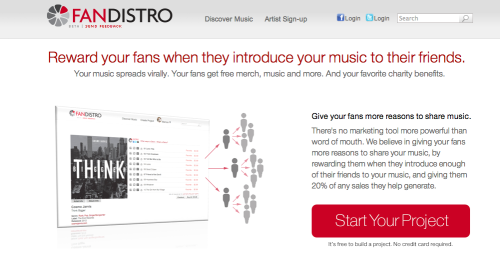
FanDistro image
#3 Create a FanDistro project to help charities & reward your fans.

FanDistro is another favourite. After creating your project page and sending it out to your fans, each fan receives a unique link, which they can send to their friends. If their friends then share your music or buy any of your products, they are rewarded with free merch and 20% of the sales go to a charity in the fan’s name. FanDistro is a brilliant way of increasing your social media engagement – artists like Cosmo Jarvis generated ~19 new fans for each fan who shared his music on the site!

#4 Build an app for your music with BandApp.
Created by Adam Perry, BandApp is a great platform for getting a free mobile app for your band.

#5 Upload your music to Soundcloud.
Soundcloud is arguably one of the best sites to host your music on, especially now that they’ve announced heavy integration with many of Google’s services. If you haven’t already, upload your music on Soundcloud, tag it well, and encourage fans to leave comments on the tracks.

Read the rest of Marcus' list on Music Think Tank. Many are UK-centric, but there's still lots of great ideas if you don't reside there.
----------------------------------

Follow me on Forbes for some insights on the new music business.

You should follow me on Twitter for daily news and updates on production and the music business.

Check out my Big Picture blog for discussion on common music, engineering and production tips and tricks.

Tuesday, August 20, 2013

Top Concert Draws

Pollstar logo image
Here are the top concert draws as of last week, courtesy of Pollstar. The list indicates this weeks ranking, last week's ranking in parenthesis, total revenue, and average ticket price in the last column.

There are a couple of things to note here. First of all, most of the acts are decidedly "old school," although Taylor Swift, Justin Bieber and Bruno Mars are strong. Secondly, the prices for the country artists are very reasonable, costing between $31 and $40, although Bad Company/Lynyrd Skynyrd and Styx/REO Speedwagon/Ted Nugent are reasonable as well.

1. (1) The Rolling Stones; $7,772,849;                                    $345.49.
2. (New) Paul McCartney; $3,620,049;                                    $131.27.
3. (2) Taylor Swift; $3,021,717;                                                  $86.51.
4. (3) Kenny Chesney; $2,246,701;                                           $75.53.
5. (4) Fleetwood Mac; $1,427,403;                                             $110.90.
6. (New) Phish; $1,391,413;                                                         $48.76.
7. (5) Justin Bieber; $1,267,409;                                                  $80.71.
8. (6) Dave Matthews Band; $1,134,333;                                   $55.10.
9. (8) Bruno Mars; $1,029,608;                                                     $71.36.
10. (9) New Kids On The Block; $830,439;                                $65.06.
11. (New) Blake Shelton; $672,657;                                           $32.24.
12. (10) Tim McGraw; $586,428;                                                  $38.25.
13. (11) Brad Paisley; $569,683;                                                  $36.13.
14. (New) Rascal Flatts; $567,025;                                              $40.02.
15. (12) Carrie Underwood; $527,808;                                        $70.00.
16. (14) Barry Manilow; $377,596;                                                $67.98.
17. (13) Widespread Panic; $376,122;                                         $47.11.
18. (16) Bad Company / Lynyrd Skynyrd; $311,304;                  $31.44.
19. (17) The Postal Service; $249,253;                                         $41.27.
20. (18) Styx / REO Speedwagon / Ted Nugent; $225,939;       $35.27.
----------------------------------

Follow me on Forbes for some insights on the new music business.

You should follow me on Twitter for daily news and updates on production and the music business.

Check out my Big Picture blog for discussion on common music, engineering and production tips and tricks.

LinkWithin

Related Posts Plugin for WordPress, Blogger...