Thursday, August 16, 2012

Radio Still Tops In Music Discovery

radio image from Bobby Owsinski's Music 3.0 music industry blog
Yesterday I looked at the portion of Nielsen's latest Music 360 survey that pertains to CDs. Today we'll look at some of the other sections.

The one that intrigued me almost as much as teens listening to CDs is how much people still use normal terrestrial radio. According to Nielsen:
  • 48% discover music most often through radio
  • 10% discover music most often through friends or relatives
  • 7% discover music most often through YouTube
Radio is supposed to be dying, but you wouldn't know that looking at the info outlined here. If we go even further into the data and look at teens:
  • 64% of teens listen to music through YouTube
  • 56% of teens listen to music through radio
  • 53% of teens listen to music through iTunes
  • 50% of teens listen to music through CD
There's that radio thingy again. Conventional wisdom says it's not supposed to be that high, especially with teens, but apparently it's not dead yet. But there's more:
  • 54% have music player apps on their smartphones
  • 47% have radio apps on their smartphones
  • 26% have music store apps on their smartphones
What I'm surprised about here is that the numbers are so low. I would've expected entertainment apps to be closer to 100%.

There's some other fascinating info that can be gleaned from the survey.
  • 38% of males purchase rock most often (no surprise here)
  • 15% of females (compared to 9% of males) purchase top 40 most often (much lower than I thought)
  • 33% of teens purchased a digital track within a week of release (lower than it once was)
  • 21% of persons 18+ purchased a digital track within a week of release
  • 7% of 18 to 24 year olds attend a music event once a week (that's a lot lower than it used to be)
  • 30% of 18 to 24 year olds attend a music event once a month
What's most interesting in all this data is that people's listening and purchasing habits have changed in some ways and not much in others. CDs and radio are still in widespread use, but the overall enthusiasm for consuming music seems to be down. What this shows is that uur Music 3.0 world continues to be full of surprises.

-----------------------------------
You should follow me on Twitter for daily news and updates on production and the music business.

Check out my Big Picture blog for discussion on common music, engineering and production tips and tricks.

Wednesday, August 15, 2012

CDs Still Important States New Study

Nielsen logo graphic from Bobby Owsinski's Music 3.0 music industry blog
Nielsen Research just came out with its yearly Nielsen Music 360 study, and like every year, it provides an interesting overview of the music world we live in. That said, it also provides a different look at reality of the music world we live in than we're led to believe.

You're going to see different parts of the study cited in the news in coming days, but I bet that most will overlook something that screamed out to me - CDs are much more relevant than most of the world thinks.

Let me say up front that I don't use optical discs of any kind and haven't for at least a year, so I have no love for the shiny pieces of plastic, but the fact of the matter is that there are a lot of people out there that still use them regularly, according to Nielsen. Here's an example from the study:
  • 50% of teens still listen to music on CD.
Now it's also true that 64% of teens listen to music on YouTube, 56% on radio, and 53% on iTunes, but who would've thought that the number for CDs would be so high? If you listen to the media, you'd think that any kid that still listens to CDs is stuck in the back woods of Appalachia. still has a black and white television and only gets power for 4 hours a day. But the problem is that the media sometimes confuses the kids of Silicon Valley with the kids everywhere else, and let's face it, there's just no comparison.

Want some other figures that may blow your mind?
  • 36% of teens purchased a CD last year. 
Now it's also true that 51% purchased some sort of download, but once again, most media savvy people wouldn't in a thousand years expect the CD purchase figure to be that high.

How about this one:
  • 55% identified physical CDs as a very or fairly good value.
Once again, this was beaten by digital albums (63%) and digital singles (61%), but who would've thought that the CD would be anywhere near those on the chart?

This all goes to show that while the CD may a medium in a death spiral, it's a not buried just yet. It's much more viable as a distribution medium than we're all led to believe.

Tomorrow I'll provide some other interesting info from the same survey.

-----------------------------------
You should follow me on Twitter for daily news and updates on production and the music business.

Check out my Big Picture blog for discussion on common music, engineering and production tips and tricks.

Tuesday, August 14, 2012

Music Sales Needed For Minium Wage

A few years ago there was an interesting infographic that floated around the Internet regarding the number of sales of various music products in order for an artist to make the US minimum wage of  $1,160 per month. Based on an analysis of attorney Steve Gordon, the chart has been updated for 2012, and the good news is that there's more potential income streams than ever. The bad news is that the magic number isn't any easier to attain if you're in DIY mode.

Take a look.


If you take notice, you need a large number of streams on Spotify to make money as an indie, but it's almost impossible if you're on a major label, since they take most of the income. That sounds pretty bad, but the reality is that if you're getting a huge number of plays and you're on a major, then you're probably touring and making money that way. As is the premise of the Music 3.0 strategy, your music is your marketing.

-----------------------------------
You should follow me on Twitter for daily news and updates on production and the music business.

Check out my Big Picture blog for discussion on common music, engineering and production tips and tricks.

Monday, August 13, 2012

Beck Releases New Album Only On Sheetmusic

Beck image from Bobby Owsinski's Music 3.0 music industry blog
Alternative artist Beck Hansen, who the world knows as just plain "Beck," has just come out with a new album that uses an "innovative" delivery platform - sheet music.

Yes, some clever publicist somehow has spun this to be a "genius" move that only the clever Beck would come up with, but I guess they never checked out the fact that sheet music has been available for every release by a popular artist going back to about 1900.

So the idea here is that if the album is not available on CD, digital, vinyl, etc., and only via hardcopy sheet music, is that it won't be pirated. Did Beck's management never hear of or use a copier or scanner? Granted, this is all a pretty good PR trick because it's gotten a lot of people talking about it, but I'm not sure why.

My question is, how will people hear about the album if they can't hear it? Yes, it's getting some publicity, but it can't be nearly enough. And what about the people that aren't musicians, or are musicians but can't read music (there are a lot out there)?

In all seriousness, his album Song Reader will be available in 20 full color booklets, one for each song, in a hard cover. The one interesting aspect is that the publisher Faber and Faber is encouraging fans to post their recorded versions online.

-----------------------------------
You should follow me on Twitter for daily news and updates on production and the music business.

Check out my Big Picture blog for discussion on common music, engineering and production tips and tricks.

Sunday, August 12, 2012

The Part Of Your Fanbase That Will Pay

Pareto Principle image from Bobby Owsinski's Music 3.0 blog
I've written about this before both here and in my Music 3.0 Internet Music Guidebook, but thought it was worthy of revisiting again.

There's a common rule-of-thumb in business that states that 80 percent of your business comes from 20 percent of your customers (actually called the Pareto Principle). This usually rings true in that in most businesses you have you major customers who bring in most of your revenue, and all your other customers that supplies the rest. If you're in a subscription or mass marketing business where your collecting funds from thousands or even millions of customers (like online), you can still break it down to 80/20 where 80 percent of your business comes from a certain category of users.

The music business was always thought to work on the 80/20 rule as well, but lately there's been a general change of outlook about those numbers. In fact, many music marketers now feel that 90 percent of an artist's income (especially an indie artist) comes from only 10 percent of their fans.

The thinking in the 90/10 rule is that superfans (sometimes called uber-fans or your "tribe") are so passionate that they're purchase just about anything the artist offers for sale, and as a result the income is skewed more heavily in their direction than in other businesses.

There's at least some empirical evidence that 90/10 is indeed true, which means that for an artist to really break big, he has to move those numbers closer to the traditional 80/20 split. A superstar artist has to move those numbers even more. This is how it breaks out:

INDIE NICHE ARTIST
90% - income from tribe/superfan/uberfan (and anything else you want to call them)
10% - income from casual fans

MASS MARKET ARTIST
80% - income from tribe/superfan/uberfan
20% - income from casual fans

SUPERSTAR ARTIST
less than 80% - income from tribe/superfan/uberfan
more than 20% - income from casual fans

Once an artist establishes himself with a fanbase, regardless how small, the marketing goal from that point is always trying to move the 90/10 split closer to 50/50.
-----------------------------------
You should follow me on Twitter for daily news and updates on production and the music business.

Check out my Big Picture blog for discussion on common music, engineering and production tips and tricks.

Thursday, August 9, 2012

Warner Music Loss Down Thanks To Digital Sales

Warner Music Group logo image from Bobby Owsinski's Music 3.0 production blog
Warner Music Group's 3rd quarter report is out, and if you look at it closely, it really is a indicator to the trends of the music business today. Here's what we discovered:
  • Warner's loses were $32 million, which were down from $46 million last year at this time. This is considered a positive somehow, which is the crazy world of publicly traded companies for you. It always amazes me when a company gets hammered for having only a 14% increase rather than the predicted 15%, and this is much the same. WMG is still losing money, and even though it lost "only" $32 mil, that's not that great when you factor in that there was actually a $11 million tax benefit figured in.
  • Total revenue decreased about 5% to $654 million, and much of that they attribute to an unfavorable exchange rate. 
  • Recorded music sales slipped 8.4%, and publishing revue also slipped from from $97 to 84 million.
Now for the good news:
  • Digital music revenue climbed 13% to $230 million and represented about 35% of WMG's income.
  • 25% of the digital revenue came from streaming, which amounted to $54 million, or about 8% of total revenue.
  • Domestic revenue was up slightly to $282 million from $276, mostly on the basis of hit records by Jason Mraz, Lincoln Park and B.O.B.
If you want to see exactly how their revenues break down, Digital Music News did a nice graphics below.
Typical major label income split image from Bobby Owsinski's Music 3.0 blog


What does this tell us? Major record labels are sinking, but very slowly as they hold their own, at least for now. Digital music income may be rising, but it's not going to replace the sales of physical product, and streaming music makes the situation even worse, as that doesn't replace the income from digital downloads. Oh, and the most important piece of the puzzle - you still need hits to make money.

If you're from the musical old school, you're probably lamenting the fact that the business model is changing from the way it previously worked. If you're not tied to that paradigm, you're embracing the change, as a new business model will have to replace the old one at some point. None of us know what that that is at the moment, but we're all on the lookout for it. When you find it, let me know, please.
-----------------------------------
You should follow me on Twitter for daily news and updates on production and the music business.

Check out my Big Picture blog for discussion on common music, engineering and production tips and tricks.

Wednesday, August 8, 2012

Artists Warming To Facebook Timeline

Facebook Timeline image from Bobby Owsinski's Music 3.0 music industry blog
In a study conducted by ReverbNation and Hypebot, it seems that artists and bands have a more positive opinion of Facebook's much maligned Timeline after using it for a bit. Here's what they found:
  • 30 days after release, only 39% of artists would give Timeline a Like. After 90 days, that figure increased to 45%.
  • 62% said that Timeline makes it easier to share videos and photos.
  • 55% say that Timeline is better at publicizing shows.
  • 54% say that Timeline is better at sharing music.
  • 49.5% say that Timeline is just as good or better at growing their fanbase.
  • 49% say that Timeline has helped their fan engagement.
  • 68% are getting more likes since the switch.
  • 61% thing that their "People talking about this" stats are better after the change.
  • Only 15% say they have more comments since the introduction of Timeline.
  • Only 17.6% are noticing more Shares.
It seems that the more artists live with Timeline, the more they like it. What do you think?

-----------------------------------
You should follow me on Twitter for daily news and updates on production and the music business.

Check out my Big Picture blog for discussion on common music, engineering and production tips and tricks.

Tuesday, August 7, 2012

Online Music Store Differences

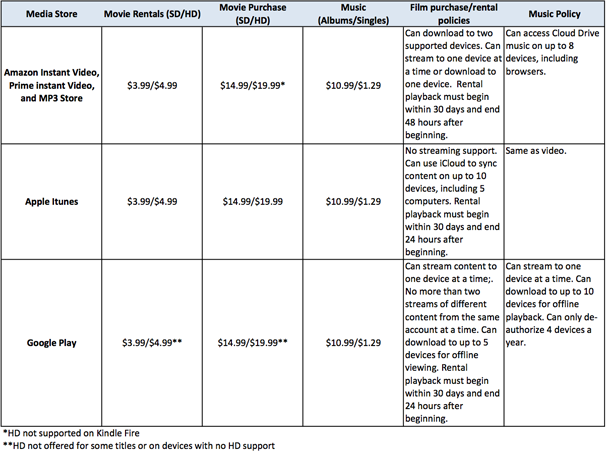
It seems like every year we look at the differences between the big 3 music stores of Amazon MP3, Google Play and iTunes, and every year they're the same in some ways, and different in others. While subscription streaming music is trending in an upward direction, it's nowhere near critical mass yet, so buying downloads is still a big business. PC World recently ran a great article regarding the latest state of the download content business and below you'll find the salient points of the post.
  • Tablets now allow new access to the online music stores, with the Nexus Q and Android tablet providing direct access to a Google Play stream, Kindle Fire to Amazon's music and video stores, and of course, and the iPad for Apple's iTunes.
  • All stores have lots of content. iTunes now has over 28 million songs, Amazon hosts more than 20 million, and Google Play isn't saying exactly, but it's plenty more than you can listen to in a lifetime.
  • The pricing really varies. Current songs and movies are pretty much the same across all 3, but catalog in both music and video varies.
  • The real differences between them all is in the video offerings. Each service has a different idea of what the pricing and features model should be, with rentals and HD offerings differing.
Check out this chart for some clarity.
Online Media Store Comparison image from Bobby Owsinski's Music 3.0 blog

The article goes into detail on some of the differences, especially on the video side, so be sure to take a look if that's important to you.


-----------------------------------
You should follow me on Twitter for daily news and updates on production and the music business.

Check out my Big Picture blog for discussion on common music, engineering and production tips and tricks.


Monday, August 6, 2012

11 YouTube Tips From The Pros

YouTube logo image from Bobby Owsinski's Music 3.0 music industry blog
RealSeo just ran a great post about 11 YouTube mistakes and tips from some of the most successful video makers on the service. You can read the entire article here, but below I've condensed it to just the main points.

1. Have a main channel.

2. Make your vlogging channel unique so you stand out from other vloggers.

3. Try humor to keep your viewer's interest.

4. Don't steal or copy other people's tags, descriptions or titles for your video.

5. Don't keep putting up videos when your not getting views. Find out why they're not connecting, or collaborate with someone with more subscribers.

6. Don't try to be someone else. Originality is important.

7. Don't forget to add hyperlinks in the description box.

8. Don't make things too long.

9. Don't forget to have a Subscribe button at the end.

10. Don't do something just because you think it might get views. Do content that you care about.

11. Don't forget to watch other videos for inspiration and tips.

These are all pretty common sense tips, and a number of them I've already touched on in previous posts. Keep in mind that they're all from people who've had much success on YouTube, so they're worth some consideration.

-----------------------------------
You should follow me on Twitter for daily news and updates on production and the music business.

Check out my Big Picture blog for discussion on common music, engineering and production tips and tricks.

Sunday, August 5, 2012

The 3 Pillars Of A Successful Brand

Brand image from Bobby Owsinski's Music 3.0 music industry blog
I've discussed branding a lot here and in my Music 3.0 Internet Music guidebook, and I've found that the thought of it either intrigues or appalls most artists. One of the problems with the process of branding is that by being such an obvious goal, it can feel like a sell-out. That very well may be true in some cases were the branding is created more for manipulation than for overall promotional strategy, but it is a new fact of life in the current music business that everything is based upon brands.

The problem is that whether you like it or not, if you're an artist you're already a brand. It may not be a strong brand, but then again, it very well may have become just that without any thought or effort on your part. What I want to outline here is exactly what a brand is and how it's created.

First of all, what exactly is a brand? In all situations, it's a promise of quality and consistency. For McDonalds, that means that anywhere in the world you can easily recognize a franchise, and a Big Mac will taste the same. For an artist, that means the sound and feel of their music and their image will retain the same familiarity. Madonna changed her style in clothing and music over the years yet her sound and image has always been relatively the same. The same goes for The Beatles or any of the legacy acts that have lasted 20+ years.

So what are the pillars of building the brand? There are 3:

Familiarity: You can't have a brand unless your followers or potential followers are familiar enough with who you are. They don't even have to know what you sound like to be interested if you have enough buzz and they've heard about you enough to want to check you out.

Likeability: Your followers have to like you or something about you. It could be your music, or it could be your attitude or your image. You could even say how much you hate your fans and do everything to ridicule them, and that could be the thing they like about you. It doesn't matter what it is, but there has to be something.

Similarity: Your fans have to feel that either you represent them either in a cause or movement (like a new genre of music), or that they can be you someday. Female Olympic athletes usually don't do well in this category because their sleek and muscular look is so far beyond what the ordinary girl or women can attain that they can't relate to them. On the other hand, young girls love Taylor Swift because they feel that she could be their best friend from next door.

If you have those three things along with consistent quality product (which hopefully is your music), you've got a brand. I wouldn't intentionally try to manufacture your brand so it absolutely complies with these pillars (people usually see right through that), but always keep these things in mind that this is how your audience looks at you, although none of them may even know it.
-----------------------------------
You should follow me on Twitter for daily news and updates on production and the music business.

Check out my Big Picture blog for discussion on common music, engineering and production tips and tricks.
Thursday, August 2, 2012

Amazon Cloud Player Now Does Song Matches

Amazon MP3 logo from Bobby Owsinski's Big Picture music production blog
Talk about a long time coming. Amazon recently updated their Cloud Player music service so it now has a function similar to iTunes Match where it scans your computer to match the songs in a master database. This allows you to listen to your songs on multiple devices without having the laborious task of uploading them to every one.

The only trouble was that iTunes had this over a year ago.

Here's the problem. A feature like this requires a new license from the record labels, which Apple was way ahead of the curve to get. Amazon had a long tough negotiation after the fact, since the labels felt that they could get a better deal than they got from Apple. So now that just leaves Google's music service on the outside looking in, but chances aren't good that will happen, since the majors don't feel that Google does enough to prevent piracy to begin with.

The new Amazon Cloud Player is available in two tiers; 250 songs stored for free, or up to 250,000 for $24.99 a year. The trick is that anything bought from the Amazon store isn't counted in those numbers, and even if you purchased a song at a lower fidelity, all songs are now available at 256kb per second. And the catch? - it won't upload anything with copy protection, which includes just about everything from the iTunes store prior to 2009.

Catch 2 - If you have more than 250 songs already uploaded and he opt for the free version, it will delete any songs above the limite, although you can reimport them when you upgrade. Catch 3 - Amazon has now separated Cloud Music from their Cloud Drive service, so they're now separate subscriptions. That means that you can't store your files along with your music on a single cloud area.

Oh, and there's a catch if you're an artist waiting for a payday thanks to the new license fees extracted from Amazon. Forget about it, since you'll see pennies on the dollar. Most of licensing money goes directly to the labels bottom line and not the artist's.
-----------------------------------
You should follow me on Twitter for daily news and updates on production and the music business.

Check out my Big Picture blog for discussion on common music, engineering and production tips and tricks.

Wednesday, August 1, 2012

The State Of Music Then, Now And Tomorrow

If a picture is worth a thousand words, the following graphic from theoatmeal.com is worth 10's of thousands, as it illustrates the music business of yesterday, now and tomorrow so perfectly.

Music business of the past image from Bobby Owsinski's Music 3.0 blog

Music business in 1999 image from Bobby Owsinski's Music 3.0 blog

Music business now image from Bobby Owsinski's Music 3.0 blog
Music business of the future image from Bobby Owsinski's Music 3.0 blog

-----------------------------------
You should follow me on Twitter for daily news and updates on production and the music business.

Check out my Big Picture blog for discussion on common music, engineering and production tips and tricks.

LinkWithin

Related Posts Plugin for WordPress, Blogger...