Showing posts with label iTunes. Show all posts

Thursday, April 28, 2016

Your Cover Songs May Not Be Streamed

Cover songs might not be streamed imageDoing a great cover version of a hit song has been a successful tactic in helping to raise the visibility of an artist or band for some time, but that practice may soon come to an end thanks to new efforts by iTunes, Spotify and other streaming services.

More and more, digital streaming services are either hiding or removing cover songs, sound-alikes, re-recorded songs and live performances in an effort to simply their catalogs and make it easier for users to find the song they really want.

And they have a point. Searching for a popular song sometimes turns up more than 50 choices, making it difficult to find the original that you're looking for.

The problem is that there are many unintended policies that come with this editorial decision.

For instance, it's been reported by Billboard that one service's "blacklist" of recordings that include 400 artists that range from B.B. King, Frank Sinatra, John Coltrane and Pete Seeger.

Re-records, the practice of an artist or band re-recording one of their hits so they own the recording instead of the record label, are also frequently marginalized as well, although many fans aren't all that unhappy as most prefer the original versions.

So beware if you're recording a cover song in the hopes of gaining some extra streams. While the practice may still work on YouTube, chances are your cover won't see the light of day on the other streaming services from now on.

Wednesday, October 7, 2015

Which Gets The Most Google Searches: Apple Music Or Spotify?

One way to measure the popularity of just about anything these days is the number of Google searches the topic has.

Music Business Worldwide looked at the number of searches for Spotify and Apple Music and found that Spotify beats Apple Music handily.

Except for a sharp spike around the time it was launched, Spotify (the blue line on the chart) has far more searches on a continuing basis than Apple Music (the red line).

That said, iTunes (the yellow line) beats them both, showing that the service still has plenty of life left.

Streaming Google Search Comparison image

Keep in mind that Apple Music is only 4 months old, and rumor has it that Apple is gearing up for a massive holiday ad blitz, which should raise the service's visibility significantly.

Monday, August 10, 2015

Apple Music Up To 11 Million Users

Apple Music image
The initial figures are in and after about a month, the number of Apple Music subscribers is up to 11 million, according to Apple.

While this may seem like a prodigious start to the service, that figure may be moot since all users are still within the 90 day trial period. The number that actually sign up for service after the trial ends will determine its success.

That said, industry insiders predict that the service will end up with around 20 million paying customers by the end of the year by virtue of the fact that iTunes already has 850 million accounts, complete with credit cards, and many of these are fans that automatically sign on to the latest offerings from the company.

Another reason is that Apple makes the service difficult to miss, as it's registration is front and center upon an operating system update if you've not already subscribed.

Apple Music's $15 a month Family Plan may be its greatest feature however, and while no official figures have been given, it's been reported that around 2 million have already signed up. The Family Plan provides separate accounts for up to 6 family members under the same $15 per month fee.

All that being said, Spotify continues to roll along with 75 million users, 20 million of which subscribe to the $9.95 per month premium tier.

Can Apple Music get people to change from Spotify or any of the other services? Industry pundits say that's difficult, as once a user has made a choice of services they're not likely to try another. Apple Music offers features the like Beats 1 global radio station that other services don't have though, so the logic of the past doesn't necessarily apply going forward.

Friday, June 12, 2015

Like A Coiled Snake Spotify Strikes Back At Apple Music

Beware of Spotify image
If you thought it was a coincidence that Spotify released new and much improved subscriber numbers directly after the big Apple Music announcement at its World Wide Developer Conference, then you haven’t been paying attention to what many are calling the “Streaming Wars.”

At least in the short term, Spotify is still the market leader in the interactive music streaming space, and the company did its best to put an exclamation point on that fact by providing a lot of new information, strategically waiting a day for the Apple Music furor to die down a bit to steal a little thunder for itself.

At the end of last year, the company touted 60 million total subscribers, with 15 million of them paying the going rate of $9.99. That number far outpaced its closest rival in Deezer, with only 6 million paid subscriptions, and others like Rdio and Tidal that fall below the 1 million mark.

But Spotify’s new user numbers show a striking increase in a short time, with the company announcing it now has 75 million users, of which 20 million are now paid subscribers. This makes the company a major player even when compared to the non-interactive streaming side of things, as Pandora only sports 79 million total users, with the vast majority of those using the free tier. 

While user numbers are solid proof of growth, another part of the same announcement may be even more important. The company also reported another round of funding for $526 million, which places its valuation at around $8.53 billion (keep in mind that it has yet to turn a profit). 

Among the partners that invested in this round include Swedish telecommunications firm TeliaSonara AB and Abu Dhabi’s sovereign wealth-fund, so there are some deep pockets with a large stake in the company’s success. Read more on Forbes.

Tuesday, June 9, 2015

Apple Music Just Might Prove Skeptics Wrong

Apple Music image
There have been plenty of naysayers willing to condemn Apple’s new Apple Music service before it was even launched, but they might just have to take back their words if today’s presentation outlining the service was any indication.

It’s certainly true that Apple has fallen behind its competition when it comes to music streaming, and that Apple Radio wasn’t the resounding success that everyone anticipated. It’s also true that Beats Music, which the company paid a bundle for last year, wasn’t exactly setting the world on fire and quite possibly wouldn’t even be around today had Apple not thrown it a life preserver.

Then there’s the fact that while Apple touts 850 million credit cards on file for iTunes, more of them apply to the app side of the store than music, making the number slightly dubious when anticipating subscriber numbers.

All of that could lead you to believe that Apple Music could easily come and go after the initial wave of enthusiasm from today’s announcement died down.

If you watched today’s presentation however, it was readily apparent that there were a number of features shown that differentiate Apple Music from the competition, any one of which could make a big enough difference to help it dominate the industry in no time.

First and most important is its ease of use. Apple Music appears to be very easy to navigate, with My Music, For You and New tabs designed to help you negotiate the music that you’ve already purchased, find recommendations based on your previous playlists or listening trends, and discover recently released music. A mini-player complete with artwork also provides easy to access control of the music being played as well, and a playlist function makes it easy to add your own graphics, reorder songs in the list, and search the library to find additional music. Read more on Forbes.


Thursday, April 9, 2015

Apple's New Streaming Service May Have A Rough Start In Europe

Apple Beats image
Regulators in the European Union may throw a roadblock into Apple's upcoming launch of its new streaming music service.

Reports from both the New York Times and Wall Street Journal have sited multiple sources that say that the computer giant is increasingly under examination in Europe in its dealing with record labels. As a result, EU regulators have sent questionnaires to major labels and other streaming services regarding their dealings with Apple.

The supposition is that the tech giant hasn't been entirely truthful with the record labels in the past and regulators want to get to the reality of the situation before the new streaming service is launched. The streaming network is expected to be part of iTunes and is based upon the infrastructure of Beats Music, which Apple purchased last year.

There have been reports that Apple has been pushing the labels hard for a new deal that would enable the company to lower the monthly subscription rate for the upcoming service from the industry standard $9.95 per month to $7.95.

While $4.95 is thought to be the pricing sweet spot, major label licensing deals have made that price point impossible except for limited feature tiers or introductory pricing. Read more on Forbes.

You should follow me on Forbes for some insights on the new music business, Twitter and Facebook for daily news and updates on production and the music business.

Wednesday, March 4, 2015

U2's iTunes Stunt Actually Worked

U2 Songs of Innocence image
After all the hubbub over the iTunes/U2 album giveaway at the end of last summer has died down, it looks like the promotion actually worked after all.

Research company Kantar found that 24% of all iOS music listeners in the US listened to the band's Songs of Innocence album within 5 months of its release.

In fact, Kantor found that even as recently as January, more than twice the number of people listened to U2 than the current hottest artist on the planet, Taylor Swift.

T he study found that nearly every iOS owner who listened to U2 in that time period listened to at least one song from Songs of Innocence.

A lot of skeptics have since blasted the study as being biased towards English speakers or towards U2, but the fact remains that at the end of the day the giveaway did its job to get the album in front of a very large audience, and much of that audience actually listened. That's all an artist can ask from any promotion.

You should follow me on Forbes for some insights on the new music business, Twitter and Facebook for daily news and updates on production and the music business.

Wednesday, February 25, 2015

Submitting Your Songs To iTunes

iTunes Producer image
If you're an indie artist you know that its possible to submit your songs to many of the digital streaming services like Pandora or Spotify, but that's not possible when it comes to iTunes. The fact of the matter is that many digital services, including iTunes, require either a mid-sized record label or a digital aggregator like CD Baby or Tunecore to submit your songs.

One of the reasons for this is the expense of administering a large number of accounts. There's a cost for the initial setup of the account (which is why an aggregator sometimes charges a setup fee) and most solo artists accounts won't be able to cover that amount during the lifetime of their songs on the service.

Then there's customer service, or the lack thereof. It's expensive to provide and just one call can wipe out any lifetime profits for either the aggregator or the digital service. That's why it's so hard to get someone on the phone at virtually every online company.

iTunes is a special case though, in that it only deals with larger accounts, meaning labels with at least  20 albums or more, or an aggregator. Apple supplies a great submission tool called iTunes Producer that prepares your songs for submission in terms of all the metadata and artwork, but you must be approved by Apple first before the app can connect to the iTunes store.

Let's say you have the prerequisite 20 albums in your catalog and you want to become an approved iTunes label. Apple still requires the following:
  • A UPC code for each album
  • ISRC codes for each song
  • A US Tax ID
  • An iTunes store account with a credit card on file 
Finally, Apple sets a sales threshold for each territory that you must exceed before it pays you, so sometimes you can get paid much faster by using an aggregator.

If you're a solo artist, you're pretty much forced to use a digital aggregator to get your music on iTunes and many other digital services. It's much easier than submitting to each one, as an aggregator is a single submission, but it will cost you either a yearly fee or a percentage of your sales revenue. If you're a label that meets the submission standards, then it's worth it to keep the submissions in house.


You should follow me on Forbes for some insights on the new music business, Twitter and Facebook for daily news and updates on production and the music business.
.

Friday, February 6, 2015

iTunes To Block Sound-Alike Covers

Cover songs image
Many up and coming artists have found cover songs to be the ticket to gaining a larger audience. While this is a tried and proven method on Youtube, taking it to iTunes will no longer receive the same reception. Digital Music News reports that sound-alike cover songs will now be banned from the service.

iTunes is really trying to clean itself up after years of complaints about people buying a song only to find out it's a tribute or cover, or even worse, a cover by the real artist. Many artists re-record a track in order to cut the record company out of the royalty pipeline. It may sound close, but it's not the original and usually you can tell.

The latest iTunes Style Guide (here's a link to the previous one) apparently says that track titles that state "Originally performed by," "In the style of," "Tribute to," or "Cover of" will be automatically rejected. Also, any songs that violate these guidelines that currently are on the library will eventually be taken down.

Karaoke and instrumental versions are the exception, however, as long as they're placed in the correct category.

iTunes will also no longer accept titles that include popular song lyrics either.

This problem is more acute on digital download services where you think you're getting one thing and instead pay for something else. With a streaming service you just move on, trying to find the version that you want, so they don't have the same restrictions in place that iTunes has.

Thursday, January 29, 2015

Apple's New P2P Patent Is A Head Scratcher

P2P Network image
Apple has just been granted a patent that allows users to legally share music and videos with friends by using P2P technology instead of downloading from iTunes. This is curious indeed, considering the considerable resources put behind the tech industry in trying to kill P2P in the past.

Apple claims that this will save bandwidth costs by having users obtain the desired media files from other users, but they'll still receive the necessary licenses separately from Apple. That's actually the interesting part of the patent - decoupling the license from the content. Instead of getting a file from iTunes, users just purchase the license, which requires virtually no bandwidth and drops the delivery costs to almost zero.

While the company takes the stand that this will make piracy less attractive, streaming has already made piracy a non-issue, so it seems like this is a technology that's an answer without a question.

That said, the patent was filed in 2011 when it was a little more relevant than it is now, which goes to show how fast things run in the tech side of the business. Check here for the full patent.

Tuesday, January 13, 2015

A New Twist On Social Concert Apps

wego concerts logo image
There are apps to help you find concerts, there are social apps, and there are dating apps. Most of them cross over a bit, bit they all stay in their particular specialization. So what if you want to go on a date with someone in a low pressure environment? If that's you, then meet Wego Concerts, which arranges a date at a concert you'll both enjoy.

Fans connect to the free services through their Facebook page, and the app then probes your iTunes library to create a musical profile of you to make recommendations to concerts that you'd probably like to see. You have the ability to edit your playlists before anyone else sees them (which can be handy if you're a closet Justin Bieber fan), then you set your dating preferences - male/female, age, etc.

At that point you're able to browse through a range of people in your area with similar musical tastes. Users seeking dates have a heart surround by a pair of headphones so they can be easily identified, but you can look for other like-minded people to share the concert experience as well with no dating in mind.

One interesting thing that the app developers have found is that the romantic connection is deeper if the act they see together isn't that well known.

I'm not sure how they're monetizing this app, but anything that helps people go to shows can only be a good thing.

Thursday, November 20, 2014

Apple Beats/iPhone Bundle Tries To Counter Music Key

Apple Beats image
The Financial Times is reporting that Apple plans to bundle its newly acquired Beats Music service into an upcoming version of iOS, making it instantly available to hundreds of millions of users. This news should come as no great surprise, since the company originally bought Beats with the intention of doing exactly that. What is interesting is the timing of the leak, however.

As I wrote in my last post, a beta version of YouTube’s new Music Key service has just been introduced, and that provides a far greater threat to Apple’s position in the music business than other services like Spotify and Pandora ever will. Considering that YouTube is the number one online source of music consumption, and that Music Key provides audio and video (with no adverts either) as well as the full Google Play library, Apple’s iTunes service faces a clear and present danger of being majorly usurped as far as market share goes.

For Apple, the real threat is that Music Key will hit the market in full stride before it can roll out the next Beats-baked iOS. Guess what? If too many people get a taste of Google’s offering, they’re not coming back to iTunes any time soon.

Apple suddenly finds itself in a dilly of a pickle in that even though it has those reported 800 million credit cards on file and a built in audience in iPhone and iPad users, the music side of the iTunes is shedding sales faster than even CDs. Read more on Forbes.
----------------------------------

Tuesday, November 11, 2014

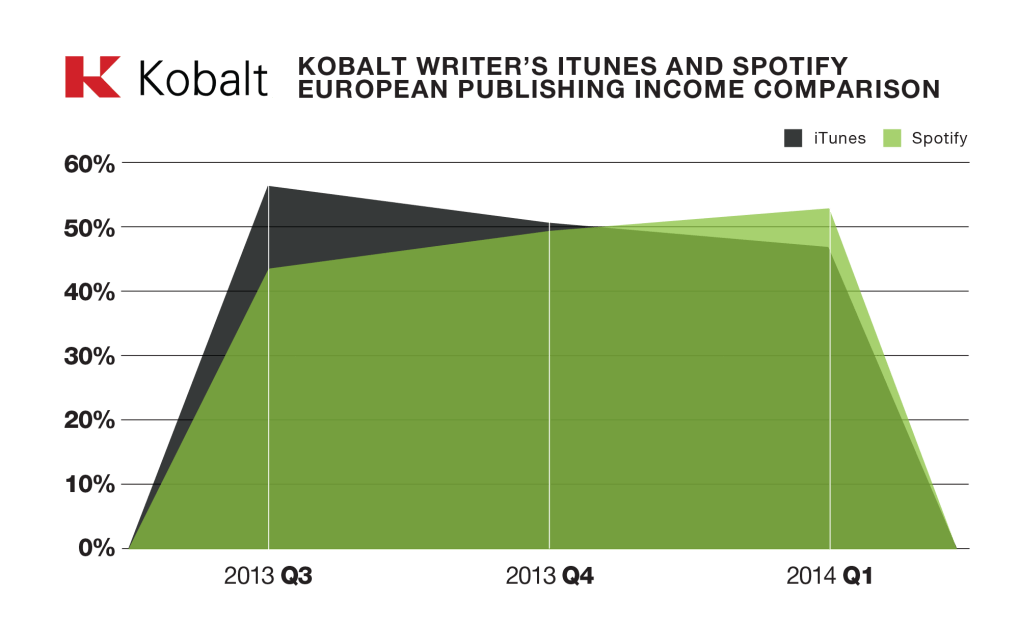
Spotify Royalties Overtake iTunes In Europe

Many high profile artists are railing against the royalty payments provided by Spotify, but it's paying out more and more money every day. In fact, the streaming service has now overtaken iTunes as far as royalty revenue in Europe, according to Kobalt, a company that helps collect music royalties on behalf of artists.

Kobalt has a number of big artists in its stable, including Maroon 5, Lenny Kravit, Dave Grohl, Max Martin, Bob Dylan and many more. The company reports that revenue from Spotify streams were 13% higher than from iTunes last quarter, but it only collects for its artist in Europe.

What's interesting is how fast this has flipped. It was only a year ago that Kobalt found iTunes earnings were 32% higher than Spotify.

People can deny that streaming isn't gaining traction or isn't paying, but the facts say that's definitely not true.

The problem is that many artists aren't seeing these new revenues mostly because of the deals they've struck with their record labels. Labels have always been good at siphoning off money from artist royalties, and even though we're now in the digital age, it seems just as difficult as ever to track.

That said, streaming is coming on strong, and soon it will mean more money for all involved. How much more remains to be seen.

Kobalt iTunes and Spotify income

----------------------------------

Wednesday, October 22, 2014

Apple Asks Labels For Discount

Beats Music image
Artists, bands and songwriters are complaining about what they're making from streaming services, but new negotiations by Apple and the major labels might have a big bearing on future royalties.

While $10 a month seems to be the going rate for most interactive streaming services like Spotify (Pandora charges $5, but it's non-interactive), Apple thinks that's too much. The company would like to lower that to $5 per month for Beats Music, but says it can only do so with a new licensing deal with the majors.

A new economic model could go either way for artists. If subscriptions increase, as analysts (including me) predict, then artists will make more money than they are now, and some cases, a lot more. Apple thinks that a lower price would accelerate growth, but it would also mean that subscriptions would have to at least double to just stay even.

This might sound far-fetched on the surface, but the fact of the matter is that there's only around 20 million paying subscribers globally for all services at the moment, so doubling the growth seems like a no-brainer.

That said, the general thought is that we'll reach 100 million subscribes with a few years anyway, and that's with the current model of $10 per month.

Then again, apple has more than 500 million credit cards on file on their iTunes stores worldwide. It seems like they're pretty sure that they can do some steep conversion at that lower $5 price. Hard to say which is the better way to go right now, but getting the labels to give in on this is certainly going to be an uphill climb.
----------------------------------

Wednesday, October 8, 2014

3 Reasons Why Japan Still Buys CDs

While most of the world is rapidly changing to music streaming there is still one market where where CDs reign supreme - Japan. Indeed the round plastic discs still account for 85% of sales in Japan, while in most of the world the figure hovers around 40%.

That figure, along with pricing restrictions that keep the price of CDs above $20 each, has resulted in Japan being second in total music sales just behind the much larger US. In fact, Tower Records, which closed its stores in the US in 2006, still has 85 outlets there and does nearly $500 million a year in revenue!

But why are CDs still so popular there? There are actually 3 reasons:

1. The Japanese consumer relishes collectibles, which a CD can be classified as. Greatest Hits releases do especially well there because of this fact.

2. Digital music services, especially streaming services, haven't been able to obtain music licenses because Japan's labyrinth of copyrights makes it more difficult than other countries. There's also a reluctance on behalf of the record labels and licensing bodies to grant licenses.

3. The existing digital services don't have the latest hits. Even iTunes doesn't have many of the hits from its competitor Sony.

All that being said, Japan's total music sales were still down by more than 17% last year, and this year doesn't look to be much better, which does not bode well for the music industry in general. While the rest of the world is evolving, Japan still wallows in the past.
----------------------------------

Tuesday, September 23, 2014

Apple Will Kill Off The Beats Music Brand Sooner Or Later

There have been recent conflicting reports that Apple is about to kill off one of it’s most recent acquisitions, the Beats Music service, leaving the tech world to ponder what will eventually happen with the service over the long term. Regardless of which side of the rumors you care to listen to, it’s probably fair to say that at some future date Beats Music as a brand will be no more, although the backbone of the service will still live on.

Apple actually gave us a hint that Beats Music wasn’t exactly a priority when it wasn’t included in the new iOS 8, and was only referred to in passing during the recent iPhone 6 introduction event last week. This was quite curious for a product that seemed to be right in the sweet spot of event.

Actually, retiring the Beats Music brand would strengthen the theory that the acquisition of Beats Electronics/Music was more about getting Jimmy Iovine on board than anything, although the company also got an extremely savvy digital music exec in Ian Rogers, who was CEO of Beats Music and is now in charge of iTunes Radio. There may be more to the acquisition than that simple supposition however.

The Apple sources have been pretty emphatic that regardless of what happens to Beats Music, the company was is not about to abandon the interactive streaming business. That said, Apple has a bit of a conundrum on its hands in that it still wants users to buy songs on iTunes, and it no doubt has promised ongoing support for this to the various record labels as well. Read more on Forbes.
----------------------------------

Sunday, September 21, 2014

Analyzing Apple’s U2 Mistake

U2 in concert image
By now everyone is familiar with the blowback received from the ill-fated U2 album giveaway on iTunes. Apple and the band thought that giving a free album to all iTunes users would be heralded as a huge win, only to find that many of them objected to the album being forced on them, even when it’s by a legendary superstar group like U2. Let’s analyze what’s going on here.

1. People want pull, not push. By and large users of any platform hate to have info pushed to them. Yes, there are exceptions like email and text notifications, but by and large, we hate being shouted at, even if it’s being done electronically. A better strategy in this situation might have been to say, “Here’s the new U2 album. Take it if you want it.” While that wouldn’t have amounted to the same ability to say that it was the biggest album release of all time, it would have alleviated the feeling that people were getting an unwanted musical virus planted on their phone or computer.

2. Downloads are over. When the entire world (except Japan, which is still stuck in the CD world thanks to oppressive laws) is turning to streaming music wholeheartedly, why would Apple hold on to this vestige of the past by thinking that anyone wanted to download an album’s worth of files? Oh, that’s right, the company has this vested interest in downloads by virtue of the fact that the music side of iTunes is still a huge business that features a billion downloads a year. The fact of the matter though is that the company and band could have looked a lot hipper by providing a free 90 day Beats Music account that included a proprietary playlist of the album along, and used the iTunes downloads as a secondary offering.

3. The band isn’t as cool anymore. Let’s face it, they’re all in their 50s, and while they’ve done an admirable job staying relevant far beyond the life span of most artists, to a great number of younger people it’s just, “Who is U2 and why are they sending me their spam music files?” The fact that the song that’s featured in the ad (“The Miracle of Joey Ramone”) is about another dinosaur rocker (although well-deserving) doesn’t help the cause either. Read more on Forbes.
----------------------------------

Monday, August 25, 2014

Analyzing Online Album Buying Patterns

Album Release Buying Patterns image
Fewer and fewer people are buying albums, especially online, but it's still interesting to look at the buying patterns. Global ecommerce company GeoRiot analyzed 500,000 clicks to albums on iTunes and found an interesting trend.
  • 26% of clicks occur before the album release as potential pre-orders.
  • 19% of clicks happen within 24 hours of release.
  • 54% of clicks happen within 2 weeks of release.
  • 20% of clicks happen after the release.
What that means is you have a very short period for potential album sales that's based around the release date in most cases. That's why the new strategy of releasing a digital single every 4 to 8 weeks before the album is released makes much more sense for our Music 4.0 world. That way there are many more events to generate interest, many more opportunities for your fans and listeners to be exposed to the music, and you can still compile them into an album release at the end anyway.

We now live in a singles world and that means our strategy based on the album has to be revamped.
----------------------------------

Monday, August 18, 2014

Using A Single URL for Multiple Landing Pages

As an artist begins to have more widespread success, it's typical to have different landing pages and merch stores for different countries. What can become awkward is that it might not always be easy for someone to find the appropriate country-dedicated URL from your main "xxxx.com" address.

One way around this is to use a service that will is geo-aware enough to serve up multiple landing pages from your main URL and one of the best is smarturl.it.

Smarturl is very versatile, allowing you to assign multiple country landing pages from a single URL, as well as shortcode aliases and real time stats. It does much more though, as you can also use a single URL to access your multiple country-oriented iTunes links and send to multiple devices, and you can also point towards multiple streaming providers.

Smarturl is free, but it does have a premium tier which allows iTunes affiliate tracking and conversion tracking.

Smarturl.it image
SmartUrl.it
----------------------------------

Wednesday, June 25, 2014

Apple Removing Music Download Apps From Its App Store

App Store purchase image
There's something brewing in iTunes land as Apple has removed many of the popular music downloading apps from the iOS App Store, which also includes those from third-party file sharing sites. Users that search for "music download" in the App Store now get a message inviting them to try out iTunes Radio instead. Most apps for streaming music services that don't have a download feature are unaffected, although both Soundcloud and YouTube have also made the blacklist.

The speculation is that there may be an update of both the iTunes Store and App Store coming in preparation for the upcoming iOS 8 operating system, and that Apple wants to pump up its flagging download sales. The new App Store reportedly will employ a new search algorithm, app bundles, and improved discoverability.

But it's not only music apps that have suffered. The App Store has also removed apps that include social sharing and ad watching as well, plus many developers report that Apple has asked them to alter their apps to remove any trace of music downloading.

It looks like the Apple Police are on the march, although that's not always a negative. Both iTunes and the App Store have a low degree of malware as a result, especially compared to other platforms. Let's see how this plays out when iOS 8 launches.
----------------------------------

LinkWithin

Related Posts Plugin for WordPress, Blogger...