Showing posts with label ReverbNation. Show all posts

Friday, August 7, 2015

Muzooka - The One Stop Submission Engine

Muzooka image
It's always been difficult to get new music in front of industry professionals and maybe that's the way it should be in order to keep the quality bar high. That being said, most managers, agents, producers, label execs and producers are daily faced with a heap of email and physical press releases, CDs, videos, links, bios, and anything else trying to get their attention by up and coming artists.

Muzooka, a startup submission engine aiming to make the discovery process easier for both artists and industry pros, wants to change all that.

The beauty is that artists upload their music to the intended pro's account, and then highlight any 10 second clip that they feel will garner attention. The music pro can then sift through numerous submissions quickly without having to go outside to YouTube or Soundcloud, or even listen to a CD.

The platform is gaining some traction with a wide variety of industry pros, such as Epic Records A&R EVP Sha Money, producers Rodney Jerkins and Tony Maserati, and venues like The Basement in Nashville. Radio is also on board with Nashville radio station Lightning 100, and long-time music editor and KCRW radio host Chris Douridas.

The best part of Muzooka is that it's free for both artists and industry pros, unlike other services like Reverbnation and Sonic Bids that offer similar features.

This can definitely be a very cool and helpful service if it catches on industry wide.

Wednesday, August 8, 2012

Artists Warming To Facebook Timeline

Facebook Timeline image from Bobby Owsinski's Music 3.0 music industry blog
In a study conducted by ReverbNation and Hypebot, it seems that artists and bands have a more positive opinion of Facebook's much maligned Timeline after using it for a bit. Here's what they found:
  • 30 days after release, only 39% of artists would give Timeline a Like. After 90 days, that figure increased to 45%.
  • 62% said that Timeline makes it easier to share videos and photos.
  • 55% say that Timeline is better at publicizing shows.
  • 54% say that Timeline is better at sharing music.
  • 49.5% say that Timeline is just as good or better at growing their fanbase.
  • 49% say that Timeline has helped their fan engagement.
  • 68% are getting more likes since the switch.
  • 61% thing that their "People talking about this" stats are better after the change.
  • Only 15% say they have more comments since the introduction of Timeline.
  • Only 17.6% are noticing more Shares.
It seems that the more artists live with Timeline, the more they like it. What do you think?

-----------------------------------
You should follow me on Twitter for daily news and updates on production and the music business.

Check out my Big Picture blog for discussion on common music, engineering and production tips and tricks.

Tuesday, October 11, 2011

9 Steps To Using ReverbNation's Promote It

Brian Hazard recently wrote a great post on Music Think Tank about using ReverbNation's Promote It tool to promote a Depeche Mode song, "But Not Tonight," that he covered on Facebook. The Promote It tool is unique in that it automatically generates dozens of optimized Facebook ads based on past Promote It campaigns, and continually optimizes your campaign based on the performance of those ads. Right now there are two types of campaigns available: you can either promote a song and promote your Facebook page, but soon you’ll also be able to promote  shows as well.

Here are the 9 steps to starting a Promote It campaign that Brian came up with:

"1. Which Song Would You Like to Promote? You should pick one that grabs the listener in the first 5-10 seconds. The song I chose starts right in on the first verse, with no instrumental introduction whatsoever.

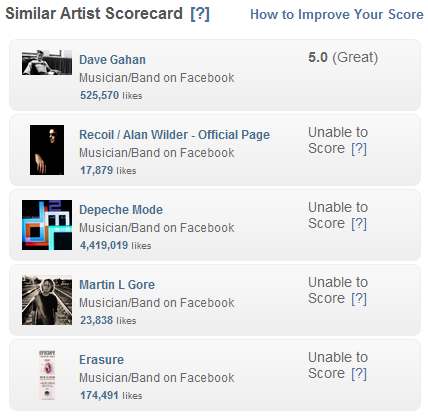
2. Pick 5 Similar Artists. Since I was promoting a Depeche Mode cover song, I picked the band and its members’ solo projects: Dave Gahan (lead singer), Martin L Gore (songwriter), and Alan Wilder (long-departed yet still beloved keyboardist/producer) - plus Erasure, since half of that duo was in the original line-up of DM. The product manager for Promote It told me that artists who have between 50,000 and 500,000 likes work best, and my results bear that out:
Similar Artist Scorecard

The Dave Gahan ads performed so well that they completely crowded out the rest. Perhaps it’s because Depeche Mode has millions of casual fans, but only the most serious ones keep up with the lead singer’s solo work, and are therefore more motivated to check out my cover.

3. Write Ad Text. You can choose to author one of the ads yourself, or let Promote It generate them all. Since my custom ad was outperformed by the auto-generated ads, I won’t bother sharing it with you.

4. Choose Picture. Your choice here can make or break the campaign! My previous campaign was identical to this one, except I used a close-up of yours truly. The results were pathetic. It should come as no surprise that a photo featuring 1) a world-famous band and 2) an attractive female does a better job of catching the eye.

5. Geo-Targeting. Choose between local (your state), national, all English-speaking countries, or global. Theoretically you should get the best results from global, but national did just as well for me in my limited experience.

6-8. Name Your Campaign, Sync with Facebook, Start Date. Pretty much self-explanatory.

9. Budget. Choose between $25, $50, $100, $250, or $500 on a one-time, weekly, or monthly basis. I recommend you experiment with successive $25 campaigns until you find a winning formula, and expand from there.

It seems like the tool really works. Brian's $50 campaign lasted six days and got some impressive results, as you can see from the graphic below:"

This looks like a great tool that's well worth the few bucks that it takes to implement a campaign. Read the rest of the article here.

-----------------------------------

You should follow me on Twitter for daily news and updates on production and the music business.

Check out my Big Picture blog for discussion on common music, engineering and production tips and tricks.

Wednesday, June 29, 2011

The Big List Of DIY Helpers

These days most artists or bands are in DIY mode ("do it yourself") in order to develop an audience, promote themselves and further their careers. Of course, there are a host of services that will gladly help you for a fee, and more seem to be coming online all the time. Some of these services have an advantage or two over the others, but most offer more or less the same services. If you're not happy with the service you're using now, it's pretty easy to find another that might better meet your needs.

Here's a list of the top 30 services, courtesy of Digital Music News:

1. ReverbNation
2. TuneCore
3. CD Baby
4. Topspin
5. Nimbit
6. VibeDeck
7. Bandcamp
8. Bandzoogle
9. FanBridge
10. Sonicbids
11. ArtistData
12. Headliner.fm
13. Soundcloud
14. BFM Digital
15. Zimbalam
16. ONErpm
17. Ditto Music
18. Rebeat Digital
19. Valleyarm
20. Mobile Roadie
21. BlueHaze
22. StageIt
23. ThingLink
24. GigsWiz
25. Slicethepie
26. Sellaband
27. Beta Records
28. Next Big Sound
29. Musicmetric
30. Dropcards
-----------------------------------
Help support this blog. Any purchases made through our Amazon links help support this website with no cost to you.

You should follow me on Twitter for daily news and updates on production and the music business.

Check out my Big Picture blog for daily discussion of music, recording, and production tips and tricks.

Tuesday, April 5, 2011

Does Being Signed To A Label Rock?

A recent ReverbNation and Digital Music News poll revealed that 75% of artists no longer want to be signed to a record label. No surprise there. On March 31st Liz Kennedy, the director of communications for the RIAA (the Record Industry Association of America - the US record record label trade group), posted the following interesting ditty on the RIAA blog about why it "rocks" to be signed to a label.
"So why would an act want to be signed by a music label today?  For starters, the investment associated with developing new talent is substantial. IFPI estimates that music companies internationally invested $4.8 billion in discovering, nurturing and marketing artists in 2010.  Record labels today invest an average of $1 million to break a new pop act in a major market.  That investment supports a variety of production and promotional pursuits that most individual artists would never be able to afford on their own, including advances, recording time, music video creation, tour support and marketing. 
In a world where there are 2.5 million hip-hop and 1.8 million rock acts on MySpace alone, more often than not, the addition of a music label is usually the difference between a band that offers songs to a few devoted fans online, and one who embarks on a multi-city tour, whose music is featured on a hit TV show or commercial and who goes on to earn Gold and Platinum plaques. In a noisy digital music market, it takes a label to help acts stand out in the crowd."
You can read the entire post here, but what's interesting is that it references an interesting study done by the IFPI (the International Federation of the Phonograph Industry - the world wide record label trade group) called Investing In Music that supposedly breaks down the investment that a label makes in a act today.
"Investing in Music outlines the very substantial investments involved in developing and marketing successful artists. In the UK and US, it is estimated that it typically costs more than US$1 million to break a pop artist. This is spread across an advance paid to the artist, recording costs, video production, tour support and promotional work. A typical example of the breakdown of the costs of breaking a new pop act in major markets is as below:
Advance US - $200,000
Recording US - $200,000
3 videos US - $200,000
Tour support US - $100,000
Promotion/marketing US - $300,000
TOTAL US - $1,000,000"
Okay, this is what you expect from record label shills - lots of good news, glowing reports, and big numbers. Unfortunately, the whole thing is based on an alternate reality.

1) First of all, artists don't want to sign deals with labels (especially the majors) because they feel ripped off. You mean you want a piece of my touring and merch sales? And I get exactly what for that?

2) Today's artists feel that they can lay so much of the groundwork themselves, thanks to social media and digital distribution. Why bother with a label that will take most of the money (if there is any) and will most likely ignore you anyway?

3) Those IFPI numbers are totally out date. They may represent a typical signing in years past, but that's not the world we live in today. When was the last time you heard of an artist getting a $200k advance? When was the last time you heard of an artist getting a $200k budget? And tour support? That went away for most signed acts in the 90s. If anything, the promotion and marketing number is low. About 5 years ago it cost $1 million to break an act the traditional way with radio and television. It probably takes more today since those methods aren't nearly as effective anymore. So sure, those $1mil  deals still occur, but they're few and far between these days.

You can poke a lot more holes in both of these posts, but remember this: If you want to break big as an artist, you still need a major label, at least for now. Sorry, it's a fact of life. Look at any chart and see how many artists are indie. Not many. But here's the thing -  if they don't guarantee those big dollars to you, who needs them? You're better off going it alone. Besides, it's still better to build your core audience up slowly but surely, one fan at a time. Always was, always will be.
-----------------------------------

You should follow me on Twitter for daily news and updates on production and the music business.

Check out my Big Picture blog for discussion on common music, engineering and production tips and tricks.

LinkWithin

Related Posts Plugin for WordPress, Blogger...