Monday, July 16, 2012

Louis CK And The Off-Air Radio Game

Local Radio image from Bobby Owsinski's Music 3.0 blog
As I posted a few times before comedian Louis CK does things his own way that many consider cutting edge in terms of marketing and distribution. Recently he embarked on a tour that bypasses ticketing giant Ticketmaster and charged fans a flat rate of $45 for any ticket. Here's a great interview with him posted on AVclub where he discusses the little-known game that radio plays with touring artists in a quid pro quo for promotion.
"I like to try to see if something can work. It’s really satisfying to figure out, “What if we try it this way? What if we made it way more pleasurable and cheaper to come see me? Or to watch my show online? And if we do this right, how much benefit were we getting from the giant companies?” The first time I ever toured in theaters—the first time I toured, really. You do comedy clubs, it’s just working clubs, but the first time I went on a tour in theaters—they were like 500-to-700-seat theaters, my agent asked me some blanket questions, like, “Here’s what’s going to come up,” and he said, “What is your radio tolerance?” That’s what he asked me. He said, “What presence are you willing to let radio people have at your shows?” and I said, “Give me an example.” And he goes, “Well, here’s all the things they will ask for in every city: Thing one is that the radio personality gets to come onstage and introduce the show. And the second thing they’re going to want is a van outside, broadcasting from the show. Then they’re going to want a banner onstage, with the name of the radio on it. Then they’re going to want a table out in the lobby with bumper stickers.”
He just made a list of, “Here’s the things that they will want.” Another one was meet-and-greets. They get to give away tickets, and the DJ introduces you to the contest winners who won the meet-and-greets. Ten minutes with you alone in a room where you take pictures and stuff. So they said, “What of these things are you willing to do?” And I said, “Let’s say no to all of this.” [Laughs.] One hundred percent of it. As a professional courtesy, if a radio DJ wants free tickets, he can come to the show. He can’t come backstage. He certainly can’t come onstage. They may not have their logo on any of the shit on the stage, anywhere near it. I want people to come to the theater and feel like they’re just coming to see this; they’re not being promoted to. I don’t think there’s anything more obnoxious than when someone has paid to be somewhere, to be promoting to them. That they’re paying to be advertised to is really annoying to me.  
I said to him, “Let’s do none of it.” And he said, “Well, here’s the thing: If you let them do these things, then they talk about your show all the time. They talk about your show on the air, and you get more free promotion from radio stations. If they get to say, ‘I’m going to be there,’ they’ll get more into it.” And I said, “Well, first of all, I don’t want people at my shows that are there to see the DJ. I just don’t want them to come.” And I said to my agent, “Let’s find out if this is a huge mistake. Let’s find out. I’m willing to sacrifice my first theater tour and have the places empty and identify that it’s because I wouldn’t let the radio people participate. But we also might find out that it didn’t make a difference and that I never have to do it.” [Laughs.] Because you can’t roll that shit back once you’ve started. Anyway, the obvious story is that it didn’t make a fucking difference. It didn’t matter."
Of course, most artists just trying to make it would gladly do anything radio asked, but does radio really have that much influence these days? The point is, just because something has also been done a certain way, that doesn't mean that it's the right thing in our new Music 3.0 world.

-----------------------------------
You should follow me on Twitter for daily news and updates on production and the music business.

Check out my Big Picture blog for discussion on common music, engineering and production tips and tricks.

Sunday, July 15, 2012

Women Singers Dominate Highest Paid Under 30

Taylor Swift Speak Now cover image from Bobby Owsinski's Music 3.0 blog
Forbes has recently posted their highest paid entertainers under 30 list, and it's probably no surprise that so many women make up the list. The interesting thing is that so many of them are singers. Here's how much person on the list made in the last year.

1. Taylor Swift - $57 million. Her concerts now bring in about a million a night.

2.  Justin Bieber - $55 million. He's also a venture capitalist, with investments in Spotify, Stamped and Tinychat.

3. Rihanna - $53 million. She gets big money from endorsements and sponsorships.

4. Lady Gaga - $52 million. But down from $90 mil last year.

5. Katy Perry - $45 million. Still hot even though her film bombed.

6. Adele - $35 million. 21 is still on the charts and going strong.

7. Kristen Stewart - $34.5 million. Film stars still do make money.

8. Lil Wayne - $27 million. The bulk of his income comes from live shows, earning about $600k per.

9. Taylor Lautner - $26.5 million. Twilight was bigger than we thought.

10. Robert Pattinson - $26.5 million. Again, Twilight was far bigger than we thought.

It should be no surprise that the audience for most of those on the list was teen and pre-teenage girls. What is a surprise is how much spendable cash they have.

-----------------------------------
You should follow me on Twitter for daily news and updates on production and the music business.

Check out my Big Picture blog for discussion on common music, engineering and production tips and tricks.


Thursday, July 12, 2012

Old Records Outselling New For The First Time

Record Store image from Bobby Owsinski's Music 3.0 blog
Here's a twist in music sales that I think everyone saw coming, but didn't want to admit could ever happen. For the first time since Nielsen Soundscan has been keeping track of sales since 1991, older catalog records are outselling current albums. A catalog album is one that was released more than 18 months ago.

Catalog sales were at 76.6 million for the first half of the year, compared to 73.9 million current albums. The top selling catalog items include Guns 'n Roses Greatest Hits, and four by Whitney Houston (no doubt boosted by her untimely death).

There seems to be a couple of reasons for the turnaround:

1) There hasn't been a blockbuster hit by a superstar act during the period (although Adele's 21 still continues to be strong seller, though it was released last year).

2) Record labels and retailers have dropped the prices on catalog items to $4.99 to $7.99. Compared with a current CD price of $13 to $18 and a digital album from $7.99 to $10.99, catalog items are a bargain.

3) The buyers of albums are predominantly older and purchase more albums, especially catalog items.

All this signals an uptick in business for brick and mortar retailers, which is good for the industry. Let's see if this trend continues until the end of the year.

-----------------------------------
You should follow me on Twitter for daily news and updates on production and the music business.

Check out my Big Picture blog for discussion on common music, engineering and production tips and tricks.

Wednesday, July 11, 2012

8 Tips On Formatting Your Sponsorship Proposal

Sponsorship Opportunities image from Bobby Owsinski's Music 3.0 blog
Simon Tam, the owner of Last Stop Booking and author of How To Get Sponsorships and Endorsements recently posted some tips on how to get sponsorships on Music Think Tank. Below you'll find his 8 tips on how to format your proposal.

1. Cover: Make it distinctive. You might consider adding something like “2012 Sponsorship Proposal Prepared Especially For [the company]” with their logo on it. Give them plenty of opportunities to visualize working with you.

2. The Call Out (optional): The second page can be for a large dramatic image/photo or some of the major “bragging rights” stats. Artists can typically use this page as the “one sheet” – a one page descriptor of who you are, major stats or accomplishments, or press excerpts/testimonials from other sponsors.

3. The Partnership: This is where you want to focus on the main benefits for working with your organization. What are the main ways you and the sponsor are a good fit?

4. The Fact Sheet: The nitty-gritty details of your event, tour, or organization that they are sponsoring. Cover all of the major who/what/when/where/why questions, such as as “What is the event?,” “Where does the event take place?,” “Who is involved?,” “Why should I be sponsoring this event,” etc.

5. Key Marketing Information: This is where your research into your industry pays off. You’ll want to talk about your niche market, the demographics of your audience (and who you are targeting), how you will be messaging your brand/event along with their company, and talk about successes with past sponsorship campaigns.

6. Co-Branded Marketing Opportunities: You’ll want to send 3-6 custom, creative pitches to the company that allows for them to visualize working with you. This should play directly off of your niche market/their target audience. The more custom the idea, the higher the asking price that you can fetch. It also helps you stand out from other sponsorship opportunities that only offer logo placement. Marketing folks love creative ways to showcase their brand, especially to an interested audience who they might never be able to reach in any other way. If there is also a “viral” component to one of the ideas, that’s even better.

7. The Benefit List: List all of the benefits that the company gets from sponsoring you. Put your emphasis on the more custom, creative options and less on the generic commodities that typical sponsorship packages offer (such as logo placement). This is your formal offer so make it as clear as possible on what they can be expecting in return from their sponsorship dollars or in-kind gifts. If you’ll accept a payment schedule, include that as well.

8. The Sponsorship Agreement: The sponsorship agreement should be easy to complete and return. Details such as a self-addressed and stamped envelope are good. Add an extra bit of professionalism by having this portion printed on NCR (carbonless copy) paper where they can tear off a copy for themselves and send one to you. You can also do things such as adding a QR code or link to a digital version of the agreement.


Read Simon's entire article at Music Think Tank.

-----------------------------------
You should follow me on Twitter for daily news and updates on production and the music business.

Check out my Big Picture blog for discussion on common music, engineering and production tips and tricks.

Tuesday, July 10, 2012

iTunes Gets Swindled

Jail image from Bobby Owsinski's Music 3.0 blog
We all think of Apple as this monolithic company with high and enclosed electronic walls, far too smart for anyone to scam. Usually that's true, but every once in a while it happens, most recently with the UK iTunes store.

According a story in the The Telegraph, DJ Denver White, an unknown part-time rapper, was sudden selling on the level of a superstar like Madonna, yet without any buzz or visibility. While it's possible for someone to get a street buzz that quickly cascades into major sales, anything resembling that was nowhere to be found, which prompted an investigation.

It turned out to be a very sophisticated scam where gang members with at least 24 laptops along with thousands of stolen credit cards, purchased the music of DJ Denver from both iTunes and Amazon for six months in early 2009, which accrued royalties of nearly $1 million.

What's worse, Denver's songs were uploaded through digital aggregators Tunecore, CD Baby and SongCast, who were unknowingly caught in the operation as well.

The gang members installed a program on the computers called "Hide My IP" which was intended to disguise their location. They then used the stolen credit cards to purchase the music, which then generated a royalty for DJ Denver, which the group then divided.

The fraud was detected when someone at iTunes noticed that a part-time DJ with no marketing or record label affiliation was selling enough to be featured on the high volume sales chart. After some forensic investigation, the police were able to track them through email and Paypal accounts, since the "Hide My IP" software couldn't hide their identity as much as the crooks had hoped.

At that point iTunes stopped paying royalties, so someone named Daniel Thompson began to call Tunecore demanding payment of the outstanding royalties. Tunecore was already in touch with police, so they told Thompson they could only pay that large amount in person for tax reasons, and offered to send him a free airline ticket to come to New York to pick up the royalty check. After Thomspon sent them his address in order to have the tickets sent to his home, the police swooped in. In total, 11 gang members were charged in the crime.

So let that be a lesson. Don't even think about screwing Apple.

-----------------------------------
You should follow me on Twitter for daily news and updates on production and the music business.

Check out my Big Picture blog for discussion on common music, engineering and production tips and tricks.

Monday, July 9, 2012

Chuck D's 5 Tips For Music Industry Survival

Chuck D image from Bobby Owsinski's Music 3.0 blog
Chuck D has been one of the most influential rappers ever, acting as a spokesperson for the state of the urban black man through his powerful lyrics in Public Enemy. In a series of tweets, Chuck lays out his tips for music industry survival. These apply to everyone trying to make it in the business.
Rule #1: Don't let other people's money distort your goals. Their shit has nothing to do with you. Be thankful and work with what you got. 
Rule #2: Don't spend more than you make.What you don't know you'll have to partner up or pay for. What you save is what you make. 
Rule #3: Celebrity and artists are two different things. You can be a celeb, but that's like winning the lottery. Make yourself valuable to something. 
Rule #4: It's easy to make recordings now but learn how to perform your art very well. So well that when people see you they undeniably have no words. 
Rule #5: Always top yourself. Put the AWE in audience. If the crowd feels they can do better than you, why would they take the time and money to be bothered?
Sadly, Public Enemy seems to have fallen out of fashion these days, as boasting about how great you are seems to top social commentary. Still, Chuck's words about the music business are wise and worth taking heed.
-----------------------------------
You should follow me on Twitter for daily news and updates on production and the music business.

Check out my Big Picture blog for discussion on common music, engineering and production tips and tricks.

Sunday, July 8, 2012

New Keyword Research Tools

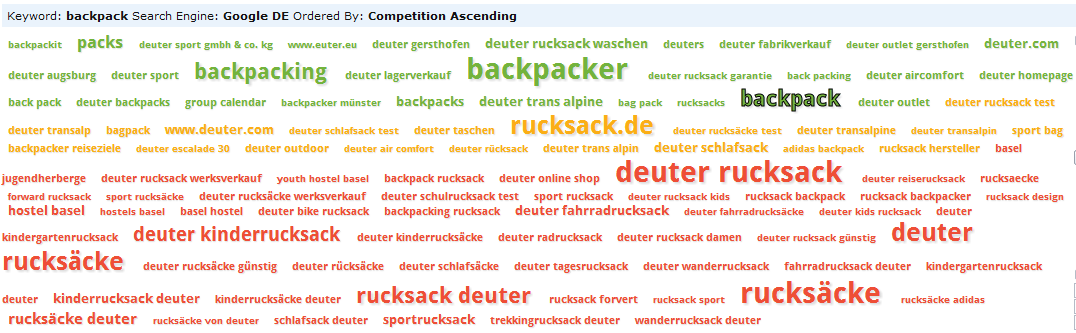
Keyword Eye cloud results image from Bobby Owsinski's Music 3.0 blogSince every artist is an online marketer at heart these days, there's a great awareness in the importance of keywords when it comes to websites, videos and social media. The better your keywords, the more likely people will find you. That's why doing research before settling on a set of keywords is your primary weapon when outlining your online strategy.

While most people usually use Google's Keyword Tool (here are some tips), here are 3 additional tools that you can try. Best of all, they're all either totally or partly free.

KeywordEye.co.uk
While KeywordEye comes from a UK developer and as a result uses British defaults, it doesn't take much to make it more US oriented. In fact, it can give you keywords for several countries and languages if that's needed.

One of the coolest things is that it offers a cloud visualization of the most used keywords (see the graphic on the left). Keep in mind that the free version limits you to 100 keyword searches, which is normally plenty for most music campaigns.

Keyword Spy
Keyword Spy approaches keyword search a little differently than most, allowing you to search a domain for keywords. That means you can look at a competitor's site to easily determine what they're using. There's an "Ads" page that shows you some information about the adverts used on a site, and a "Top List" page provides a list of the most successful keywords.

SEMRush
This tool is really a paid tool that has a useful free option that has the unique ability to provide a metric for the number of Google results. This shows you how big the field or the competition is, as well as a useful section on related keywords.

If you're really serious about keywords and don't mind spending some money, paid services like SpyFu, Wordtracker, Adgooroo, Complete.com, and KeywordDiscovery are all viable options as well.
-----------------------------------
You should follow me on Twitter for daily news and updates on production and the music business.

Check out my Big Picture blog for discussion on common music, engineering and production tips and tricks.

Thursday, July 5, 2012

Music Sales For 2012 Not Pretty

Soundscan image from Bobby Owsinski's Music 3.0 blog
Soundscan released its mid-year music sales report on Wednesday and for the most part, the state of the industry is not pretty.

Album sales are down 3% from last year, but that's not the worry. The biggest seller is still Adele's 21, an album released at the beginning of last year. New albums from superstars like Justin Bieber, Madonna, Bruce Springsteen and Nicki Minaj have yet to make much of a sales dent.

150 million albums have been sold so far this year, behind last years 155 million. Adele's 21 has sold 3.69 million this year and more than 9.4 million in the US since it was released in January of 2011. What's a bit depressing is that 21 is the only album that's cracked the million barrier this year. Lionel Ritchie's Tuskegee is close with 912,000, and the latest boy band sensation One Direction and their Up All Night comes in third at 899,000.

But only 11 albums have gone past 500,000 this year so far, despite all the superstar releases. This is also down from last year when 16 went gold by this time.

Singles are a bright spot, however, as they're up over last year by 6%. The top selling track is Gotye's "Somebody That I Used To Know," with over 5.5 million downloads since the first of the year. fun.'s "We Are Young" is the runner up with 5.09 million sold, with Carly Rae Jepsen's "Call Me Maybe" (which is selling for a quarter on Amazon MP3) coming in third with 4 million downloads.

Even those numbers are down a bit though. In 2012, 47 songs have sold at least a million, while in 2011, 52 songs had reached that point by this time of the year.

Is streaming starting to take it's toll?

-----------------------------------
You should follow me on Twitter for daily news and updates on production and the music business.

Check out my Big Picture blog for discussion on common music, engineering and production tips and tricks.
Wednesday, July 4, 2012

Facebook Loses Active Users

Facebook-unique-visitors-drop image from Bobby Owsinski's Music 3.0 blogIt's been evident that the number of unique visitors on Facebook was leveling off in recent months, but now comes evidence of a significant decline. Via an article on Hypebot, the site analyst company ComScore has determined that the number of unique visitors to Facebook have declined by 4.8% in the last six months!

This is pretty substantial in that Facebook was counting on its subscribers to rise a bit in the US rather than dropping, in order to support its recent IPO and subsequent investors. It's true that its more likely that the company will gain users in other parts of the world (in Asia in particular) as the US market seems somewhat saturated, but a decline of almost 5% is really unexpected.

So what's the reason for the decline? Are the users tiring of the Facebook experience? Do they hate the redesign (especially Timeline)? Are they using another social network instead? Are they still using the network but not loggin in? What do you think?

For the record, Facebook claimed that it has over 900 million "active" users in their last quarterly report. It'll be interesting to see what the next quarter report looks like.

-----------------------------------
You should follow me on Twitter for daily news and updates on production and the music business.

Check out my Big Picture blog for discussion on common music, engineering and production tips and tricks.

Tuesday, July 3, 2012

The Latest "Best Time" To Tweet And Post

Distorted Clock image from Bobby Owsinski's Music 3.0 blog
Sometimes getting solid data about anything online is such a moving target. There's a lot of different studies and none of them may correlate. A new study by the URL shortening service Bit.ly has some new info on the best time to tweet in order to gain more responses, and the best time to post on Facebook in order to get more Likes. Here's what they found:

Twitter
  • The most clickthroughs come between 1 to 3PM EST Monday through Thursday.
  • Not much happens after 8PM weeknights, or 3PM on Friday.
  • The lifetime of a typical tweet is 2.8 hours.
  • Peak traffic time is from 9AM to 3PM EST Monday through Thursday. That doesn't necessarily mean that you'll get more responses, since there's already a lot more competition for attention.

Facebook
  • The highest clickthroughs come at 3PM EST on Wednesday, with links posted from 1 to 4PM getting the highest average clickthroughs.
  • Links after 8PM and before 8AM struggle for attention.
  • Facebook traffic starts at about 9AM, but Bit.ly suggests waiting until 11AM to post.
  • Facebook traffic begins to fade after 4PM.
Now just to show you how some of these studies differ, previous studies by Dan Zarrella and Vitrue have found that the best time for Facebook posts were 8AM, 11AM and 4PM EST, while the best time for tweets is 11AM, 3PM and 8PM EST.


Just to go a bit further, Buddy Media did a study a month earlier and discovered the following about Facebook:
  • Brands that posted outside of business hours had 20% higher engagement than between 10AM and 4PM.
  • Thursday and Friday got the best engagement, while Monday and Saturday had the worst.
  • Posts with questions have a 15% higher engagement rate. A question starting with the word "would" gets the most engagement, followed by "where," "when," and "should." "Why" gets the least engagement.
So like with much of the stats that we see online, you have to take these things with a grain of salt and see what works best for every specific application. The only thing that they all have in common is that posting or tweeting at the top of the hour (i.e. 8AM), is a lot more effective than anything else. At least that's something solid.
-----------------------------------
You should follow me on Twitter for daily news and updates on production and the music business.

Check out my Big Picture blog for discussion on common music, engineering and production tips and tricks.

Monday, July 2, 2012

Beats Buys MOG

Beats - MOG image from Bobby Owsinski's Music 3.0 blog
Here's something I don't think anyone saw coming. Headphone maker Beats Electronics, owned by rap artist/producer Dr. Dre and music exec Jimmy Iovine, has acquired the digital music service MOG Inc. What's particularly interesting is that the purchase price was reportedly "less than $10 million" for a service that has 500,000 registered users. Sounds like a bargain to me.

The deal makes sense at that price since Beats is trying to create an ecosystem built around their headphones. If you have a supply of high-quality tunes to listen to (MOG uses a very good 320kbs codec), that side of the company can feed the headphone side and vice versa. With Iovine being the ultimate music industry insider, any licensing problems should be easy to overcome, especially since both Universal and Sony were owners in MOG (beside 3 venture capital groups).

Beats is an interesting story in that they take some more or less crappy Chinese headphones, jack up the price to way beyond what they're worth, and somehow get people to buy them. It sort of reminds me of Monster Cable, who does the same thing. The company has now taken over more than 43% of the headphone market, I'm sure much to the chagrin of quality headphone manufacturers like Audio Technica, Sennheiser, Shure and others. You snooze you loose, guys.

Let's see if Beats continues with their magic touch as they proceed with MOG in the fold.

-----------------------------------
You should follow me on Twitter for daily news and updates on production and the music business.

Check out my Big Picture blog for discussion on common music, engineering and production tips and tricks.

Sunday, July 1, 2012

The EMI Publishing Deal Is Now Complete

As EMI winds down from being a major record label, thereby taking the number of majors from 4 to 3, the first part of the deal is now complete. An investor group led by Sony/ATV Publishing now brings the famous and powerful EMI Music Publishing under its wing.

The group, which includes the sovereign wealth fund of Abu Dhabi, Jynwel Capital of Hong Kong, Blackstone's GSO Capital Partners, the estate of Michael Jackson and mogul David Geffen, paid $2.2 billion to purchase EMI Publishing, which appears to be a pretty good deal. EMI Publishing has long been considered the jewel of the industry, with a catalog of 1.3 million songs including classics like "Somewhere Over The Rainbow" and "New York, New York," as well as songs by The Beatles, The Police, The Beach Boys, Kenye West, Alica Keys, Justin Beiber and many other superstars.

Terms dictated by the Jackson Estate stipulate that EMI Music Publishing still remains as a separate company, which is all well and good, but it's still under the same conglomerate umbrella.

Isn't this country supposed to have anti-trust laws to prevent major consolidation like this? It's not only a bad idea for one company to have such a large market share (well over 30%), but it's bad for the writers too. With that many songs to administer, it's too easy to fall between the cracks.

This is just another indication of how badly the music business needs a major reset, even more so than we're seeing today.

-----------------------------------
You should follow me on Twitter for daily news and updates on production and the music business.

Check out my Big Picture blog for discussion on common music, engineering and production tips and tricks.

LinkWithin

Related Posts Plugin for WordPress, Blogger...