Thursday, October 13, 2011

4 Steps For Creating A Video Blog Post

video blog image from Bobby Owsinski's Music 3.0 blog
I saw this great article on ReelSEO.com by Nick Stamoulis called "4 Tips For Creating A Video Blog Post," which outlined a number of things to think about when adding a video to your blog post (or any other post for that matter). While you can read the entire article for yourself, I thought I'd use his 4 Tips and fill in my own explanation.

1, Write A Unique Title And Video Summary - It's vitally important that you have not only a descriptive title for the post, but also a summary of what's in it. Just because you have a video in your post, that may not be enough for someone to click on it to find out if it's something they might be interested in. A short summary (even just a line or two) explains why they should take the chance.


2. Embed The Video - Why have a link that takes people away from your blog or site when you can easily keep them there in the first place? With YouTube, it's so simple to embed a video these days. Just click on the Share button, then the Embed button, copy the code and paste it into the html of your blog. It's easy and almost no hassle, since you don't have to worry about uploading video or bandwidth limitations.


3. Promote It Like A Regular Blog Post - After all, for all intents and purposes, it is a regular blog post. It should get no less promotion than any other post. Share the link on Facebook, Twitter, Google+, or any other network that you might be a part of.

4. Create A Video Blog Post Archive - I admit that I haven't done this yet myself, but I'm going to because it's such a great idea. First of all, search engines love site maps like this, but so will your readers if it makes it easier for them to look at other video blog posts. The spiders of the search engines can read video, but they can read descriptions and links, so this is a great way to up your page ranking.

You can read the ReelSEO article here.
-----------------------------------

You should follow me on Twitter for daily news and updates on production and the music business.

Check out my Big Picture blog for discussion on common music, engineering and production tips and tricks.

Wednesday, October 12, 2011

Artists Can't Expect Much From Facebook Music

Linkin Park facebook fans image from Bobby Owsinski's Music 3.0 blog
One of the unstated promises of Facebook's recent collaboration with a variety of music delivery services was that it would be a boon to artists, both from an income and a visibility standpoint. It seems that viewpoint might be only a myth, according to a post on Inside Facebook.

It seems that since Spotify, Rdio, and other music service began being automatically shared to the social network late last month, the Facebook Pages of musicians have not been gaining fans any faster than before.

Now matter what the usage, artists and bands weren't going to get rich off of the music streams affiliated with Facebook since they're only making a little over 1/10th of a percent per stream. What they could look forward to however, was increased Likes and visits to their Facebook page. Unfortunately, that just isn't happening. Using Linkin Park as an example, you can see from the chart on the left that there's been absolutely no spike whatsoever when Facebook Music came online.

There is something that FB could do to rectify the situation though. They could add a prominent, one-click “Like this artist” button to stories about listening activity. When users see who they’ve been listening to on their profile Timeline, or discover a new artist by clicking through a story about a friend’s listening activity, they could then instantly become a fan.

Then again, they could also make a deal with iTunes, the one service that's missing from the whole FB Music concept. Although there's a lot less money in downloads than with physical product, it's still a whole lot more than a stream.
-----------------------------------

You should follow me on Twitter for daily news and updates on production and the music business.

Check out my Big Picture blog for discussion on common music, engineering and production tips and tricks.

Tuesday, October 11, 2011

9 Steps To Using ReverbNation's Promote It

Brian Hazard recently wrote a great post on Music Think Tank about using ReverbNation's Promote It tool to promote a Depeche Mode song, "But Not Tonight," that he covered on Facebook. The Promote It tool is unique in that it automatically generates dozens of optimized Facebook ads based on past Promote It campaigns, and continually optimizes your campaign based on the performance of those ads. Right now there are two types of campaigns available: you can either promote a song and promote your Facebook page, but soon you’ll also be able to promote  shows as well.

Here are the 9 steps to starting a Promote It campaign that Brian came up with:

"1. Which Song Would You Like to Promote? You should pick one that grabs the listener in the first 5-10 seconds. The song I chose starts right in on the first verse, with no instrumental introduction whatsoever.

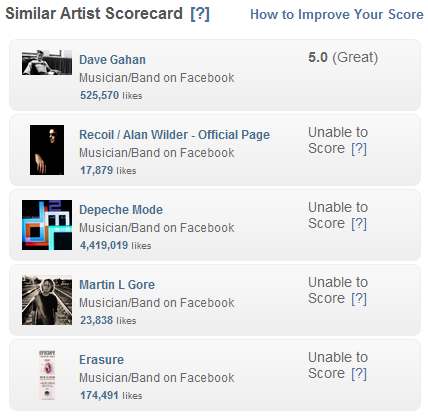
2. Pick 5 Similar Artists. Since I was promoting a Depeche Mode cover song, I picked the band and its members’ solo projects: Dave Gahan (lead singer), Martin L Gore (songwriter), and Alan Wilder (long-departed yet still beloved keyboardist/producer) - plus Erasure, since half of that duo was in the original line-up of DM. The product manager for Promote It told me that artists who have between 50,000 and 500,000 likes work best, and my results bear that out:
Similar Artist Scorecard

The Dave Gahan ads performed so well that they completely crowded out the rest. Perhaps it’s because Depeche Mode has millions of casual fans, but only the most serious ones keep up with the lead singer’s solo work, and are therefore more motivated to check out my cover.

3. Write Ad Text. You can choose to author one of the ads yourself, or let Promote It generate them all. Since my custom ad was outperformed by the auto-generated ads, I won’t bother sharing it with you.

4. Choose Picture. Your choice here can make or break the campaign! My previous campaign was identical to this one, except I used a close-up of yours truly. The results were pathetic. It should come as no surprise that a photo featuring 1) a world-famous band and 2) an attractive female does a better job of catching the eye.

5. Geo-Targeting. Choose between local (your state), national, all English-speaking countries, or global. Theoretically you should get the best results from global, but national did just as well for me in my limited experience.

6-8. Name Your Campaign, Sync with Facebook, Start Date. Pretty much self-explanatory.

9. Budget. Choose between $25, $50, $100, $250, or $500 on a one-time, weekly, or monthly basis. I recommend you experiment with successive $25 campaigns until you find a winning formula, and expand from there.

It seems like the tool really works. Brian's $50 campaign lasted six days and got some impressive results, as you can see from the graphic below:"

This looks like a great tool that's well worth the few bucks that it takes to implement a campaign. Read the rest of the article here.

-----------------------------------

You should follow me on Twitter for daily news and updates on production and the music business.

Check out my Big Picture blog for discussion on common music, engineering and production tips and tricks.

Monday, October 10, 2011

New Music Opportunities In Gaming

Music 3.0 2nd edition image from Bobby Owsinski's Music 3.0 blog
Here's another excerpt from the upcoming 2nd edition of Music 3.0: A Survival Guide For Making Music In The Internet Age, which will be out in early November.

This time it's an excerpt from an interview with my good friend Thom Kozik, who knows more about gaming (and tech in general) than most people on the planet. Thom began in digital media in 1990 while at Microsoft where he helped engineer the beginning of both the multimedia revolution and interactive television. Along the way he's spent most of his time on the gaming side of the tech industry, having served as president of gaming search engines Wazap and All-Seeing Eye (which he sold to Yahoo in 2004), before he became director of business development for Yahoo’s Media group, then Executive Vice President of Online Gaming at Atari. He is now president of Nüko Games.

In this excerpt, Thom talks about how games are evolving and how that's providing opportunities for artists and composers like never before.
---------------------
"There are two big things that have changed; the explosion of online gaming in the Western markets (predominantly driven through Facebook), and the music games that we were talking about two years ago have sunsetted with the change in appetite among gamers.

As far as console games like Rock Band and Guitar Hero, there’s a feeling by video game publishers that they’ve milked that cow as far as they could and can no longer sell tracks endlessly into those franchises. They haven’t turned them off completely and there’s still an effort to continue to sell into their installed base, but we’re not going to see another Beatle’s Rock Band on the horizon. The economics just aren’t there.

For an artist who wants to produce for this space, I think there’s actually more opportunity than there was a couple of years ago. Back then the focus was on the music games, but the publishers really didn’t worry about new music at all. They just wanted old back catalog to throw into the channel.

Now browser-based and mobile gaming (which I still consider to be online gaming) is where the action is. The truth is that the biggest growth area is based around games that depend upon and live via an online connection. In mobile games in particular, most of the early games in this area were self-contained experiences where titles like Angry Birds and Doodle Jump had the audio assets for the entire experience, along with all other elements, in the download package that the consumer purchased from an App Store. That’s shifting quickly to games like Infinity Blade, which uses a traditional console gaming engine and has taken the iPhone and iPad markets by storm. No one expected to see a game of this breadth and quality on a mobile device. It wasn’t because of the limitation of the device, but more about the nature of the product being released by the game developers. What’s most important about a game like Infinity Blade and those that are going to follow is that they’re structurally more like console games in that different levels load dynamically as the player progresses. What’s important for musicians is that there’s a need for more soundtracks and audio assets as the publishers continue to sell and ship those new levels to players. This trend in mobile gaming is much bigger than the equivalent of “map packs” that publishers put out for console and PC games in years past.

From a creative standpoint, now you have a few leading indicators of what can really be done on these mobile platforms. We’re opening up a really cool opportunity for the composer, artist or publisher to do the same kind of grand scoring and creative expression of music on a mobile device that they would have done on a console as recently as a couple of years ago. That’s a big opportunity.

On the browser game side, one of the things that we’re going to see is that the game developers and studios have had their eyes opened to what can be done in a web browser, so the games are getting much bigger in scope. What’s important is that in the Angry Birds or Doodle Jump world, the ability to create a score or the amount of music available in the game is fairly limited. Contrast that to the kind of games we’re used to seeing on consoles or PCs or massive multiplayer games like World Of Warcraft. The music is epic -- it’s a lot more than some catchy loops.

It’s soon going to be easier to have great epic scores on mobile games than on the browser because of the nature of the way that a browser talks to the Internet. There is technology out there that can make this easier, but it will be a question of how smart the game developers are with this."

For more book excerpts from this book and others, go to my website.
-----------------------------------

You should follow me on Twitter for daily news and updates on production and the music business.

Check out my Big Picture blog for discussion on common music, engineering and production tips and tricks.

Sunday, October 9, 2011

How About $10 For a Copyright Violation?

Pirate Key image from Bobby Owsinski's Music 3.0 blog
When the RIAA chose to hammer illegal downloaders with lawsuits, much of the world yawned instead of quivered in fright. Wave after wave of bad publicity over a technique that clearly failed to stem the piracy tide finally caused the music industry to rethink the best way to stem the illegal file tide. And the solution? Be reasonable.

Many content owners are now using a small LA-based firm called Digital Rights Corp to monitor file-sharing sites, then contact the alleged copyright infringers with an offer - pay a mere $10 to settle up each infringement and we'll call it even. Refuse to pay and you may be liable for up to $150,000 because of copyright violations and be at risk of having your Internet service cut off.

This is what the letter states:
“If you click on the link below and login to the Rightscorp, Inc. automated settlement system, for $10 per infringement, you will receive a legal release from the copyright owner.”
The link directs the email recipient to a page where they are will get a settlement letter in exchange for $10.

Now don't forget, this isn't just a straight amount of $10; it's 10 bucks per infraction. That means that if you've illegally downloaded 250 songs, it'll cost you $2,500. That's still cheaper than facing an RIAA lawsuit, where that amount probably won't even cover the retainer for a good attorney.

But the real carrot on the stick is loss of Internet privileges, something that most people today can't live without. This is made possible by a portion of the Digital Millinium Copyright Act that requires an ISP to terminate a repeat copyright offender if notified. While we haven't seen this happen much so far, this may become a big part of the RIAA's playbook in the future, although many consumer advocates say that they'll fight such action. Ultimately, the Supreme Court might eventually be asked to resolve the issue.

Either way, it looks like we're moving into a new age in the fight against digital piracy. At least the tactics are more reasonable for a change.

You can read more on the subject in this article in paidcontent.org.
-----------------------------------

You should follow me on Twitter for daily news and updates on production and the music business.

Check out my Big Picture blog for discussion on common music, engineering and production tips and tricks.


Thursday, October 6, 2011

10 Best Facebook Practices For Artists

facebook lineup image from Bobby Owsinski's Music 3.0 blog
Facebook is one of the best social networks for artists for artists and bands, but execution is everything in order to take full advantage of it. Mashable Social Media recent ran a great article about the 10 best practices for bands, and you can read the article here, but what follows is an abridged version with mostly of my comments.

1. Reach out to other artists. Ask a band whom you’re tight with to post your new music video/track/album art to their wall with a link back to your Facebook Page, and remember to return the favor. This is one of the best ways to use the network to expand your audience.

2. Take your fans backstage. Everyone loves to see behind the scenes, but fans are especially interested. It might seem insignificant to you, but any kind of backstage access is a big deal to them.

3. Go beyond the music. As I've said many times before, music is your marketing, but don't forget to make available any merch or touring info. That said, don't try to sell to your fans, just make it easily available if they want it.


4. Ask for input from fans. Communication is a two-way street and fans love to be asked their opinion on just about anything. Besides, they're your fans so they know what they want.


5. Be visual. Music is an aural medium for sure, but either still or moving pictures add so much to entire package that you can't ignore them any more. Besides, it's so easy to take pictures these days or make movies, you can't use gear or expertise as excuses anymore.

6. Make everything an event. This is one of the secrets of multiple singles releases rather than full albums. Every release becomes an event. You can expand upon that idea in just about any direction, from gigs or giveaways on your birthday to your best fan's birthdays, to making every gig a special occasion. Use your imagination.7.

7. Don't just ask for things. Once again, communication is a two way street. You give some and you take some and vice versa. If you ask for information, give something away for free. This goes a long way in keeping your tribe happy.


8. Don't forget the basics. Bios, press kits, pictures, logos are still important so be sure to have links to where people can get them if needed.


9. Offer exclusive content. The way to a fans heart is through exclusive content. If a fan can get exclusive mixes or movies that no one else can, that legitimizes his or her fandom and makes them want even more. Alternative mixes, outtakes, interviews - these are all inexpensive and easy to make content that any fan would love to have.


10. Use some tools. Make sure you take advantage of everything that Facebook has to offer, but also check out apps like Bandpage or Reverbnation for their event, sales and music plugins as well.
-----------------------------------

You should follow me on Twitter for daily news and updates on production and the music business.

Check out my Big Picture blog for discussion on common music, engineering and production tips and tricks.

Wednesday, October 5, 2011

Don't Depend On Social Media

Music 3.0 2nd edition image from Bobby Owsinski's Music 3.0 blog
The second edition of Music 3.0: A Survival Guide For Making Music In The Internet Age will be out in a few weeks so I thought that this would be a great time for a quick preview. The completely updated version has 5 more chapters, some new interviews and is about 40 percent larger than the last one, so there's a lot of new up-to-date info available. Here's a brief excerpt from a brand new chapter on Social Media Management called "Don't Depend On Social Media." In the coming weeks, I'll post more excerpts.
----------

"It's too easy for today's artist who only dabbles in social networking to get complacent and comfortable with the abilities of a single social network, but that can spell disaster for maintaining your fan base if you're not careful. As those artists who formerly depended upon MySpace now know, what's hot today can become ice cold tomorrow. But other negative scenarios also exist that can be far worse than the network falling out of favor.
Scenario #1 - Let's say that you've cultivated a huge following on Facebook. What would happen if Facebook was purchased by Google, who decides that all it wants is the underlying technology of the network, and shuts the rest down? If you didn't capture the email addresses of all your followers, you'd lose them to the nothingness of cyberspace. Don't laugh - it could happen.
Scenario #2 - What would happen if Facebook (I'm picking on them because they're the big dog on the social block) changes its terms of service, and now charges you $.25 for every fan past 100? If you’ve built an audience of 80,000 fans, it's going to cost you $20 grand to continue. Wheat if they decided to limit everyone's fan connections to 100? Both are unlikely, but something similar could happen, where suddenly you were unable to access that large fan base that you've worked so hard to develop.
That's why it's imperative that you harvest as many email addresses as you can for your own mailing list so you can keep your social communication under your control. If you rely on an external network, sooner or later you're going to get burnt. It's the nature of the Internet to constantly change, and it's too early to get a feel for the life span of even of the largest sites and networks. So play it safe - develop that mailing list."
-----------------------------------

You should follow me on Twitter for daily news and updates on production and the music business.

Check out my Big Picture blog for discussion on common music, engineering and production tips and tricks.


Tuesday, October 4, 2011

Apple's Latest Music Announcements

Cloud Music image from Bobby Owsinski's Music 3.0 blog
Apple's press conference today didn't introduce the iPhone 5 like everyone was anticipating, and the general feeling was that it was underwhelming in terms of product announcements. If you look underneath the surface of the event though, it wasn't really about product at all. This was more for the investment community and developers to let them know that Apple was still in good hands and there was truly some continuity from Steve Jobs to Tim Cook as the guiding light of the company.

That said, there were a few announcements that did affect the music industry. First was the official introduction of iCloud, which officially launches on October 12th. According to Apple, fully a third of all music sold on iTunes store is purchased on iOS devices, so iCloud is an important tool for the future of that ecosystem. As we were lead to believe, songs purchased via iPhone or iPad on iTunes will automatically be downloaded to a user's Mac for no additional charge.

And finally, some real details on iTunes Match, which launches at the end of October as well. With over 20 million songs, Apple claimes that iTunes is the largest music store in the world, which becomes an important piece to Match. Match "scans and matches your library against our 20M songs we’ll upload. What we don’t find, we’ll stream,” according to Apple's Eddie Cue. The operative word here is "stream." The price is $24.99 per year. Worth it? We'll see, although it seems to be a no brainer at the moment.

Finally, news about the death of iPod are extremely premature apparently. Apple introduced a new iPod Nano with a modified touch screen and a new clock face that also measures walking and running sessions, and a new iPod Touch and Shuffle were also introduced. It seems there's some life left in those Pod's, and the digital files in your life, yet.
-----------------------------------

You should follow me on Twitter for daily news and updates on production and the music business.

Check out my Big Picture blog for discussion on common music, engineering and production tips and tricks.

Monday, October 3, 2011

Supreme Court Rejects Music Download Case

Gavel striking image from Bobby Owsinski's Music 3.0 blog
On Monday the U.S. Supreme Court denied an appeal on a ruling that could have had serious revenue implications for all songwriters, with virtually 100's of millions of dollars at stake.

ASCAP had sued the United States government in the hopes of changing a traditional Internet download of sound recording to that of a public performance of the recorded musical work under federal copyright law. ASCAP had argued that digital downloads were also public performances for which the copyright owners must be compensated, but a federal judge and the appeals court rejected that argument, so the organization took it's final appeal to the highest court in the land.

"Music is neither recited, rendered, nor played when a recording (electronic or otherwise) is simply delivered to a potential listener," the appeals court ruled.

Being a songwriter myself, I'm all for getting more royalties at a higher royalty rate, but in all honesty, I just can't see how this argument holds water. A live performance and a recorded performance are simply not the same, as any engineer or producer will tell you. They're completely different animals. If the Supremes would have reversed the decision, it would have opened a huge can of worms with CDs, radio and streams eventually having to pay extra, potentially collapsing the whole music distribution system as we know it.

On second thought, maybe this was a missed opportunity to start all over again. What do you say Supremes; care to take another look?

The case is ASCAP v. United States, No. 10-1337, if anyone is interested.
-----------------------------------

You should follow me on Twitter for daily news and updates on production and the music business.

Check out my Big Picture blog for discussion on common music, engineering and production tips and tricks.

Sunday, October 2, 2011

5 Features Missing From Facebook Music

music on facebook image from Bobby Owsinski's Music 3.0 blog
Facebook Music has awaited with almost as much anticipation as Apple's iCloud (which we'll probably see this week). Now that it's finally here and we've got a chance to look at it, it appears there are a few things missing. Here's a piece of a great article from CNN.com regarding the 5 features missing from Facebook Music. For me, number 4 is the big one. You can read the entire article here.

"1. True music sharing
We're not saying it would be easy, but if Facebook really wants to help people listen to each other's music, it should let them do so using whatever music service they want. True, Facebook has started down the road of universally translating between music services, so that I can hear your songs even if you use Rhapsody and I use MOG -- but so far, it has done so by tilting the playing field favorably (some would say unfairly) towards Spotify.
If Facebook really wants to offer "frictionless" music sharing, to borrow Zuck's oft-repeated phrase, it will let people listen to shared stuff using whatever they want, rather than the same service used by the sharer.

2. Real-time group listening
A Facebook employee deleted a tweet about it, but Evolver.fm has confirmed that at least two streaming radio services plan to implement it. Slacker, specifically, says it has been working with Facebook to do so for months. So why didn't Facebook Music launch with the ability to join other listeners on a station in real-time, so that people can chat about what they're hearing a la Turntable.fm? This will probably be the neatest thing about Facebook Music, and even after yesterday's presentation, it's 100% vaporware.

3. Music tab in the ticker
Facebook is now more cluttered than ever, which, according to hilarious Wired.com pundit Lore Sjöberg, is because Facebook finds it beneficial to keep its users dissatisfied while offering them a forum where they can express that dissatisfaction -- just like the Democratic Party.
Zuckerberg kept using the word "lightweight" to describe the new Ticker on the right side of Facebook, but accusations of clutter are not without merit. So why not add a music filter? As a music fan, I'm mainly interested in what people are listening to, Ticker-wise. I don't care about who my friends have friended. The Facebook Ticker should offer a way to look only at music activity, and there's no good reason for it not to.

4. Apple
As Matt Rosoff of Business Insider observed, the white elephant not in the room at f8 yesterday was Apple, iTunes, and iCloud. Apple would need to swallow some pride in order to join Facebook's music ecosystem, but maybe it should.
Some argue that Apple only ever sold music in order to sell more iPods and iPhones anyway. Now that it can sell apps for other music services, and run those on its devices, perhaps Apple is no longer concerned about selling music. From a user perspective, it would be nice if iTunes activity were included in Facebook's music activities. Last.fm scrobbles from iTunes, so why can't Facebook? Maybe this one will happen when Apple takes the wraps off of iCloud later this year.

5. Independent developers
For this one, Facebook's off the hook for the most part -- it just needs to stay out of the way.
One of the neatest things about Rdio and now Spotify is that they let independent app developers build third-party players atop their catalogs. If I subscribe to either service, I can use any music app that taps into it, offering a potentially huge range of interfaces, platforms, designs, features, etc. to choose from -- more than Rdio or Spotify could ever develop on their own.
WIRED: Facebook's gone rogue -- it's time for an open alternative
If someone wants to build a music player that lets people choose what to play by rolling virtual dice, slaying a dragon, wandering through a 3-D library, or whatever, on any platform, I can use that interface to play Rdio's or Spotify's music.
This is already starting to happen -- and unless Facebook somehow gets in the way, all of the music played in these third-party apps should appear on Facebook. In fact, Facebook could even encourage this sort of thing."

 Let's see what happens at Apple's press conference tomorrow. iCloud, anyone?
----------------------------------
You should follow me on Twitter for daily news and updates on production and the music business.

Check out my Big Picture blog for daily discussion of music, recording, and production tips and tricks.

Thursday, September 29, 2011

How Many Photos Have Ever Been Taken?

There are some questions that are unanswerable. What is love? How do you make a hit? How many people have inhabited out planet from the beginning of time? How much water is in the oceans of the world?

While we don't know exactly, we do have a fair idea regarding the number of pictures that have been taken in the history of photography. How is that? Well, considering that the art has only been around for about 200 years or so, it's a pretty recent development in human history, and fairly well documented. That said, with the proliferation of cameras in just about every camera, picture taking has grown exponentially, and I'll show you some graphs that will blow your mind in a minute.

First, here are some interesting stats to set the stage:
  • From all the photos taken up until about 1960, it's estimated that 55% of the photos were of babies.
  • The 20th century was the golden age of analog photography, peaking at an amazing 85 billion physical photos in 2000, which turns out to be an incredible 2,500 photos per second.
  • It's estimated that 2.5 billion people in the world today have a digital camera (out of 7 billion).
  • If the average person snaps 150 photos this year, that would amount to a staggering 375 billion photos.
  • People will upload over 70 billion photos to Facebook, suggesting around 20% of all photos this year will end up there.
  • Facebook’s photo collection has a staggering 140 billion photos. That's over 10,000 times larger than the Library of Congress!
  • It's estimated that we humans have now taken over 3.5 trillion photos!
  • Ten percent of all the photos we have were taken in the past 12 months!
The point here is that picture taking is so easy these days, you should never hesitate to take one. The number of times I wish I had a picture of something in the past is way too frequent, and it's usually something I could've used in a book to illustrate a point.

Below are a couple of graphics that will blow your mind. For more info as well as the references for the figures above, click here.

Number of Photos image from Bobby Owsinski's Music 3.0 blog
----------------------------------
You should follow me on Twitter for daily news and updates on production and the music business.

Check out my Big Picture blog for daily discussion of music, recording, and production tips and tricks.


Wednesday, September 28, 2011

What People Spend On Entertainment

Digital Music News had an article the other day on the average amount of money that people in the U.S. spend on entertainment. The following charts came from the US Bureau of Labor Statistics and they're very revealing.

The first chart shows that the average person in the US spends almost as much on entertainment (5.2 percent) as on healthcare (6.6 percent) and quite a bit more than on clothing (3.5 percent).

The second chart shows that the average consumer spent less on entertainment in 2010 than any of the last 4 years (no surprise there). While the rest of the numbers seem kind of bogus to me, what stood out was how much people actually spent on musical instruments and instrument repair on average. It's a huge part of American entertainment.


What People Spend On Entertainment image from Bobby Owsinski's Music 3.0 blog
----------------------------------
You should follow me on Twitter for daily news and updates on production and the music business.

Check out my Big Picture blog for daily discussion of music, recording, and production tips and tricks.

LinkWithin

Related Posts Plugin for WordPress, Blogger...