Showing posts with label kickstarter. Show all posts

Wednesday, December 23, 2015

Kickstarter Has A Very Low Failure Rate

Crowdfunding imageCrowdfunding isn't for everyone, but it turns out that the chances of getting a campaign funded are higher than ever. Kickstarter commissioned a study by the prestigious Wharton Business School at the University of Pennsylvania and found that 91% of campaigns on its platform get funded.

It turns out that the failure rate was about the same across all 15 categories on the platform, and most failures came from campaigns attempting to raise $1,000 or less. The most successful were campaigns attempting to raise between $10,000 and $50,000.

Even if a project failed, 73% of backers felt good enough about the process to want to back another project. That said, just 19% said that they would back the same creator whose project failed.

For those projects that just can't come to fruition, Kickstarter has a number of suggestions:
  • Explain to backers what work has been done, how funds were used, and what stopped them from finishing
  • Demonstrate that you’ve used funds appropriately and have made every reasonable effort to complete the project as promised
  • If there’s money left over, offer to return any remaining funds to backers who have not received their reward, or explain how those funds will be used to complete the project in some alternate form.
Crowdfunding isn't for everyone, especially when it comes to music. As stated in previous posts, unless you already have a broad fan base, your campaign has a good chance of failing unless you use some very clever marketing. But as the Wharton study found, if you do get it off the ground, there's an excellent chance it will succeed.


Thursday, December 10, 2015

5 Kickstarter Tips From Amanda Palmer

Amanda Palmer's 5 Kickstarter Tips
Amanda Palmer may be the perfect example of how social media promotion is done in our Music 4.0 age. She's developed a big online bond with her fans that hasn't quite carried over to her music, but it has in other areas.

Amanda took advantage of that social notoriety to launch a highly acclaimed Kickstarter campaign a few years ago where she raised $1.1 million more than her original $100,000 goal.

So just how did she do it? Amanda gave away her secrets on crowdfunding to the Music Awards BlogHere they are (with my comments afterward):

1) You have to have fans before you can ask them to help you. [This one seems pretty obvious, but is mysteriously overlooked by many artists.]

2) Show, don't tell: HAVE A GOOD VIDEO. [This is a lot harder than it seems. You have to sell your fans on your idea/music and not be obnoxious about it. People get paid a lot of money to do this every day, which suggests its difficulty, so make sure you put a lot of thought into it.]

3) Don't just reward the rich: keep every level rewarding. [If you look at some Kickstarter campaigns, it seems hardly worthwhile to even consider some of the lower pledge levels since you don't get all that much in return. As you get to the higher money pledges, the rewards always become a lot more interesting, but you want to reward those that can only afford the lower levels as well.]

4) Be honest: You'll be amazed at how helpful people really are when you talk straight with them. [Fans naturally want to help. The more honest and open you are, the more help they'll give you. If something feels funny or below board, they'll start to pull back.]

5) No tool is deus ex machina: ANY platform can work. [Don't get stuck on one platform since the name of the game is delivering your music to people, and giving them the chance to help you out by buying something occasionally. Without those last two things, the platform doesn't matter.]

Last but important, Palmer gives the best tip: Your music must be good, you must respect your fans, and pretty much without exception; YOU HAVE TO TOUR.

Another great tip from Amanda comes from a conversation she had with Techdirt in which she states just how she developed that fanbase in the first place:
"I've been tending this bamboo forest of fans for years and years, ever since leaving roadrunner records in 2009. Every person I talk to at a signing, every exchange I have online (sometimes dozens a day), every random music video or art gallery link sent to me by a fan that i curiously follow, every strange bed I've crashed on...all of that real human connecting has led to this moment, where I came back around, asking for direct help with a record. Asking EVERYBODY...And they help because...they KNOW me."
Every time I post something about Amanda Palmer I get a lot of negative comments and emails, as she can be a polarizing figure if you're not a fan. The thing is, she's done extremely well for someone who's music is rather niche.

Whether you like her or her music or not, at least take heed of her techniques. She's giving them away for free.

Wednesday, September 3, 2014

There's More To Music Than Social Media

Amanda Palmer TED talk image
So much of an artist's promotion and visibility is built around social media these days that it's easy to believe that it's almost more important than the music itself. Sometimes it's possible to be a social celebrity without making any meaningful penetration with your music however, as this excerpt from the New Masters chapter of my Music 4.0: A Survival Guide for Making Music in the Internet Age guidebook illustrates.

"If you’re in the music business there’s a good chance that you’ve heard of Amanda Palmer, although there’s an even better chance that you’ve not heard her music. Palmer represents a conundrum in social media where she’s become a huge presence in the music industry thanks to her extremely effective social media and crowdfunding campaigns, yet that hasn’t helped to spread her music much beyond a small, yet avid following.

Palmer rose to a low-level of prominence as half of the duo Dresden Dolls before going solo in 2008. Her cult following grew from there thanks to her extremely hands-on relationship with her fans. In an interview with Techdirt in 2012, she gave her secret:
"I've been tending this bamboo forest of fans for years and years, ever since leaving Roadrunner Records in 2009. Every person I talk to at a signing, every exchange I have online (sometimes dozens a day), every random music video or art gallery link sent to me by a fan that I curiously follow, every strange bed I've crashed on...all of that real human connecting has led to this moment, where I came back around, asking for direct help with a record. Asking EVERYBODY...And they help because...they KNOW me."
Palmer’s notoriety again grew thanks to reports of big merch sales through Twitter campaigns (like $19,000 worth of T-shirts in less than a day), to where it reached a peak with a massively successful Kickstarter campaign in which she raised $1.2 million (the goal was $100,000) from nearly 25 thousand fans in 31 days for the marketing of an album/art book/gallery tour. This was followed shortly thereafter by a riveting TED talk where she described her fan-first business model.

Considering the exposure that Palmer has garnered from the mainstream media thanks to these events, her music still hasn’t gained much traction and she remains very much a niche artist, though one with a fanatical following. Only three of her videos have barely cracked 1 million views, she has less than a million Twitter followers, and just over 200,000 Facebook Likes. 

While these are really great numbers for an indie artist, Palmer hasn’t managed to transcend that narrow category despite generally positive and vast exposure and a supercharged fanbase. Amanda Palmer proves that no matter what your social media connections are, star and superstar success still depends on your music. In order to gain a mass audience, it must connect with the masses.

There’s More To Music Than Social Media Summary
  • Social prominence won’t automatically cause people to like your music
  • But it can cause people to notice you
  • Caring deeply about your fans builds an avid fanbase
  • An avid fanbase is essential for crowdfunding"
To read more excerpts from Music 4.0 and my other books, go to the excerpts page at bobbyowsinski.com.
----------------------------------

Wednesday, March 12, 2014

The Tiny Piece That Neil Young's Pono Needs To Succeed

Pono Music players image
Singer/songwriter/guitarist Neil Young’s dream of a higher quality consumer music service appears to be slowly getting closer, as evidenced by the latest announcements at the annual South by Southwest conference and its accompanying Kickstarter campaign. Pono Music, in which Young is heavily invested, is a high-quality audio ecosystem consisting of a download service supplying digital audio files transferred from the original high-resolution audio masters, and a dedicated player with the ability to play back those files. Along with Apple’s best kept secret in their Mastered for iTunes program, Pono is an attempt to raise the bar in audio quality, a bar that has been continually lowered since just before the turn of the century thanks to the public’s acceptance of the quality impaired MP3 format, but can be traced by as far as the introduction of the CD.

Through the years, Young has always been a notorious stickler for audio quality, being one of the first artists to build his own personal studio based around hand-picked vintage audio gear, then later investing in Pacific Microsonics, which developed the HDCD audio technology that was acquired by Microsoft in 2000. He’s also been a big proponent of hi-res audio formats like DVD-Audio and most recently Blu-Ray.

When I first heard of Pono three years ago I was initially skeptical. Large digital files like the ones required for the hi-res audio backbone of Pono weren’t easy to deliver, and the public seemed just fine with the lower quality offered by MP3 and streaming services. Even last year, when Pono’s introduction was teased, success still seemed somewhat far-fetched with the wholesale movement towards the convenience of streaming music, one that continues in earnest today.


Today is a different day, however, and now I look at the Pono player/service in a somewhat different light. First of all let’s look at what Young and his cohorts have done right. Read more on Forbes.
----------------------------------

Follow me on Forbes for some insights on the new music business.

You should follow me on Twitter and Facebook for daily news and updates on production and the music business.

Check out my Big Picture blog for discussion on common music, engineering and production tips and tricks.

Monday, May 27, 2013

A New Revenue Stream For Musicians

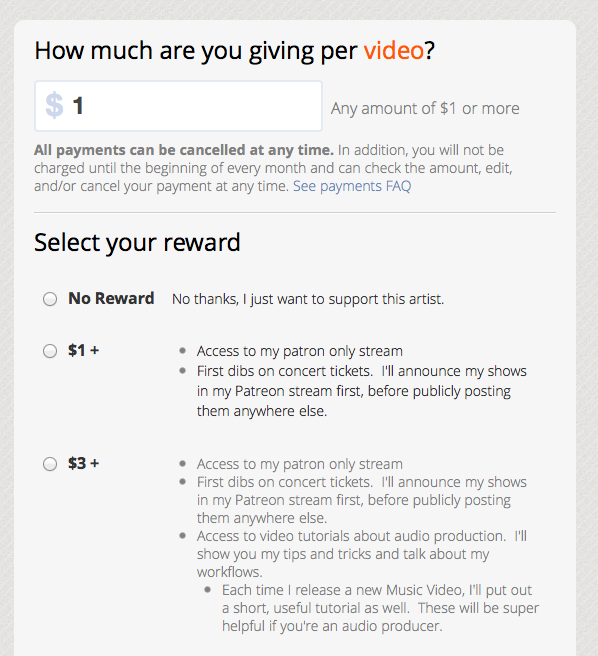
Patreon Subscribe menu imageWhile a Kickstarter or Indie Gogo campaign is all the rage for artists to fund a recording these days,  another twist on an old idea may give traditional crowdfunding a run for its money. A new site called Patreon, labeled as a "fundraising" site, allows fans to subscribe to the artists they follow and receive "patrons-only" streams of their work.

The brainchild of Pomplamoose's Jack Conte and AdWhirl founder Sam Yam, the site allows fans to perform the age-old function of patron. The difference from European royalty is that instead of a large lump sum bestowed upon the artist, each patron can contribute a small amount (think of it as a tip) every time the artist releases a piece of content. The content can be videos, songs, blogs, articles or recipes or anything other "art" that comes on a regular basis.

A patron receives more than the stream though, as they also have the ability to post in the artist's stream and can unlock additional patron packages like private Google+ Hangouts or tutorials with different levels of support.

It's a cool idea and just another way that an artist with a fanbase (that's the key here) can create a new income stream. Check out the video below for a more detailed description of Patreon.


----------------------------------

You should follow me on Twitter for daily news and updates on production and the music business.

Check out my Big Picture blog for discussion on common music, engineering and production tips and tricks.

Thursday, April 4, 2013

Warner Music Goes To Kickstarter

Warner Music Group logo image from Bobby Owsinski's Music 3.0 blog
If you've never read music insider Bob Lefsetz' newsletter, then you really should. Love him or hate him (he gets equal parts of both), he comes up with both an interesting global perspective of the music world as well as some breaking news or commentary on breaking news.

One of the bigger stories that he's let us in on is the fact that Warner Music has just tied in with Kickstarter to offer a recording contract to any act that raises $100,000 or more, or if they get 1,000 people or more to contribute.

First of all, I don't know why anyone would want such a deal under those circumstances, since if you've raised that amount or have that many fans willing to support you, you probably don't need a major label, at least under their terms.

What this offer does go to show you is how well an old adage really applies. It goes something like this - "A record label doesn't sign you for your music, they sign you for your audience." This means that they generally don't give a crap about you or your songs, but if you have a line around the block waiting to see you when you gig, they're interested big time.

Another Lefsetz piece of news is that Warners has also hired Amanda Palmer to teach their acts how to self-promote. I don't know much about her music, but I do know that she's great at getting people to passionately care about her, so this is probably a good thing. Will her methods translate to other artists? I don't think we can be sure, since she has such a strong personality, which is part of her allure with her fans.

If all this is true (and there's no reason to think it's not), you have to hand it to Warners for at least trying to stay relevant and trying something new. It's long been held that they've been the major label leaders when it came to understanding our new digital world, now they're trying harder than ever to prove it.

PLEASE NOTE: This news might be a product of April Fools day. I'm still checking out the validity. It's not like Lefsetz to do this sort of thing, but you never know.
----------------------------------

Interested in the Music 3.0 archives? Buy The Music 3.0 Guide To Social Media. The best of over 800 posts.

You should follow me on Twitter for daily news and updates on production and the music business.

Check out my Big Picture blog for discussion on common music, engineering and production tips and tricks.

Wednesday, February 13, 2013

When Kickstarter Doesn't Work

Crowdfunding campaigns are sometimes considered an almost can't-miss way to raise money for a project, but that's often far from the case. Even though slightly over 50% of music projects do get fully funded, there have been some high profile failures (think Public Enemy) recently.

The latest is Bjork's Kickstarter campaign to crowdfund the development of a new version of her Biophilia album app, this time for Android and Windows 8. The campaign was cancelled just 10 days in when it reached just 4% of it's goal of 375,000 pounds (about $580,000US).

The original Biophilia iPad app offered interactive modules for each song on Bjork's Biophilia album, which included games, animation and the ability to remix songs. Porting it to both Windows and Android platforms was a way to get it into more low income households in the interest of music education, according to the site.

When it comes to crowdfunding campaigns, there are 3 main impediments to funding:

1. Is the project sexy? Porting an app from iOS to Windows and Android just doesn't grab the imagination somehow. iOS owns the market (at least for now), and a great number of potential donators are Apple fanboys, so the basic premise was never going to work.

2. The reward tiers. There just wasn't anything sexy with the Biophilia app award tiers either. Art prints of the app graphics from a B list artist won't cut it, no matter how cool they might be (and they are very cool).

3. The monetary goal. Let's face it, the lower the amount of money you're trying to raise, the more likely you'll achieve it. While I don't for a second think that the amount Bjork was trying to raise was out of line with its needs, it was just too big a chunk to bite off. Bjork isn't successful enough as an artist to pull a campaign like this off.

For those of you who intend to create a crowdfunding campaign in the future, use this as a template of what not to do.

Here's the promo video for the project.


----------------------------------

Interested in the Music 3.0 archives? Buy The Music 3.0 Guide To Social Media. The best of over 800 posts.

You should follow me on Twitter for daily news and updates on production and the music business.

Check out my Big Picture blog for discussion on common music, engineering and production tips and tricks.

Wednesday, October 3, 2012

4 Rules For Crowdfunding

Crowdfunding image from Bobby Owsinski's Music 3.0 blog Here's a post from a couple of years ago that I thought I'd repost, given the every increasing interesting in crowdfunding.

Crowdfunding is becoming a popular way to finance a recording project, thanks to sites like KickstarterMyBandStockindiegogo, Rockethub and Sellaband, among others. Regardless of which site you use, the idea is the same - it allows your fans to pool their money in order to fund your project.

If crowdfunding is something that you'd like to pursue, here are 4 rules to help your campaign be successful.

1) Choose an attainable goal amount. Everybody would like a $100,000 budget to work with, but unless you have a large fan base to begin with, you're probably dreaming if you think you can raise that amount. Even a once-huge selling band like Public Enemy had to cut their goal from $250k to $75k, so be realistic in both what you need and what you can raise.

2) Concentrate on low price points. Kickstarter's data indicates that $50 is the optimum investment point, closely followed by $25. While most artists also include amount in the thousands as well, don't count on these being filled.

3) Make sure the investment reward is sufficient. Remember that you're not getting a donation, it's an investment and your investors will expect something in return. Check out this list of incentives from Hind as an example. Of course, one of the most brilliant list of incentives comes from Josh Freese (Perfect Circle,  Nine Inch Nails, Devo, Weezer). A lot of it was meant to be funny for promotion's sake, but people took him up on it anyway.

4) Keep the campaign short. Kickstarter has found that the optimum campaign is 30 days, with longer campaigns performing significantly worse. The biggest periods of investment come right in the beginning and right before it closes, with everything in the middle a somewhat "dead period." If that's the case, you might as well make the campaign short since there's no advantage to dragging it out.

Kickstarter has some great additional info and data on a recent blog post that's also worth checking out.

-----------------------------------
You should follow me on Twitter for daily news and updates on production and the music business.

Check out my Big Picture blog for discussion on common music, engineering and production tips and tricks.

Tuesday, August 28, 2012

Get Kickstarter Analytics Data From Kicktraq

With so much data available on just about anything you can think of when it comes to social media and the web, the one area that's come up short in that regard has been crowdfunding, as up until now there were no serious analytical tools available. Now that looks to be resolved with a sort of Google Analytics tool for Kickstarter called Kicktrag.

Kicktraq allows you to see inside a campaign in more detail than ever before. You can see the Funding Progress over time, the Pledgers and Backers by day, how the campaign is trending, and the final projections for it. Check out one of the data screens below.

Kicktrag data screen image from Bobby Owsinski's Music 3.0 blog

While I'd like to see how much progress each pledge level is getting as well, Kicktraq still gives you a better idea of exactly where you're at during the campaign than what was available before. Remember that as little as a single tweet can make the difference in the outcome of a campaign. Now you can actually see its effect when it happens.

-----------------------------------
You should follow me on Twitter for daily news and updates on production and the music business.

Check out my Big Picture blog for discussion on common music, engineering and production tips and tricks.

Monday, June 18, 2012

Kickstarter: Behind The Numbers

Funded With Kickstarter image from Bobby Owsinski's Music 3.0 blog
Kickstarter is one of the better known and more long-lived crowdfunding sites, and if you look inside the numbers that they publicly acknowledge, there's a wealth of information. As with most things in life, information is power. Let's take a look:
  • Kickstarter has ad almost 46,000 projects from its inception, which have raised nearly $215 million thanks to almost 3 million backers.
  • A full 50% of those projects have been successful, raising the amount amount of money established as a goal. 41% of projects have failed, .1% were suspended, and .1% were cancelled. The rest (8.5%) are currently ongoing.
  • It's surprising the types of projects that are most successful:
Dance - 75%,  Theater - 71%,  Music - 68%,  Art - 57%,  Comics - 54%,  Film and Video - 51%,  Food - 51%,  Photography - 47%,  Design - 47%,  Games - 43%,  Publishing - 40%,  Technology - 39%,  Fashion - 33%
  • But the most successful categories don't necessarily raise the most money (in millions):
Film & Video - $55,  Music - $33,  Design - $40,  Games - $23,  Art - $9.4,  Publishing - $9.3,  Technology - $9.0,  Theater - $6.8,  Food - $6.1,  Comics - $4.8,  Photography - $3.2,  Fashion - $2.3,  Dance - $1.8
  • The average duration of a successful campaign is 38 days, but it's 43 days for the average failed project.
  • Lower is better when it comes to monetary goals, as the average successful project raised $5,487 while the average failed project's goal was $16,365.
  • Finally, 8.5% of funded projects received more than double their goal.
As you can see, crowdfunding is competitive, but if you have the right product, the right sales goal, and right sales pitch, the odds are good about even that you'll succeed. That's a lot better than most chances you'll ever take in the music business.

-----------------------------------
You should follow me on Twitter for daily news and updates on production and the music business.

Check out my Big Picture blog for discussion on common music, engineering and production tips and tricks.

Tuesday, May 22, 2012

Crowdfunding Tours With Gigfunder

Gigfunder logo image from Bobby Owsinski's Music 3.0 music industry blog
Crowdfunding is quite the buzz word these days and rightfully so. Both new and established artists are using it to gain funding for new recording projects using a variety of sites like Kickstarter, Crowdfunder, Sellaband, Rockethub, and many many more.

But one new crowdfunding site recently launched that's very unique. Gigfunder is like those other sites in that it helps raise money from fans, but it's dedicated strictly to funding tour dates.

Let's face it. Touring is not easy or cheap, especially if you're just starting out. You not only have to pay for gas, but hotel rooms, food, transportation and even festival buy-ons. A new band, no matter how good they might be, are at an immediate disadvantage money-wise. Gigfunder not only mitigates some, but adds a few extra incentives too.

First of all, it's a way to publicize your tour and where you're playing in a targeted way. That's because fans suggest cities and venues for you to play. If you don't reach the funding tier, you don't play there, which is the second great thing about the service. No use playing to an empty club. If a gig is funded by your fans, you can be sure they'll be there.

You can find out more about Gigfunder by checking out this FAQ.

Touring is the key to a band's success. Don't let expenses get in the way.
-----------------------------------
You should follow me on Twitter for daily news and updates on production and the music business.

Check out my Big Picture blog for discussion on common music, engineering and production tips and tricks.

Wednesday, May 9, 2012

Amanda Palmer's Kickstarter Tips

Amanda Palmer image from Bobby Owsinski's Music 3.0 blog
Amanda Palmer's always been used as a the perfect example of how social media promotion is done in our Music 3.0 age. As I posted last week, she's now a beaming example of how to mount a Kickstarter campaign as well.

As of this writing, she's had over $600 in pledges just 8 days into her month-long campaign, which is pretty amazing. So just how did she do it? She gave away her secrets on crowdfunding to the O Music Awards Blog. They are (with my comments afterward):

1) You have to have fans before you can ask them to help you. [This one seems pretty obvious, but is mysteriously overlooked by many artists.]

2) Show, don't tell: HAVE A GOOD VIDEO. [This is a lot harder than it seems. You have to sell your fans on your idea/music and not be obnoxious about it. People get paid a lot of money to do this every day, which suggests its difficulty, so make sure you put a lot of thought into it.]

3) Don't just reward the rich: keep every level rewarding. [If you look at some Kickstarter campaigns, it seems hardly worthwhile to even consider some of the lower pledge levels since you don't get all that much in return. As you get to the higher money pledges, the rewards always become a lot more interesting, but you want to reward those that can only afford the lower levels as well.]

4) Be honest: You'll be amazed at how helpful people really are when you talk straight with them. [Fans naturally want to help. The more honest and open you are, the more help they'll give you. If something feels funny or below board, they'll start to pull back.]

5) No tool is deus ex machina: ANY platform can work. [Don't get stuck on one platform since the name of the game is delivering your music to people, and giving them the chance to help you out by buying something occasionally. Without those last two things, the platform doesn't matter.]

Last but important, Palmer gives the best tip: Your music must be good, you must respect your fans, and pretty much without exception; YOU HAVE TO TOUR.

Another great tip from Amanda comes from a conversation she had with Techdirt in which she states just how she developed that fanbase in the first place:

"I've been tending this bamboo forest of fans for years and years, ever since leaving roadrunner records in 2009. Every person I talk to at a signing, every exchange I have online (sometimes dozens a day), every random music video or art gallery link sent to me by a fan that i curiously follow, every strange bed I've crashed on...all of that real human connecting has led to this moment, where I came back around, asking for direct help with a record. Asking EVERYBODY...And they help because...they KNOW me."

Every time I post something about Amanda Palmer I get a lot of negative comments and emails as she can be a polarizing figure if you're not a fan. The thing is, she's out there doing well in what a lot of people can't. Whether you like her or her music or not, at least take heed of her techniques. She's giving them away for free.

Check out her Kickstarter campaign, and read both the O Music Awards blog and Techdirt posts for more info.

-----------------------------------
You should follow me on Twitter for daily news and updates on production and the music business.

Check out my Big Picture blog for discussion on common music, engineering and production tips and tricks.

Thursday, May 3, 2012

$100k On Kickstarter In 6 Hours

In an excellent case study in the art of social media and crowdfunding, Amanda Palmer has turned a Kickstarter campaign on its head, raising $100,000 in a mere six hours, then oversubscribing to the tune of $443,000 with 27 days left. Considering that she was expecting to raise the $100k in 32 days, I'd say the result is nothing short of amazing and shows the power of having an open communication with your fans.

Amanda was trying to raise the funds for the mixing, manufacturing, promotion and distribution of her album as well as an book of art. Actually, the original budget is not all that large by major label standards, but it's way beyond what an indie artist would normally spend.

She's offering not only the CD, but lots of vinyl options as well as the book to her backers of $100 or more, including free shipping. Since most people don't have a turntable, she's also decided to include one in some of the packages as well.


Here's the simple yet effective video she created for the campaign.


Check out Amanda's campaign. It's a great example of just how to do it.

-----------------------------------
You should follow me on Twitter for daily news and updates on production and the music business.

Check out my Big Picture blog for discussion on common music, engineering and production tips and tricks.

Thursday, November 4, 2010

4 Tier Rewards Of A Crowdfunding Campaign

The great Hypebot blog recently posted a nice interview with Yancey Strickler, the co-founder of Kickstarter, which is one of the leading crowdfunding platforms used by artists and bands today. While Yancey described many of the elements that work for a crowdfunding campaign, one of the best pieces of the article was about funding tier rewards. A funding tier is a level of investment, like $25, $50, $100 and $500 dollars.

One of the most important elements of a crowdfunding campaign has to do with the rewards that an investor receives for putting money into the project. Just getting credit and money back usually isn't enough, and Yancey had these suggestions (I've messaged the text a little for clarity) to make the campaign a bit more enticing.

1) The Basic Reward - If nothing else, the investor should receive a copy of the CD or a free download.

2) Limited Editions - For either the first 100 investors or the next higher tier, the investor receives a deluxe edition that's individually numbered and personally signed.

3) Share The Story - The next tier investor would receive something even more exclusive, like Polaroids (these certainly are a limited and rare item) from the studio, used guitar strings or drum heads, the coffee cup used by the artist, or some other personal item.

4) The Creative Experience - Bring the investor into the process itself by asking for his or her opinion on which version of a song or photo to release, bring them into the studio for background vocals or handclaps, or just invite them to sit in on a recording, photo session or video. The idea is to give an investor at the highest level a once-in-a-lifetime thrill.

None of these cost very much, yet they could mean the difference between someone investing or not, or investing in a more costly tier.

-----------------------------------
Follow me on Twitter for daily news and updates on production and the music business.

Check out my Big Picture blog for discussion on common music, engineering and production tips and tricks.

Sunday, October 3, 2010

4 Rules For Crowdfunding

Crowdfunding is becoming a popular way to finance a recording project, thanks to sites like Kickstarter, MyBandStock, indiegogo, Rockethub and Sellaband, among others. Regardless of which site you use, the idea is the same - it allows your fans to pool their money in order to fund your project.

If crowdfunding is something that you'd like to pursue, here are 4 rules to help your campaign be successful.

1) Choose an attainable goal amount. Everybody would like a $100,000 budget to work with, but unless you have a large fan base to begin with, you're probably dreaming if you think you can raise that amount. Even a once-huge selling band like Public Enemy had to cut their goal from $250k to $75k, so be realistic in both what you need and what you can raise.

2) Concentrate on low price points. Kickstarter's data indicates that $50 is the optimum investment point, closely followed by $25. While most artists also include amount in the thousands as well, don't count on these being filled.

3) Make sure the investment reward is sufficient. Remember that you're not getting a donation, it's an investment and your investors will expect something in return. Check out this list of incentives from Hind as an example. Of course, one of the most brilliant list of incentives comes from Josh Freese (Perfect Circle,  Nine Inch Nails, Devo, Weezer). A lot of it was meant to be funny for promotion's sake, but people took him up on it anyway.

4) Keep the campaign short. Kickstarter has found that the optimum campaign is 30 days, with longer campaigns performing significantly worse. The biggest periods of investment come right in the beginning and right before it closes, with everything in the middle a somewhat "dead period." If that's the case, you might as well make the campaign short since there's no advantage to dragging it out.

Kickstarter has some great additional info and data on a recent blog post that's also worth checking out.

-----------------------------------
Follow me on Twitter for daily news and updates on production and the music business.

Check out my Big Picture blog for discussion on common music, engineering and production tips and tricks.

LinkWithin

Related Posts Plugin for WordPress, Blogger...