Showing posts with label crowdfunding. Show all posts

Wednesday, December 23, 2015

Kickstarter Has A Very Low Failure Rate

Crowdfunding imageCrowdfunding isn't for everyone, but it turns out that the chances of getting a campaign funded are higher than ever. Kickstarter commissioned a study by the prestigious Wharton Business School at the University of Pennsylvania and found that 91% of campaigns on its platform get funded.

It turns out that the failure rate was about the same across all 15 categories on the platform, and most failures came from campaigns attempting to raise $1,000 or less. The most successful were campaigns attempting to raise between $10,000 and $50,000.

Even if a project failed, 73% of backers felt good enough about the process to want to back another project. That said, just 19% said that they would back the same creator whose project failed.

For those projects that just can't come to fruition, Kickstarter has a number of suggestions:
  • Explain to backers what work has been done, how funds were used, and what stopped them from finishing
  • Demonstrate that you’ve used funds appropriately and have made every reasonable effort to complete the project as promised
  • If there’s money left over, offer to return any remaining funds to backers who have not received their reward, or explain how those funds will be used to complete the project in some alternate form.
Crowdfunding isn't for everyone, especially when it comes to music. As stated in previous posts, unless you already have a broad fan base, your campaign has a good chance of failing unless you use some very clever marketing. But as the Wharton study found, if you do get it off the ground, there's an excellent chance it will succeed.


Thursday, December 10, 2015

5 Kickstarter Tips From Amanda Palmer

Amanda Palmer's 5 Kickstarter Tips
Amanda Palmer may be the perfect example of how social media promotion is done in our Music 4.0 age. She's developed a big online bond with her fans that hasn't quite carried over to her music, but it has in other areas.

Amanda took advantage of that social notoriety to launch a highly acclaimed Kickstarter campaign a few years ago where she raised $1.1 million more than her original $100,000 goal.

So just how did she do it? Amanda gave away her secrets on crowdfunding to the Music Awards BlogHere they are (with my comments afterward):

1) You have to have fans before you can ask them to help you. [This one seems pretty obvious, but is mysteriously overlooked by many artists.]

2) Show, don't tell: HAVE A GOOD VIDEO. [This is a lot harder than it seems. You have to sell your fans on your idea/music and not be obnoxious about it. People get paid a lot of money to do this every day, which suggests its difficulty, so make sure you put a lot of thought into it.]

3) Don't just reward the rich: keep every level rewarding. [If you look at some Kickstarter campaigns, it seems hardly worthwhile to even consider some of the lower pledge levels since you don't get all that much in return. As you get to the higher money pledges, the rewards always become a lot more interesting, but you want to reward those that can only afford the lower levels as well.]

4) Be honest: You'll be amazed at how helpful people really are when you talk straight with them. [Fans naturally want to help. The more honest and open you are, the more help they'll give you. If something feels funny or below board, they'll start to pull back.]

5) No tool is deus ex machina: ANY platform can work. [Don't get stuck on one platform since the name of the game is delivering your music to people, and giving them the chance to help you out by buying something occasionally. Without those last two things, the platform doesn't matter.]

Last but important, Palmer gives the best tip: Your music must be good, you must respect your fans, and pretty much without exception; YOU HAVE TO TOUR.

Another great tip from Amanda comes from a conversation she had with Techdirt in which she states just how she developed that fanbase in the first place:
"I've been tending this bamboo forest of fans for years and years, ever since leaving roadrunner records in 2009. Every person I talk to at a signing, every exchange I have online (sometimes dozens a day), every random music video or art gallery link sent to me by a fan that i curiously follow, every strange bed I've crashed on...all of that real human connecting has led to this moment, where I came back around, asking for direct help with a record. Asking EVERYBODY...And they help because...they KNOW me."
Every time I post something about Amanda Palmer I get a lot of negative comments and emails, as she can be a polarizing figure if you're not a fan. The thing is, she's done extremely well for someone who's music is rather niche.

Whether you like her or her music or not, at least take heed of her techniques. She's giving them away for free.

Tuesday, June 3, 2014

A Peek At The Upcoming YouTube Mobile Features

Google is becoming more and more sensitive to YouTube video creators and has been hard at work developing new features to make posting more efficient. In this video preview of the upcoming YouTube mobile tools, you'll see some of the things they're working on, including:
  • a community captions feature to help make a video more accessible overseas
  • more royalty-free music available
  • a way for artists to collect money from doing cover songs
  • its own way of crowdfunding video creators (you can now link to Kickstarter and Indiegogo via annotations)
Musicians are receiving more and more of their income from YouTube videos, and anything that makes it more lucrative is most welcome. The real key is that you have to use the tools, including the existing ones, and not enough people are doing that yet.


----------------------------------

Monday, July 22, 2013

The Next Step Beyond Crowdfunding

Shopstarter logo image
One of the the things about crowdfunding is that raising the money you think you need is only half the battle. After you've reached your goal, that's the end of the line with the crowdfunding platform, since they're not designed to help beyond that. That's also the point where you need the another round of marketing help.

A new site called Shopstarter wants to be the next step beyond your crowdfunding campaign. The platform is designed to help the project creator manage backers and preorders after the campaign has ended.

The platform makes a lot of sense, since it allows the project's backers to create accounts with all the shipping information for the reward packages (which are updatable if people move), stay in touch with the backers, and even allow them to pledge more if they want.

Shopstarter also can import all the information from your Kickstarter campaign, which includes any videos, images or text.

The individual project "shops" are hosted for free, but are subject to 5% of the transactions plus 30 cents.

I see Shopstarter as only the first to jump into this area. What I'd like to see is a company that actually helps on the fulfillment side as well, since artists (and creators in general) are generally really good at making things and not as good on the operations beyond that. It's a potentially lucrative market, since the clients are already funded.

If anyone decides to use Shopstarter, please report back with your experience.
----------------------------------

Follow me on Forbes for some insights on the new music business.

You should follow me on Twitter for daily news and updates on production and the music business.

Check out my Big Picture blog for discussion on common music, engineering and production tips and tricks.

Tuesday, July 2, 2013

Crowdfunding Without A Fan Base

Crowdfunding image
Crowdfunding for music projects has proved to be very successful, with just over 50% of campaigns being fully funded. In most of these cases, the key to success is all in how large of a fan base you have. Usually big fan base = successful campaign.

But what if you don't have a large fan base, or any at all if you're just starting out? Here are 5 tips that you can use that have been proven to work.

1. Make sure you contact every person you know. Most small crowdfunding efforts are successful because of friends that invest in you as a person instead of the project. Therefore, you have a better chance of success if you reach out to everyone who knows you.

2. Set a reasonable goal. The most successful campaigns of this type are usually in the $5,000 to $10,000 range.

3. Use flex goals. You might have a wealthy benefactor who's willing to contribute more to your campaign than $5k, so it's best to have multiple goals so you don't limit your fundraising possibilities. Just make sure that the lowest goal is easily obtainable.

4. Have a short campaign. A short campaign of 5 to 10 days usually works better than 30 days, since the there's usually a long lull in contributions in the middle two weeks of the longer campaign.

5. Have regular communications. Continue to communicate with your potential contributors during the campaign, even if it feels like too much.

Crowdfunding without the crowd is not only possible, but is likely to be successful if you follow these tips. Good luck!
----------------------------------

Follow me on Forbes for some insights on the new music business.

You should follow me on Twitter for daily news and updates on production and the music business.

Check out my Big Picture blog for discussion on common music, engineering and production tips and tricks.

Monday, May 27, 2013

A New Revenue Stream For Musicians

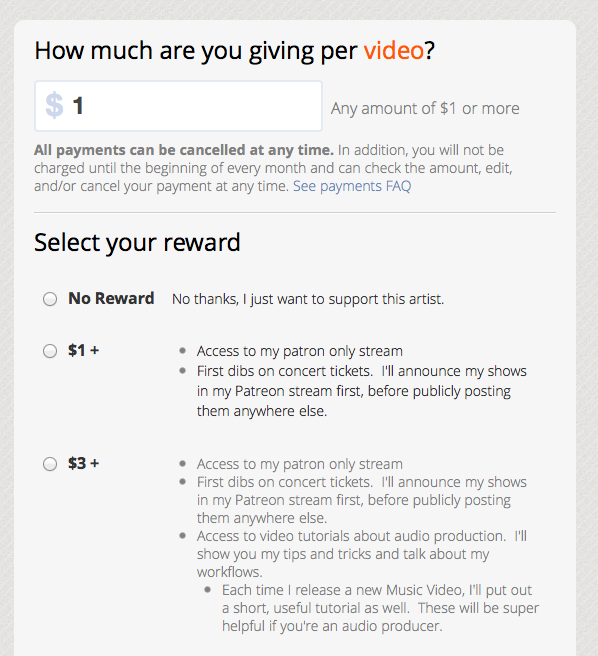
Patreon Subscribe menu imageWhile a Kickstarter or Indie Gogo campaign is all the rage for artists to fund a recording these days,  another twist on an old idea may give traditional crowdfunding a run for its money. A new site called Patreon, labeled as a "fundraising" site, allows fans to subscribe to the artists they follow and receive "patrons-only" streams of their work.

The brainchild of Pomplamoose's Jack Conte and AdWhirl founder Sam Yam, the site allows fans to perform the age-old function of patron. The difference from European royalty is that instead of a large lump sum bestowed upon the artist, each patron can contribute a small amount (think of it as a tip) every time the artist releases a piece of content. The content can be videos, songs, blogs, articles or recipes or anything other "art" that comes on a regular basis.

A patron receives more than the stream though, as they also have the ability to post in the artist's stream and can unlock additional patron packages like private Google+ Hangouts or tutorials with different levels of support.

It's a cool idea and just another way that an artist with a fanbase (that's the key here) can create a new income stream. Check out the video below for a more detailed description of Patreon.


----------------------------------

You should follow me on Twitter for daily news and updates on production and the music business.

Check out my Big Picture blog for discussion on common music, engineering and production tips and tricks.

Wednesday, February 13, 2013

When Kickstarter Doesn't Work

Crowdfunding campaigns are sometimes considered an almost can't-miss way to raise money for a project, but that's often far from the case. Even though slightly over 50% of music projects do get fully funded, there have been some high profile failures (think Public Enemy) recently.

The latest is Bjork's Kickstarter campaign to crowdfund the development of a new version of her Biophilia album app, this time for Android and Windows 8. The campaign was cancelled just 10 days in when it reached just 4% of it's goal of 375,000 pounds (about $580,000US).

The original Biophilia iPad app offered interactive modules for each song on Bjork's Biophilia album, which included games, animation and the ability to remix songs. Porting it to both Windows and Android platforms was a way to get it into more low income households in the interest of music education, according to the site.

When it comes to crowdfunding campaigns, there are 3 main impediments to funding:

1. Is the project sexy? Porting an app from iOS to Windows and Android just doesn't grab the imagination somehow. iOS owns the market (at least for now), and a great number of potential donators are Apple fanboys, so the basic premise was never going to work.

2. The reward tiers. There just wasn't anything sexy with the Biophilia app award tiers either. Art prints of the app graphics from a B list artist won't cut it, no matter how cool they might be (and they are very cool).

3. The monetary goal. Let's face it, the lower the amount of money you're trying to raise, the more likely you'll achieve it. While I don't for a second think that the amount Bjork was trying to raise was out of line with its needs, it was just too big a chunk to bite off. Bjork isn't successful enough as an artist to pull a campaign like this off.

For those of you who intend to create a crowdfunding campaign in the future, use this as a template of what not to do.

Here's the promo video for the project.


----------------------------------

Interested in the Music 3.0 archives? Buy The Music 3.0 Guide To Social Media. The best of over 800 posts.

You should follow me on Twitter for daily news and updates on production and the music business.

Check out my Big Picture blog for discussion on common music, engineering and production tips and tricks.

Sunday, December 9, 2012

Zappa's "Roxy By Proxy" Promotion

Frank Zappa image from Bobby Owsinski's Music 3.0 blog
I love Frank Zappa and spent a fair amount of time with him when he was alive (check out my Black Page and Waldorf Astoria stories if you're interested). Frank's family has been valiantly trying to keep his name alive since his passing, and son Dweezil has done a great job evangelizing his music with his Zappa Plays Zappa tours. Then came the Roxy By Proxy promotion.

The Zappa Project/Object of your Dreams: Roxy By Proxy! is the Zappa Family Trust's effort to raise at least a million dollars to fund the making of a film of Frank's 1973 performance at The Roxy in Hollywood. In order to do that, they're offering 1000 fans the right to become official "CD distributors." That means you pay a license fee of $1,000, receive a duplication master, and then have the right to manufacture and sell as many CDs as you wish, although you still have to pay a royalty of $1.20 on each one that you sell.

I love the idea of thinking outside the box here, and this is almost a clever way to do it, but the whole idea of being a "distributor" just doesn't cut it, in my opinion. First of all, if you "the distributor" expect to make money when you're competing with 999 other distributors, sorry, but it's never going to happen. I'm sure that Zappa fans still purchase CDs, but there's just not enough of them of them out there, especially when your competition is undercutting your price just so they can make their investment back.

What would have been better is if the Trust just came clean and said, "We're trying to raise money to fund a film that we know you want to see. Contribute and we'll send you an exclusive CD, and we'll even give you the right to give to your friends if you want." At least that feels a little more based in reality. After all, we see this same approach hundreds of times a day on Kickstarter and Indiegogo. In fact, if they would've gone more towards the crowdfunding route, they might have added a few more tiers where they could've actually surpassed the amount they're looking for.

I understand that the Trust feels that they don't need to go to a crowdfunding site and pay them their cut since they already have a rabid fan base that they can readily access, but this whole issue of leading a potential donator into thinking that they might be able to duplicate and sell some CDs and make their money back is probably misplaced.

That said, I sincerely hope that they raise the funding to get the movie made. Can't wait to see it myself.

What do you think?

----------------------------------

You should follow me on Twitter for daily news and updates on production and the music business.

Check out my Big Picture blog for discussion on common music, engineering and production tips and tricks.

Wednesday, October 3, 2012

4 Rules For Crowdfunding

Crowdfunding image from Bobby Owsinski's Music 3.0 blog Here's a post from a couple of years ago that I thought I'd repost, given the every increasing interesting in crowdfunding.

Crowdfunding is becoming a popular way to finance a recording project, thanks to sites like KickstarterMyBandStockindiegogo, Rockethub and Sellaband, among others. Regardless of which site you use, the idea is the same - it allows your fans to pool their money in order to fund your project.

If crowdfunding is something that you'd like to pursue, here are 4 rules to help your campaign be successful.

1) Choose an attainable goal amount. Everybody would like a $100,000 budget to work with, but unless you have a large fan base to begin with, you're probably dreaming if you think you can raise that amount. Even a once-huge selling band like Public Enemy had to cut their goal from $250k to $75k, so be realistic in both what you need and what you can raise.

2) Concentrate on low price points. Kickstarter's data indicates that $50 is the optimum investment point, closely followed by $25. While most artists also include amount in the thousands as well, don't count on these being filled.

3) Make sure the investment reward is sufficient. Remember that you're not getting a donation, it's an investment and your investors will expect something in return. Check out this list of incentives from Hind as an example. Of course, one of the most brilliant list of incentives comes from Josh Freese (Perfect Circle,  Nine Inch Nails, Devo, Weezer). A lot of it was meant to be funny for promotion's sake, but people took him up on it anyway.

4) Keep the campaign short. Kickstarter has found that the optimum campaign is 30 days, with longer campaigns performing significantly worse. The biggest periods of investment come right in the beginning and right before it closes, with everything in the middle a somewhat "dead period." If that's the case, you might as well make the campaign short since there's no advantage to dragging it out.

Kickstarter has some great additional info and data on a recent blog post that's also worth checking out.

-----------------------------------
You should follow me on Twitter for daily news and updates on production and the music business.

Check out my Big Picture blog for discussion on common music, engineering and production tips and tricks.

Tuesday, August 28, 2012

Get Kickstarter Analytics Data From Kicktraq

With so much data available on just about anything you can think of when it comes to social media and the web, the one area that's come up short in that regard has been crowdfunding, as up until now there were no serious analytical tools available. Now that looks to be resolved with a sort of Google Analytics tool for Kickstarter called Kicktrag.

Kicktraq allows you to see inside a campaign in more detail than ever before. You can see the Funding Progress over time, the Pledgers and Backers by day, how the campaign is trending, and the final projections for it. Check out one of the data screens below.

Kicktrag data screen image from Bobby Owsinski's Music 3.0 blog

While I'd like to see how much progress each pledge level is getting as well, Kicktraq still gives you a better idea of exactly where you're at during the campaign than what was available before. Remember that as little as a single tweet can make the difference in the outcome of a campaign. Now you can actually see its effect when it happens.

-----------------------------------
You should follow me on Twitter for daily news and updates on production and the music business.

Check out my Big Picture blog for discussion on common music, engineering and production tips and tricks.

Tuesday, July 31, 2012

The Most Common Crowdfunding Mistakes

Reality Check Sign image from Bobby Owsinski's Music 3.0 music industry blog
Crowdfunding campaigns for artistic projects are all the rage these days, but many of them fail when they probably shouldn't. Let's look at some of the most common mistakes you can make in a crowdfunding campaign.
  • The goal is ill defined. If potential investors aren't sure exactly what you're trying to do with the money you raise, they most likely won't invest.  
  • No audience to begin with. Although it's not out of the question that you can raise money for a music venture without an existing fan base, it really takes an outstanding idea, great promotion and an excellent campaign to do so. If you have an existing fan base, the bar is set a little lower in that you're already a known quantity. 
  • The goal amount is unrealistic. If you're trying to raise $200,000 to record an album, you better have a good explanation as to where the money is going. Major label budgets are down to $40k and 50k these days, and everyone knows that most musicians have their own recording gear, so a large amount has to be justified. Remember, if you can't reach your goal, your campaign automatically fails. 
  • The investment rewards are unappealing. If you have an investment tier of $100 and all the investor gets for that is a CD with a "thank you," you're going to fail. You have to make the rewards well worth the risk.  
  • The price points are wrong. If your minimum investment begins at $100, you'll probably fail. Most investment comes from much small $25 and $50 denominations, but don't be afraid to include a $10 tier as well. Every little bit counts, and the more people that are on board, the more moment the project will have.  
  • The campaign is too long. Most successful campaigns last for 30 days. If you think that you'll raise more money with a longer campaign, the facts don't bear that out. The first few days usually shows a big bump, followed by about 25 days of a lull, then there's a big investment push at the end. A longer campaign just stalls your momentum for little gain. 
  • No pitch video. Most successful campaigns include an effective pitch video. It doesn't have to fancy, but it has to be sincere and get the point across of exactly what your idea is, and what the rewards will be for investing. 
  • No call to action. Just like with all selling, ask for the sale in the video and elsewhere in the campaign.
Crowdfunding for music projects has a pretty good rate of success, with well over 50% being funded. Don't take that number for granted though, because a great campaign still needs a great idea, a lot of planning and a little luck to be a success.

-----------------------------------
You should follow me on Twitter for daily news and updates on production and the music business.

Check out my Big Picture blog for discussion on common music, engineering and production tips and tricks.

Monday, June 18, 2012

Kickstarter: Behind The Numbers

Funded With Kickstarter image from Bobby Owsinski's Music 3.0 blog
Kickstarter is one of the better known and more long-lived crowdfunding sites, and if you look inside the numbers that they publicly acknowledge, there's a wealth of information. As with most things in life, information is power. Let's take a look:
  • Kickstarter has ad almost 46,000 projects from its inception, which have raised nearly $215 million thanks to almost 3 million backers.
  • A full 50% of those projects have been successful, raising the amount amount of money established as a goal. 41% of projects have failed, .1% were suspended, and .1% were cancelled. The rest (8.5%) are currently ongoing.
  • It's surprising the types of projects that are most successful:
Dance - 75%,  Theater - 71%,  Music - 68%,  Art - 57%,  Comics - 54%,  Film and Video - 51%,  Food - 51%,  Photography - 47%,  Design - 47%,  Games - 43%,  Publishing - 40%,  Technology - 39%,  Fashion - 33%
  • But the most successful categories don't necessarily raise the most money (in millions):
Film & Video - $55,  Music - $33,  Design - $40,  Games - $23,  Art - $9.4,  Publishing - $9.3,  Technology - $9.0,  Theater - $6.8,  Food - $6.1,  Comics - $4.8,  Photography - $3.2,  Fashion - $2.3,  Dance - $1.8
  • The average duration of a successful campaign is 38 days, but it's 43 days for the average failed project.
  • Lower is better when it comes to monetary goals, as the average successful project raised $5,487 while the average failed project's goal was $16,365.
  • Finally, 8.5% of funded projects received more than double their goal.
As you can see, crowdfunding is competitive, but if you have the right product, the right sales goal, and right sales pitch, the odds are good about even that you'll succeed. That's a lot better than most chances you'll ever take in the music business.

-----------------------------------
You should follow me on Twitter for daily news and updates on production and the music business.

Check out my Big Picture blog for discussion on common music, engineering and production tips and tricks.

Tuesday, May 29, 2012

6 Crowdfunding Mistakes

Crowdfunding image from Bobby Owsinski's Music 3.0 blog
Crowdfunding for music projects is a hot topic these days, especially with Amanda Palmer's ongoing success (a million dollars in 30 days!). Everyone wants to get in on the act, and I've certainly covered many of the strategies on how to do that here already.

But let's look at a different side of crowdfunding. Why do some campaigns fail? There was a recent article in Mashable that specifically looked at this,  and I'll quote their bullet points, but the explanations are mine.

1. Nobody Knows You. If you don't have a fanbase to begin with, you're probably not going to attract one on a crowdfunding site. Why should someone give you money if they don't know you, or even worse, don't trust you? You have to do the hard work first before you can ask anyone for their dough.

2. No One Can Tell What You're Talking About. Unless you can concisely describe who you are, what you want the money for, and what the contributor gets back in return, you're sunk. This is easy to overcome; just test it on some friends, fans or even some strangers. Their feedback will help you hone your pitch.

3. Nothing Sets You Apart From Your Competition. There are a lot of open hands out there, especially now that crowdfunding has become so popular. You have to communicate why your campaign is different and why the rewards are so valuable before they'll pledge some money though.

4. You Fail To Ignite, Engage, Or Connect. If you don't get the word out, or can't close a potential contributor when they get to the campaign site, your campaign will fail. A great video (see Amanda Palmer) can help people to understand what you're trying to do, but engagement through social media, email and your website is just as important.

5. You Don't Maintain Contact With Supporters And Backers. It's important to keep a running dialog with contributors through email and social media. They want to know how well the campaign is doing so they can feel good about their contribution. If they do, they may tell others that might make the difference in being a success or not.

6. You're Greedy Or Clueless About Fundraising Goals. Be conservative about your fundraising goals. If you aim too high, you may scare away potential contributors. If you're unrealistic in how much you need for a project (like $500,00 to just record an album), you can be sure you won't get it. Remember, it's a good thing to blow past your goal; bad if you don't reach it.

Keep these points in mind when planning your crowdfunding campaign. It's not an easy process (nothing good ever is), but you won't help yourself much by ignoring this advice. Read the entire article at Mashable.

-----------------------------------
You should follow me on Twitter for daily news and updates on production and the music business.

Check out my Big Picture blog for discussion on common music, engineering and production tips and tricks.

Tuesday, May 22, 2012

Crowdfunding Tours With Gigfunder

Gigfunder logo image from Bobby Owsinski's Music 3.0 music industry blog
Crowdfunding is quite the buzz word these days and rightfully so. Both new and established artists are using it to gain funding for new recording projects using a variety of sites like Kickstarter, Crowdfunder, Sellaband, Rockethub, and many many more.

But one new crowdfunding site recently launched that's very unique. Gigfunder is like those other sites in that it helps raise money from fans, but it's dedicated strictly to funding tour dates.

Let's face it. Touring is not easy or cheap, especially if you're just starting out. You not only have to pay for gas, but hotel rooms, food, transportation and even festival buy-ons. A new band, no matter how good they might be, are at an immediate disadvantage money-wise. Gigfunder not only mitigates some, but adds a few extra incentives too.

First of all, it's a way to publicize your tour and where you're playing in a targeted way. That's because fans suggest cities and venues for you to play. If you don't reach the funding tier, you don't play there, which is the second great thing about the service. No use playing to an empty club. If a gig is funded by your fans, you can be sure they'll be there.

You can find out more about Gigfunder by checking out this FAQ.

Touring is the key to a band's success. Don't let expenses get in the way.
-----------------------------------
You should follow me on Twitter for daily news and updates on production and the music business.

Check out my Big Picture blog for discussion on common music, engineering and production tips and tricks.

Wednesday, May 9, 2012

Amanda Palmer's Kickstarter Tips

Amanda Palmer image from Bobby Owsinski's Music 3.0 blog
Amanda Palmer's always been used as a the perfect example of how social media promotion is done in our Music 3.0 age. As I posted last week, she's now a beaming example of how to mount a Kickstarter campaign as well.

As of this writing, she's had over $600 in pledges just 8 days into her month-long campaign, which is pretty amazing. So just how did she do it? She gave away her secrets on crowdfunding to the O Music Awards Blog. They are (with my comments afterward):

1) You have to have fans before you can ask them to help you. [This one seems pretty obvious, but is mysteriously overlooked by many artists.]

2) Show, don't tell: HAVE A GOOD VIDEO. [This is a lot harder than it seems. You have to sell your fans on your idea/music and not be obnoxious about it. People get paid a lot of money to do this every day, which suggests its difficulty, so make sure you put a lot of thought into it.]

3) Don't just reward the rich: keep every level rewarding. [If you look at some Kickstarter campaigns, it seems hardly worthwhile to even consider some of the lower pledge levels since you don't get all that much in return. As you get to the higher money pledges, the rewards always become a lot more interesting, but you want to reward those that can only afford the lower levels as well.]

4) Be honest: You'll be amazed at how helpful people really are when you talk straight with them. [Fans naturally want to help. The more honest and open you are, the more help they'll give you. If something feels funny or below board, they'll start to pull back.]

5) No tool is deus ex machina: ANY platform can work. [Don't get stuck on one platform since the name of the game is delivering your music to people, and giving them the chance to help you out by buying something occasionally. Without those last two things, the platform doesn't matter.]

Last but important, Palmer gives the best tip: Your music must be good, you must respect your fans, and pretty much without exception; YOU HAVE TO TOUR.

Another great tip from Amanda comes from a conversation she had with Techdirt in which she states just how she developed that fanbase in the first place:

"I've been tending this bamboo forest of fans for years and years, ever since leaving roadrunner records in 2009. Every person I talk to at a signing, every exchange I have online (sometimes dozens a day), every random music video or art gallery link sent to me by a fan that i curiously follow, every strange bed I've crashed on...all of that real human connecting has led to this moment, where I came back around, asking for direct help with a record. Asking EVERYBODY...And they help because...they KNOW me."

Every time I post something about Amanda Palmer I get a lot of negative comments and emails as she can be a polarizing figure if you're not a fan. The thing is, she's out there doing well in what a lot of people can't. Whether you like her or her music or not, at least take heed of her techniques. She's giving them away for free.

Check out her Kickstarter campaign, and read both the O Music Awards blog and Techdirt posts for more info.

-----------------------------------
You should follow me on Twitter for daily news and updates on production and the music business.

Check out my Big Picture blog for discussion on common music, engineering and production tips and tricks.

Thursday, May 3, 2012

$100k On Kickstarter In 6 Hours

In an excellent case study in the art of social media and crowdfunding, Amanda Palmer has turned a Kickstarter campaign on its head, raising $100,000 in a mere six hours, then oversubscribing to the tune of $443,000 with 27 days left. Considering that she was expecting to raise the $100k in 32 days, I'd say the result is nothing short of amazing and shows the power of having an open communication with your fans.

Amanda was trying to raise the funds for the mixing, manufacturing, promotion and distribution of her album as well as an book of art. Actually, the original budget is not all that large by major label standards, but it's way beyond what an indie artist would normally spend.

She's offering not only the CD, but lots of vinyl options as well as the book to her backers of $100 or more, including free shipping. Since most people don't have a turntable, she's also decided to include one in some of the packages as well.


Here's the simple yet effective video she created for the campaign.


Check out Amanda's campaign. It's a great example of just how to do it.

-----------------------------------
You should follow me on Twitter for daily news and updates on production and the music business.

Check out my Big Picture blog for discussion on common music, engineering and production tips and tricks.

Thursday, November 4, 2010

4 Tier Rewards Of A Crowdfunding Campaign

The great Hypebot blog recently posted a nice interview with Yancey Strickler, the co-founder of Kickstarter, which is one of the leading crowdfunding platforms used by artists and bands today. While Yancey described many of the elements that work for a crowdfunding campaign, one of the best pieces of the article was about funding tier rewards. A funding tier is a level of investment, like $25, $50, $100 and $500 dollars.

One of the most important elements of a crowdfunding campaign has to do with the rewards that an investor receives for putting money into the project. Just getting credit and money back usually isn't enough, and Yancey had these suggestions (I've messaged the text a little for clarity) to make the campaign a bit more enticing.

1) The Basic Reward - If nothing else, the investor should receive a copy of the CD or a free download.

2) Limited Editions - For either the first 100 investors or the next higher tier, the investor receives a deluxe edition that's individually numbered and personally signed.

3) Share The Story - The next tier investor would receive something even more exclusive, like Polaroids (these certainly are a limited and rare item) from the studio, used guitar strings or drum heads, the coffee cup used by the artist, or some other personal item.

4) The Creative Experience - Bring the investor into the process itself by asking for his or her opinion on which version of a song or photo to release, bring them into the studio for background vocals or handclaps, or just invite them to sit in on a recording, photo session or video. The idea is to give an investor at the highest level a once-in-a-lifetime thrill.

None of these cost very much, yet they could mean the difference between someone investing or not, or investing in a more costly tier.

-----------------------------------
Follow me on Twitter for daily news and updates on production and the music business.

Check out my Big Picture blog for discussion on common music, engineering and production tips and tricks.

Sunday, October 3, 2010

4 Rules For Crowdfunding

Crowdfunding is becoming a popular way to finance a recording project, thanks to sites like Kickstarter, MyBandStock, indiegogo, Rockethub and Sellaband, among others. Regardless of which site you use, the idea is the same - it allows your fans to pool their money in order to fund your project.

If crowdfunding is something that you'd like to pursue, here are 4 rules to help your campaign be successful.

1) Choose an attainable goal amount. Everybody would like a $100,000 budget to work with, but unless you have a large fan base to begin with, you're probably dreaming if you think you can raise that amount. Even a once-huge selling band like Public Enemy had to cut their goal from $250k to $75k, so be realistic in both what you need and what you can raise.

2) Concentrate on low price points. Kickstarter's data indicates that $50 is the optimum investment point, closely followed by $25. While most artists also include amount in the thousands as well, don't count on these being filled.

3) Make sure the investment reward is sufficient. Remember that you're not getting a donation, it's an investment and your investors will expect something in return. Check out this list of incentives from Hind as an example. Of course, one of the most brilliant list of incentives comes from Josh Freese (Perfect Circle,  Nine Inch Nails, Devo, Weezer). A lot of it was meant to be funny for promotion's sake, but people took him up on it anyway.

4) Keep the campaign short. Kickstarter has found that the optimum campaign is 30 days, with longer campaigns performing significantly worse. The biggest periods of investment come right in the beginning and right before it closes, with everything in the middle a somewhat "dead period." If that's the case, you might as well make the campaign short since there's no advantage to dragging it out.

Kickstarter has some great additional info and data on a recent blog post that's also worth checking out.

-----------------------------------
Follow me on Twitter for daily news and updates on production and the music business.

Check out my Big Picture blog for discussion on common music, engineering and production tips and tricks.

LinkWithin

Related Posts Plugin for WordPress, Blogger...