Monday, November 7, 2011

The 3 Secrets To Online Video Contests

Contest Clapper image from Bobby Owsinski's Music 3.0 blog
Here's an excerpt from a great post over at ReelSeo.com about how to run a successful online video contest. It's actually based on a white paper from Launchpad6, a site that specializes in conducting this kinds of contests. Whether you use them or not, the following 3 tips are worth considering.
------------
"The team over at Launchpad6 has created a 3-step success formula that should help you come up with a great contest idea, offer the right prizes and choose the right promotional mix to help ensure your contest is a success.

1. The Premise

Premise refers to the contest idea and is the most important part of a successful video contest. By asking yourself the following questions, you should be able to determine if your contest idea will be successful:
  • Is content readily available or easily created?
  • Is the content itself interesting?
  • Is the content shareable?
  • Is there enough passion for the idea?
  • Is there an element of voyeurism involved?
  • Are you harnessing group mentalities?

2. The Prize

While big cash prizes can bring your contest a lot of attention and help you gain reach, it is often more niche prizes that get better results as they appeal to your target market and drive sales. Here are some thoughts to ponder:
  • Does the prize appeal to my target market?
  • Is it unique and attractive?
  • Is the prize valuable to my target market?
  • How can I offer supplementary or bonus prizes?

3. The Promotion

Video Contests have a natural self-promotion mechanism as uploaders tell their friends vote on their video. However, it is essential to promote your contest and get as many initial entrants as possible. Consider these promotional ideas:
  • Create a contest video and seed around the web
  • List your contest in directory sites
  • Utilize product packaging
  • Harness your social channels
  • Consider partnering with an industry publication
As the weeks go by and the series progresses, we will elaborate on these points and give you more ideas and information to help make your video contest a success. Either stay tuned for the next post, or download the whitepaper from Launchpad6."
-----------------------------------
You should follow me on Twitter for daily news and updates on production and the music business.

Check out my Big Picture blog for discussion on common music, engineering and production tips and tricks.

Sunday, November 6, 2011

5 Analytic Metrics To Watch

Metrics To Watch image from Bobby Owsinski's Music 3.0 blogWhether you're using StatCounter or Google Analytics or some other measurement tool, the different metrics that are measured can be daunting. If you want to know how your website or blog is doing at a glance, here are some measurements to zero in on.

Unique Visitors: This is the number of unique visitors to your site. It doesn't include people who have reloaded your page multiple times. I like to check this number for daily visitors, monthly visitors and against the previous month.

Visits or Pageloads: Don't be fooled, this is different from unique visitors. Some visitors will come back multiple times, while others will load different pages on your site, so this number will always be higher than Unique Visitors. Still, this does give an indication as to how useful your site is to your visitors in that a lot of page loads means your site is fairly sticky.

Source or Came From: This tells you how your visitors got to your site. It may have been through a link or through a search engine, but it's good to know, especially if one link is generating a lot of traffic.

Time On Site or Visit Length: This one is sort of a moving target because I'm not sure how accurate it is. Usually there will be a big number with a visit length of 5 seconds or less, and these can be attributed to people who found you from a search engine but determined that your page wasn't what they were looking for when they reached your site. The other numbers are much more telling though. If you have visitors that are staying on your site for 5 minutes or more that's a good thing, and if they're staying more than an hour, it tells you that you're offering a lot of great content.

Popular Pages: This is another metric that I like, especially if your site is fairly large with a lot of content, because it tells you exactly how many visits each page receives. This gives you an indication of how popular each piece of content is.

Once again, to really get a feel for how your blog or site is doing, compare it daily and monthly. This will tell you whether you're gaining more visitors or losing them. For more on this subject that's aimed more at Google Analytics, take a look at this article from searchengineland.com.
-----------------------------------
You should follow me on Twitter for daily news and updates on production and the music business.

Check out my Big Picture blog for discussion on common music, engineering and production tips and tricks.

Thursday, November 3, 2011

Chuck D Wants His Royalties

Chuck D image from Bobby Owsinski's Music 3.0 blog
We all knew that this was going to happen, that sooner or later the floodgates would open. Now Public Enemy frontman Chuck D has filed a class-action lawsuit against Universal Music Group in U.S. District Court in Northern California on Tuesday, alleging that the music giant has short-changed its artists and producers in licensing deals for digital downloads and ringtones. The suit alleges that Universal owes its artists "hundreds of millions of dollars in royalties" because of the discrepancies.

This was all thanks to the fact that Eminem's production company, FBT, won a decision against UMG over what amounts to the definition of ownership of a digital file. FBT claimed that UMG owed them a lot more money for each download sold because a digital file sold by iTunes or Amazon MP3 is actually a license. UMG insisted that regardless of whether it's a CD, vinyl record, or digital file, Eminem's music is part of their distribution deal. Eventually UMG lost the decision, and now we're going to see more and more artists suing to take advantage of decision.

The difference between a license and royalty is pretty great. An artist can expect only between 10 and 20% (if they're lucky) of the revenue from a digital sale under a normal royalty agreement, but 50% under a license agreement.

According to Chuck D's claim, UMG's current method of accounting pay artists and producers $80.33 for every 1,000 downloads, when the correct amount should be $315.85 per 1,000. For ringtones it's even more drastic. UMG's current accounting method yields $49.89 per thousand downloads, as opposed to the $660 per 1,000 that the suit claims is actually owed.

You can expect that UMG is going to go down fighting, but this might be already lost. I bet that their strategy is to try to outlast them in court, but if Chuck D wins, UMG might be in big trouble. It could be the beginning of the end for the biggest record label still left standing.
-----------------------------------
You should follow me on Twitter for daily news and updates on production and the music business.

Check out my Big Picture blog for discussion on common music, engineering and production tips and tricks.

Wednesday, November 2, 2011

Increase Your Social Media Efficiency

Center of Your Online Universe image from Bobby Owsinski's Music 3.0 blog
If one really delves into social media marketing, it becomes readily apparent that there's probably not enough time in the day to do it well and still maintain an active music life. It can get overwhelming as to just how much time online promotion takes if you do it well, but that's also a common complaint that I receive - "I can do social media or I can do music, but I can't do both."

Luckily there are solutions. Here's one from the 2nd edition from my Music 3.0 Internet Music Guidebook.

"A common mistake that artists who manage their own social-media assets make is to have too many focal points (like YouTube, their Website, their blog, Twitter, and Reverb Nation, for example) all residing in different places and requiring separate updates. You can imagine how tough it is to keep every one of those sites updated regularly! Worse is the fact that it’s confusing for the fan, who just wants a single place to visit. Yet another problem is that you may be collecting email addresses from each site and they may all be going on different mailing lists.

The solution is to use one site (usually your Website) as a your main focal site and use that to feed daily updates and info to all the others via RSS or social-media broadcast tools like Dijit (dijit.com) or Ping (ping.fm). This means that you only need to do the work of updating a single site, with all the others getting updated at the same time.

The second component of this management strategy would be to have all of your satellite sites (blog, Facebook, and so on) designed in such a way to feed your social media viewers into your website (see Figure 8.1). At a bare minimum, the email registration of each satellite site should feed into the same list as your main site."

Yet another way is to use a helper program like Tweetdeck or Hootsuite and schedule all of your posts so you only have to do it once a day. I do this first thing in the morning and schedule both tweets and Facebook posts for various time during the day and evening. 10 minutes in the morning takes care of it. The only problem is that they don't service Google+ yet, which means that posts to that network must still be done manually, which is still a pain.

Remember that efficiency is the key to making social media work for you and still be a musician. Use your tools wisely and you'll be back to making music before you know it.
-----------------------------------

You should follow me on Twitter for daily news and updates on production and the music business.

Check out my Big Picture blog for discussion on common music, engineering and production tips and tricks.

Tuesday, November 1, 2011

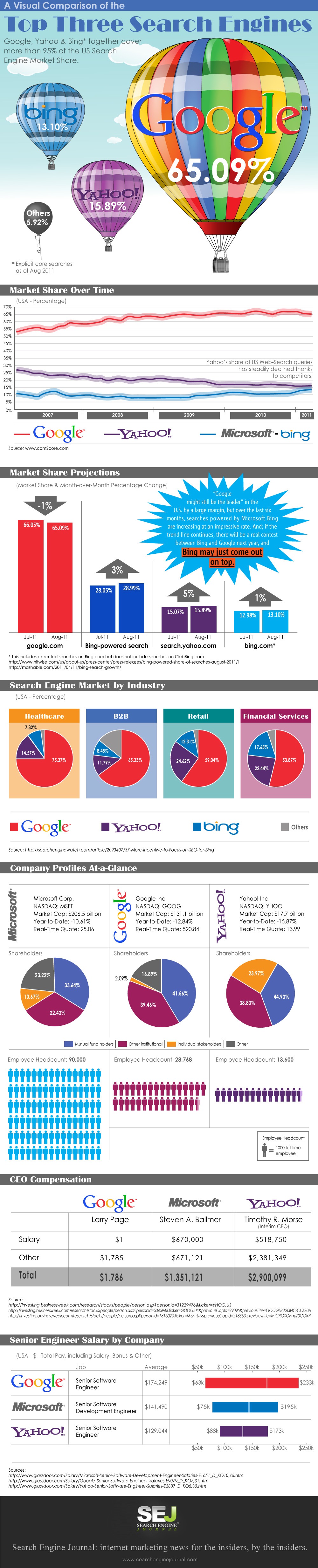
A Visual Search Engine Comparison

As you probably know, Google dominates the search engine market but there are may users that also use Bing and Yahoo as well. Here's a great infographic that compares the big 3, but beware of a few of its conclusions. One of the predictions is that Bing may overtake Google in time, but I don't think there's much evidence of that happening myself.

I should say that I mainly use Google, but also others like Quora, Wolfram Alpha and Dogpile when I'm doing research. It's surprising how different the results can be, so don't be stuck using just one.

Tope 3 Search Engines image from Bobby Owsinski's Music 3.0 blog
Source: Comparison of the Top Three Search Engines: Bing+Yahoo > Google? [INFOGRAPHIC]

-----------------------------------

You should follow me on Twitter for daily news and updates on production and the music business.

Check out my Big Picture blog for discussion on common music, engineering and production tips and tricks.

Monday, October 31, 2011

8 Rules For Facebook Engagement

facebook image from Bobby Owsinski's Music 3.0 blog
Here's an excerpt from the upcoming 2nd edition of Music 3.0: A Survival Guide For Making Music In The Internet Age, which will be available on November 15th. This is a list of 8 rules for Facebook engagement. I've posted this before with only 5 rules, but rethought it for the book and expanded the list to 8.
----------------------------

"A white paper about Facebook engagement from the research site Buddy Media Platform provided a number of interesting points gathered in a report is called Strategies For Effective Facebook Wallposts: A Statistical Review.

In the study they determined the 5 Rules for Facebook engagement, which are:

  1. Keep your posts short and sweet.
Posts of 80 characters or less have 27% higher engagement rates.

  2. Think twice before using URL shorteners. Engagement rates are 3 times higher using full-length URLs.

  3. Post when people are listening. Posts outside of business hours (10AM to 4PM EST) have a 20% higher engagement rate.

  4. Some days are better than others. Engagement rates are 18% higher on Thursday and Friday than the other days of the week, but Saturday and especially Sunday are good too. This can vary by industry though.

  5. Avoid the noise of Monday. There's too much going on after the weekend.

You can add a few more to this list that exactly parallel the email and Twitter advice.

6. Keep your posts relevant.
You’re trying to promote your brand so stay on topic.

7. Don’t post unnecessarily. Too many posts can cause your fans to tune you out.

8. Keep the interaction high. Ask your fans for their opinion and advice. It will not only keep them involved, but you’ll immediately feel the pulse of the tribe.

If you're posting to keep in touch with your friends or to let them know what you're doing, then this data is of no consequence to you. But if you're posting strategically to promote your brand, then follow the above for better fan engagement."

You can read additional excerpts on this and all my books on the excerpts page at bobbyowsinski.com 
-----------------------------------

You should follow me on Twitter for daily news and updates on production and the music business.

Check out my Big Picture blog for discussion on common music, engineering and production tips and tricks.

Sunday, October 30, 2011

Social Media Marketing Works!

Here's another great infographic from Mashable, this time on some social media marketing numbers. This time it looks at numbers from YouTube, Facebook, Twitter and location based services like Foursquare.

It also compares 6 social media campaigns and shows the results. No doubt about it, social media marketing works!

Social Media Marketing Numbers image from Bobby Owsinski's Music 3.0 blog
-----------------------------------

You should follow me on Twitter for daily news and updates on production and the music business.

Check out my Big Picture blog for discussion on common music, engineering and production tips and tricks.

Thursday, October 27, 2011

Coldplay, Adele Refuse To Stream

mylo xyloto Coldplay album cover image from Bobby Owsinski's Music 3.0 blogThere seems to be a sudden backlash from established artists like Coldplay, Adele and Tom Waits against the whole idea of streaming their music. In fact, these artists and others have decided not to stream their latest albums on Spotify or any other streaming music subscription service.

Can you blame them? With the revenue anywhere from as little as a tenth to three tenths of a cent per stream, why bother? It's almost like legal pirating with an income that small. The irony is that these artists now want you to buy their downloads (where they make anywhere from 12 to 20 cents), where not that long ago that revenue stream was considered just as tiny when compared to good old fashioned CDs. Boy, times have changed.

While this might be a worthwhile strategy for Adele (who's sold more that 10 million copies of her album 21) and Coldplay (with their latest album, Mylo Xyloto, already at #1), who already have established fan bases, a new or up-and-coming artist still has to bite the bullet and make sure that every streaming service has their product.

Remember that in Music 3.0, your music is your marketing and the only way to develop your audience is to make sure that it's everywhere. Any time you hold back product from a potential distribution channel only makes it that much harder for people to find you.

Still, it will be interesting to see if the trend of established artists holding back songs from digital streaming continues.
-----------------------------------

You should follow me on Twitter for daily news and updates on production and the music business.

Check out my Big Picture blog for discussion on common music, engineering and production tips and tricks.


Wednesday, October 26, 2011

The Best Record Label You've Never Heard Of

Greatest Video Game Music image from Bobby Owsinski's Music 3.0 blog
If you think pop music is difficult to make money with online, image what it's like with classical music, which has always had sales that were far smaller.

It turns out that a tiny music group from the great Scandinavian North called X5 has not only made money by selling digital music, it’s beat out music giants like Sony and Warner Music on the Billboard charts.

The way the company has done it is with compilation albums of licensed material with titles like “The 99 Darkest Pieces of Classical Music” or “The 50 Most Essential Pieces of Classical Music,” which has made more than $2 million worldwide since being released in 2008. X5 has released more than 8,000 of these thematic albums (wow!) and has packaged them by composer, mood, holiday, and anything else they can think of that might be attractive to their customer. The thing is, most of their releases fall under the “classical” genre, a type of music that's notoriously difficult to sell, especially in the digital space.

But believe it or not X5 was the number two classical label in the U.S. in 2010 with a 20% market share, and had 13 #1 Billboard Classical albums, which was more than any other label except for Universal.

How did they do this? By using some simple tricks that you can use as well:
1) Their albums are inexpensive and they do everything to keep the costs down, including labor.
2) The artwork is simple but striking. Even in the digital world, graphics sell, just like with physical product (see the example to the left).
3) They distribute through every major music site and distributor, no matter how small they might be. 
4) They design albums with a “music SEO” in mind. They know who their audience is and they design everything about the album around reaching him.
5) They optimize for social search (the act of finding music and albums via social networks or app search bars) since it's become the main way that a lot of people find their music. 
If X5 can do that with classical music, couldn't you do the same with your music?

You can read more about X5 in this article.
-----------------------------------

You should follow me on Twitter for daily news and updates on production and the music business.

Check out my Big Picture blog for discussion on common music, engineering and production tips and tricks.

Tuesday, October 25, 2011

How The World Uses Social Networks

Here's another great infographic from Mashable, this time showing how a few parts of the world compare in social media use.

There are a few things interesting about this graphic:

1) Except for Japan, Asian countries aren't indicated. I'd be especially interested in the numbers for China and Korea.

2) As you would think, Facebook is the most widely used social network in the world and comes in at #1 for all countries except for Brazil and Japan (where it doesn't even register).

3) But Blogger scores very high in most countries, which is a surprise. That shows that blogs are still a huge communication tool, even if you personally don't blog.

4) Where Twitter has caught on, it's widely used. It seems that either a country gets or it they don't.

How The World Uses Social Networks image from Bobby Owsinski's Music 3.0 blog
-----------------------------------

You should follow me on Twitter for daily news and updates on production and the music business.

Check out my Big Picture blog for discussion on common music, engineering and production tips and tricks.

Monday, October 24, 2011

7 Keyword Selection Tips

Keyword Selection image from Bobby Owsinski's Music 3.0 blog
The other day I posted "7 Keyword Research Tips" and I want to continue on that theme with today's topic - 7 Keyword Selection Tips. Once again this came from an article on Searchengineland.com that I've excerpted, numbered, and added a bit of my own here and there.

By the way, on the left is a graphic illustrating the steps for researching keywords, if you need a review.
------------------------
"Once you have a list of keyword candidates, you must cull through it to find your keywords. This is where a lot of people throw up their hands and give up or try to over-simplify the process. Going back and forth between dozens of export files from different keyword tools is not practical, so it's best to use a spreadsheet to compile a master table.
1. Compile your research into a master table so you can sort it and filter it.
2. I sort my keyword candidate by the number of words in each keyword or phrase first, then by the number of searches. 
3. Set aside or check off relevant one-, two- and three-word phrases.
4. Set aside or check off embedded keywords. Before Chris Anderson coined The Long Tail, I used embedded keywords to describe longer key phrases that contained shorter keywords. Search for each relevant one-, two- and three-word keyword, then mark the longer keywords that contain the shorter keywords.
At this point, what is left will be like looking for diamonds in a trash heap. There will be lots on non-relevant words and words with too little traffic. Comprehensive research is important, but now it is time to get practical.
5. Set some limits. Depending on how much traffic the website I am optimizing receives already, I will set a lower traffic limit between 100 and 1,000. The more traffic my website is getting, the higher the limit I set. Anything below the limit gets culled.
6. Review each keyword candidate you have left. If it is relevant, mark it or set it aside.
7. At the end, copy all the keywords you marked or set aside into one table. These are your keyword candidates."
This takes a good amount of work, but it's worth it since the right keywords can get you found while the wrongs ones will bring you nothing. You can read the entire article here.
-----------------------------------

You should follow me on Twitter for daily news and updates on production and the music business.

Check out my Big Picture blog for discussion on common music, engineering and production tips and tricks.

Sunday, October 23, 2011

Surprise! Kids Still Buy CDs

Research image from Bobby Owsinski's Music 3.0 blog
Here's one that will make you scratch your head. According to a recent study by the NPD Group, kids between the ages of 2 and 14 in the US still overwhelmingly purchase physical goods. In fact, 79 cents of every entertainment dollar goes towards physical product, and only 21 cents goes to digital.

NPD also found that most of these purchases come from music, as it accounts for 72 percent of all media, followed by movies, games, TV shows, books, and apps.

It's difficult to explain these figures, but there are four possibilites here:

1. Kids are collectors and they like physical objects to show their friends.

2. Kids buy on impulse and many times parents can't get out of a store without buying kids something - like a CD.

3. Most kids from 2 to 14 don't have credit cards (does a 2 year old even buy anything?), so that means their parents are buying for them, and they may be still steeped in the idea of a CD as entertainment.

4. Someone is very wrong here. Either NPD is way off the mark, or the conventional wisdom about kids being so digitally astute is wrong.

Frankly, I think it has more to do with the conventional wisdom more than anything. I know from the talks I give on social media (Social Media For Musicians And Engineers - or publishers, artists, or fill in the blank creative type), I'm always amazed at how little my audience knows about social media in particular and the digital world in general. Since most of these talks are in colleges, supposedly the sweet spot of the digital revolution, it makes me think that the Silicon Valley Illuminati thinks the world revolved around them, of which it has convinced the news media.That might not be the case at all, as the rest of the world (at least in the US) becomes increasingly hip to technology, but not at the same speed as we're led to believe.

Now obviously my experiences aren't with 2 to 14 year olds, but I just don't think the digital and social penetration is quite what the so called "common wisdom" would have us believe. Sure, I've seen the kids at the Apple store just as happy and engaged as can be, but is that really the case outside of the major media centers?

All I know is that studies like this make you re-evaluate just what we think we know about the digital world we live in. Some of us may be living in the future, while most are based squarely in slightly different reality.
-----------------------------------

You should follow me on Twitter for daily news and updates on production and the music business.

Check out my Big Picture blog for discussion on common music, engineering and production tips and tricks.

LinkWithin

Related Posts Plugin for WordPress, Blogger...