Sunday, November 21, 2010

Geolocation And Weezer

Everyone seems to agree that geolocation apps like Foursquare, Gowalla and Facebook Places are the coming thing, but until now only brick and mortar retail stores and restaurants have taken advantage of the promotional opportunities. How? Stores and restaurants often provide an extra discount or special when a person has checked into their place a minimum number of times, then increase the incentive the more they visit.

Now the band Weezer and Gowalla are rewarding fans who attend shows in much the same way. After a fan stamps his "virtual passport" by attending a show (the first one is November 26 at the Gibson Amphitheater in LA), he can download a track from the band's latest album Hurley for free, eventually earning a full discount on the the full album download by attending more shows. Additional prizes include an all-expenses trip to a Weezer tour date to meeting the band backstage.

Expect this to be only the first of many musical reward experiences based around geolocation, as artists begin get hip to the concept.
-----------------------------------
Follow me on Twitter for daily news and updates on production and the music business.

Check out my Big Picture blog for discussion on common music, engineering and production tips and tricks.

Friday, November 19, 2010

10 Cities With The Best Music Crowds

Songkick, the site that tracks live music, just released the ten best cities to listen to music, and perform it as well. This was based on the number of gigs available, audience sizes, and ticket prices. Based on these criteria, the cities were given a "Rock" score (the survey was more about rock music), with 100 being the best. There are a couple of surprises here.


1. Austin (Rock Score: 100; average ticket price $23.30)
2. Madison (78; $13.05)
3. New Orleans ( 57; $16.89)
4. Las Vegas (51; $62.76)
5. Denver (44; $33.24)
6. Milwaukee (38; $17.66)
7. Twin Cities (36; $11.36)
8. Seattle (35; $11.75)
9. Portland (OR) (35; $10.33)
10. Nashville (34; $20.13)

Although great music towns, I never would've expected Madison, Milwaukee, Portland or the Twin Cities to appear this high.

If you're an unknown band, that doesn't mean people will come to hear you play in these cities. You still have to do all the grunt work to build your visibility and audience. But if you're getting some traction already, these are definitely places to visit on your next tour.

-----------------------------------
Follow me on Twitter for daily news and updates on production and the music business.

Check out my Big Picture blog for discussion on common music, engineering and production tips and tricks.

Thursday, November 18, 2010

How A Good Drummer Video Could Be Improved

Here's another topic that I feel is important enough to deserve cross-posting with my Big Picture production blog. Below you'll see a video called "Dublin Grooves - Ricky O'Neill" from drummer Ricky O'Neill, who's playing in front of the landmarks of Dublin.

Ricky plays great and the video is very well made, so what's missing? Let's look at some basic search engine optimization that could've happened very easily which might've made a big difference in the number of views the video eventually gets.

1) There's no contact info anywhere on the video. At the very least, I would've put a screen at the end with a website, email address, Facebook and Twitter info, and another screen for the film maker. Both Ricky and the film maker potentially missed calls for gigs at most, and followers and friends at the least. This was the perfect marketing tool that never really became one and therefore missed a golden opportunity.

2) I never would've known Ricky was playing in front of Dublin landmarks had Ricky not told me via email. This video could've been a lot more interesting with a lower third or info key screen identifying each place, plus that info could've been used in both the description and keywords (see #4 and #5 below).

3) I would've titled this "Ricky O'Neill Dublin Drum Grooves" for the keyword phrase value. "Drum Grooves" has a stronger keyword value than simply "grooves" since it's more focused and precise. "Dublin Drum Grooves" even more so.

4) Take a look at the YouTube page for the video. The description of the video gives you some basic information, but reads more like the back of a DVD rather than a description of what the video is about. A 200 word description (at least) with the phrases "Ricky O'Neill" and "drum grooves" sprinkled in 4 or 5 times (about 2 percent) would've been more search engine friendly.

5) Take a look at the tags. There are too many to begin with, and they're not focused enough. The ones that could've been used are "Ricky O'Niell," "Dublin Drum Grooves" (if the titled were changed), "Curtis Morris" (the film maker), "street drums" (after a quick search with the Google Keyword Tool), and maybe "Irish drummer." Having tags like "jojo" and "excellent" and "drum kit" are a waste of time since they're not descriptive or granular enough to make a difference in search ranking.

Don't get me wrong, I really like this video. It's really well made and Ricky's playing is solid enough that I'm sure he'd get calls for gigs - if someone knew how to find him. Like I said before - opportunity lost.


----------------------------------
Follow me on Twitter for daily news and updates on production and the music business.

Don't forget to check out my Music 3.0 blog for tips and tricks on navigating the music business.

Wednesday, November 17, 2010

Warner's Earnings An Industry Warning?

Warner Music Group's quarterly SEC filing today is symptomatic of a number of trends in the music business, and not surprisingly, most of them aren't good. Here are a few lowlights.

  • Revenues declined 13 percent from the previous quarter and 7 percent for the year. While you can blame this on many things, I believe it's an indictment of the quality of music. Lots of good music = lots of sales = lots of revenue. If you give us music that goes in one ear and out the other, it will never have any catalog value, which directly translates into long term revenue.
  • Digital revenue grew 7 percent for the quarter and is now 30.9 percent of WMG's total revenue. Great, but that's not enough to offset the decrease in CD sales. Generally speaking, digital revenue industry-wide is flat to slightly declining, yet I see no company adjusting for a world with less revenue unless it's by the weight of a balance sheet.
  • CD sales have been hurt by a drop in retail floor space. You can't buy a CD even if you want to these days. Try to find a music retailer in a mall; it's hard. There are some large cities that don't even have a single record store, and the ones that are left have such a limited selection that it's only a matter of time until they die as well.
  • CEO Edgar Bronfman Jr. stated on a conference call with analysts that music in the cloud presents a "significant opportunity" to increase sales next year. This was a pep talk for the financial analysts. The fact of the matter is that no one knows how music in the cloud will be accepted. In my view, it's going to be a tough sell unless the industry finds a way to easily convince the public that it's a lot more convenient than storing music on your hard drive as you do now. No one except the music industry is waiting for this to happen, and they only want it because it will move everyone into a subscription model, which is the "Holy Grail" business model that the major labels crave. Make no mistake, music in the cloud is in our future, but it will take someone like Apple to lead the way, not a record label like WMG.
  • Music publishing revenue fell 12.9 percent, mostly due to the drop in mechanical royalties. This one is bad. Music publishing has always been the steady, if under the radar, performer in the business. Until recently, that is. There are a lot of industry execs quivering in the their Gucci's over the fact that publishing revenue is declining too.
  • The company has $430 million of cash on hand. This is code for, "We collect cash so we can make a run at buying EMI." WMG has kicked EMI's tires before. Now it gets serious.
Can't wait for the next quarter. Some big things are going to happen in the business, if this earnings report is any indication.
-----------------------------------
Follow me on Twitter for daily news and updates on production and the music business.

Check out my Big Picture blog for discussion on common music, engineering and production tips and tricks.

Tuesday, November 16, 2010

What The Beatles On iTunes Means For EMI

I received a couple of emails today regarding how The Beatles music finally being offered for sale on iTunes will affect the future of EMI, the major record label currently under siege, so I thought I'd expand on my response that I personally made to them.

First of all, despite what everyone may think, EMI did not go bankrupt. The company was purchased by the private equity firm Terra Firma with money borrowed from CitiBank, which Terra Firma could not pay back. Instead of trying to renegotiate the deal, Terra Firma sued Citi, claiming that the bank tricked them into paying too much for the label (what a wacky premise), but lost the case last week. Now Citi wants to liquidate EMI to get its money back, which may begin to happen soon.

A popular misconception is that EMI kept The Beatles off of iTunes, but that wasn't the case at all. In fact, it was the remaining Beatles and their company Apple Corps (not to be confused with Apple, the computer and iTunes company) that said no for so long. Even though EMI owns the master recordings, the band has veto power over new uses of the masters. Although it's been thought that the band and Apple Corps were too old-school anti-technology in their thinking, the real reason has been speculated that the band was unhappy with the terms demanded by Terra Firma, which if true confirms that this was a company that had no reason being in the music business in the first place. Of course, another reason to hold out this long is that all parties make more money on CDs, but that market's been saturated for some time now.

So what does the new deal with iTunes mean for the future of EMI? In the short term, this will help EMI greatly thanks to a quick infusion of cash, but will probably not change the ultimate future of the company too much. In fact, it might even hurt it a bit, since a prospective buyer no longer has the upside of the initial iTunes offering to look forward to (although they can look forward to the possible release of Bob Seger, who is still holding out on digital downloads).

Regardless, soon enough EMI will be purchased for pennies on the dollar and most likely disappear into history. The next legal battle will be over what happens to the master recordings of The Beatles, Pink Floyd, Bob Seger, Queen and other major artists if the label is sold, since it's thought that many of those masters will revert back to the artists if that should happen, thereby bringing the price down even further.

-----------------------------------
Follow me on Twitter for daily news and updates on production and the music business.

Check out my Big Picture blog for discussion on common music, engineering and production tips and tricks.

Monday, November 15, 2010

The End Of The CD?

PhotoNo matter where you look you see the same dismal numbers - sales of CDs are down 50% since 2000, and down 15% just this year alone. "The CD is over." "The CD is dead." "Nobody buys CDs anymore." The writing is on the wall; at some point in time, the sales of CDs will be right down there in the depths of inconsequential sales with cassette tapes.

But not quite yet. There will still 350 million CDs sold this year. Let me say that again. "There will be 350 MILLION CDs sold this year." Someone's still buying those suckers.

And one of the reasons why they're still selling is that some sanity has finally come into the market. With the price now between $6 to slightly less than $10, people don't feel ripped off if they buy something with only a few good songs anymore.

Yes, album sales are declining, but that goes for digital downloads as well. If people aren't buying an album, it's more a factor of the music than the price these days.

So don't fear the CD. Make it a part of your sales arsenal, but don't buy a couple of thousand and have to worry about the up-front costs and inventory. Use a service like Kunaki and buy just what you need.

Don't forget, it's still easier to get a magazine or blog review with a CD than a digital download.

-----------------------------------
Follow me on Twitter for daily news and updates on production and the music business.

Check out my Big Picture blog for discussion on common music, engineering and production tips and tricks.

Sunday, November 14, 2010

Blekko - The "Slashtag" Search Engine

A new search engine called "Blekko" has arrived and it has a chance to be something that not even Google can be. What makes Blekko different is it's use of a "slash" to create a specialty search for a topic. In other words, if I want to find out about Snew the band, I can zero in on just that by typing "snew/band" instead of "snew band."

Basically what the "slashtag" does is focus the search. In the case of "Snew band," a lot of irrelevant results pop up from "what's new" to results about bands that have nothing to do with Snew. If I plug in "snew/band," a whole new set of results pops up that are specifically related to Snew the band.

There are other ways to use the slashtag as well.

You can use "xx/people" to limit the search to pages associated with a person.
You can use "xx/blogs" to limit the search to pages associated with only a blog.
You can use "xx/date" to limit the search to pages associated with only a certain date.

Of course, you can do all of this with Google as well, but it's a lot more difficult.

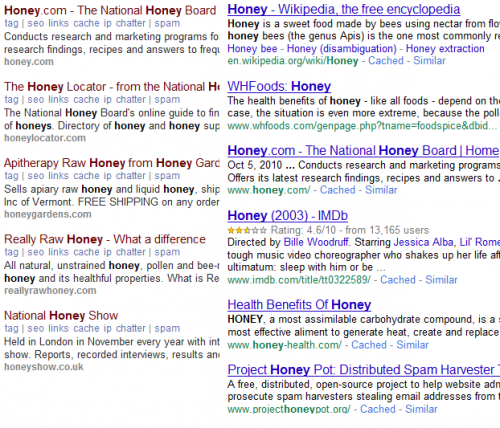
Below is a screen shot of a search for "honey/bees" with Blekko on the left and the results from Google on the right. You can see how much more specific the Blekko search is.


Here's a great article that describes Blekko and it's other operations in detail. Give it a try. I think you'll like it. In a future post, we'll talk about music implications.

-----------------------------------
Follow me on Twitter for daily news and updates on production and the music business.

Check out my Big Picture blog for discussion on common music, engineering and production tips and tricks.

Thursday, November 11, 2010

The Full "20/20" Show From 1980

A few weeks back I posted an article entitled "The Music Industry Crisis 30 Years Ago" that showed a clip from a 20/20 television news show back in 1980 about the music business. Only the first half of it was available as the second half was reportedly taken down by Universal Music.

Reader Brad Wilson took the initiative to reach out to the person that originally posted the piece (thanks, Brad!), who then posted the entire 20/20 show clip one more time.

Here it is in it's entirety. It's a hoot to look at the fashion, editing, production and opinions from that period, but it's also a little bone-chilling how close some things are to our current slice of the music industry as well.


----------------------------------
Follow me on Twitter for daily news and updates on production and the music business.

Don't forget to check out my Music 3.0 blog for tips and tricks on navigating the music business.

Wednesday, November 10, 2010

Turning Passive Fans Into Committed Fans

There are basically two kinds of fans - those that are "committed" in that they have a high level of interest in you, and those that are "passive." These are fans that kind of like you, but don't feel a need to stay connected, since they don't "love" you yet. The easiest way to grow your audience is to convert those passive fans to ones that are committed.

How do you do that? Passive fans already like what you're doing, so a great new song can easily push them over the edge, providing that they hear it. When a band who's been around for a while finally breaks out big, this is usually what happens.

Sometimes they just need a gentle push over the edge though, and a way to turn them around is by simple communication. CD Baby's DIY Musician blog had a pretty good piece about that recently that recommends that you directly ask the fans what they want from you. There may be something simple that you can do that you never thought of that will help you connect. Ask them.

Here are some questions (from the article) you should be asking, as the feedback can most directly correlate to stronger fans, stronger sales and less wasted efforts.

- Where do you live?
- What do you enjoy more: studio recordings or live performances?
- How important is it that you obtain copies of live performances?
- If we offered high-quality recordings of our shows, would you purchase them?
- Are you willing to purchase an album from us?
- Have you joined our mailing list?
- Would you prefer personal updates or free music from our bi-weekly newsletter?
- If we offered t-shirts, hoodies, hats and posters, which would you purchase?
- Would you be interested in seeing behind the scenes footage of our tour or recording sessions? If so, which would be more interest you?

Interaction alone may not convert some fans (it's still that one song that will knock their socks off), but it's a start. Read the entire article here.

-----------------------------------
Follow me on Twitter for daily news and updates on production and the music business.

Check out my Big Picture blog for discussion on common music, engineering and production tips and tricks.

Tuesday, November 9, 2010

iTunes 90 Second Preview Troubles

Even for the 800 pound music distribution gorilla in the room that is iTunes, sorting out agreements with record labels is not easy. It seems that Apple's recent October 20th press event was really to announce that Apple had negotiated 90 second previews for all the songs in the iTunes library. The only trouble was, they only did half the negotiating.


While Apple successfully negotiated with the major labels for 90 second preview clips, they forgot that publishers actually have a say in things as well, which meant that the announcement had to dropped at the last minute until that could be sorted out. Since Apple always has multiple products per press event, they were able to change the focus of the event at the last minute so that no one was the wiser.

But the music world is more than the major labels, and Apple didn't do any negotiating with the various indie labels either, instead preferring to simply "inform" them of the change. Unfortunately, the world of digital music isn't that easy, and the indies now have to go back to their artists and third-party publishers to amend their agreements from 30 to 90 second previews, a process that could take a lot longer than anyone would have initially thought.

I think that 90 second previews are great, since the best part of a song is sometimes not contained within the 30 seconds available previously. That being said, this seemingly simple change is a great example of the complexity of the modern music business. Nothing is ever as simple as it seems.

-----------------------------------
Follow me on Twitter for daily news and updates on production and the music business.

Check out my Big Picture blog for discussion on common music, engineering and production tips and tricks.

Monday, November 8, 2010

Best Time Of Day For Facebook Posts

If you just attended my AES session on Social Media For Musicians And Engineers or read my Music 3.0 Internet Music Guidebook, you know that I'm big on social marketing via Facebook and Twitter. While you might be writing the best, engaging posts, they do you no good if there's no one reading, so the question then becomes, "When is the best time of day to post to Facebook?"

Now comes a study from the social media company Vitrue that looked closely at the viewing habits of Facebook channels of selected companies and brands. The study was conducted over a period of 3 months and looked at more than 1500 brand streams, 1.64 million posts, and 7.56 million comments. Shares and "likes" were not included in the study. Here's some of what they found.

  • Usage is highest at 11AM, 3PM, and 8PM ET.
  • The biggest spike occurs at 3PM ET on weekdays.
  • Wednesday at 3PM is the busiest period of the week.
  • Fans are less active on Sunday.
  • Post that occur in the morning tend to perform almost 40% better in terms of user engagement than those in the afternoon.
  • The top of the hour (:00 to :15 minutes) sees more interaction than other parts of the hour.
  • In what seems to be a contradiction, 65% of users only access Facebook when they're not at home or at school, which means in the evening.
Remember that these are the findings of a three month period and by no means definitive, but it's a good place to start when setting up your Facebook posts.

-----------------------------------
Follow me on Twitter for daily news and updates on production and the music business.

Check out my Big Picture blog for discussion on common music, engineering and production tips and tricks.

Sunday, November 7, 2010

Soon EMI Will Be No More

We're seeing the last days of the venerable record label giant EMI pass right before our very eyes. Very soon, the music industry will be left with 3 major record labels (Sony, Universal and Warners) as EMI winds down in a slow, painful death by sell-off.

A short recap on how EMI got to this point. The label was purchased by the hedge fund Terra Firma a few years ago thanks to a big loan from CitiBank. The problem was that Terra Firma bought them at the very worst time, just at the time when the price was highest before the recession hit, and paid way perhaps twice as much as the company was worth.

Before you know it, Terra Firma couldn't make the payments, so they resorted to good old fashioned lawyering to try to get them off the hook. They sued Citi for supposedly "tricking them into borrowing more than they needed" to pay for the company. This is like asking to borrow a $1000 to buy a guitar but the bank telling you "I think it's worth more than that, so here's $4000 instead." The banks have been loose with their money in the past, but in a huge deal like Terra Firma/EMI, they do a thing called "due diligence," which means that they check things out in detail before they lend the dough.

Last week, Terra Firma lost their lawsuit, which means that EMI and all their assets will soon become the property of CitiBank. Citi doesn't want to own a record label and publishing company (thankfully) and wants the dough instead, so that means that it will probably soon break up EMI and sell the parts.

EMI owns some of the worlds most valuable copyrights (The Beatles, Pink Floyd, and Bob Seger to name a few) and it will be interesting to see if those rights will revert back to the artists or be available to be sold, so expect some additional court battles. In the meantime, look for the assets like the historical Abbey Road and the Capitol Tower to be sold as well (who knows what will happen to them), as a great piece of history dies with EMI.

Of all the labels to go, I think that EMI is the one that hurts the most. It's legacy as one of the industry giants and a home of music legends stands tall, but like Columbia Records before it, will soon be forgotten.

Thanks to everyone who made my two sessions (Social Media For Musicians And Engineers) and book signings at AES in San Francisco over the weekend a success!
-----------------------------------
Follow me on Twitter for daily news and updates on production and the music business.

Check out my Big Picture blog for discussion on common music, engineering and production tips and tricks.

LinkWithin

Related Posts Plugin for WordPress, Blogger...